
You have likely seen it in your chair: a patient who needs OSA therapy but grinds laterally so aggressively that standard connectors simply cannot keep up. It is a common frustration for many practitioners when the desire for patient comfort clashes with the mechanical demands of bruxism. Understanding the specific indications for dorsal appliance therapy allows you to provide a solution that balances midline stability with lateral freedom. Choosing the right device should not feel like a guessing game that leads to costly remakes or chairside adjustments that eat away at your clinical schedule.
This guide provides the clear clinical criteria you need to identify the ideal candidates for this interlocking design, especially following the 2025 AADSM clinical standards. You will master the anatomical factors and contraindications that ensure your clinical outcomes match your professional standards. We will explore the precise scenarios where the Dorsal outperforms other options, helping you improve both patient compliance and OSA outcomes. By the end of this article, you will have a methodical approach to prescribing these custom-fabricated devices with total precision. We are here to support your practice as a reliable ally, ensuring every appliance you seat is the perfect fit for your patient's unique needs.
Key Takeaways
- Understand how the interlocking fin design provides the necessary lateral freedom for patients who struggle with rigid monoblock appliances.
- Master the primary clinical indications for dorsal appliance therapy to help you select the most effective treatment for patients with lateral sleep bruxism.
- Learn to screen for contraindications such as severe periodontal disease or active TMJ disorders to prevent appliance failure and patient discomfort.
- Follow a precise clinical protocol for impressions and bite registration to reduce chairside adjustment time and improve device accuracy.
- Discover how meticulous hand-finishing and modern 3D printing workflows ensure your patients receive a precise, high-quality sleep solution.
Clinical Mechanism of the Dorsal Fin Sleep Appliance
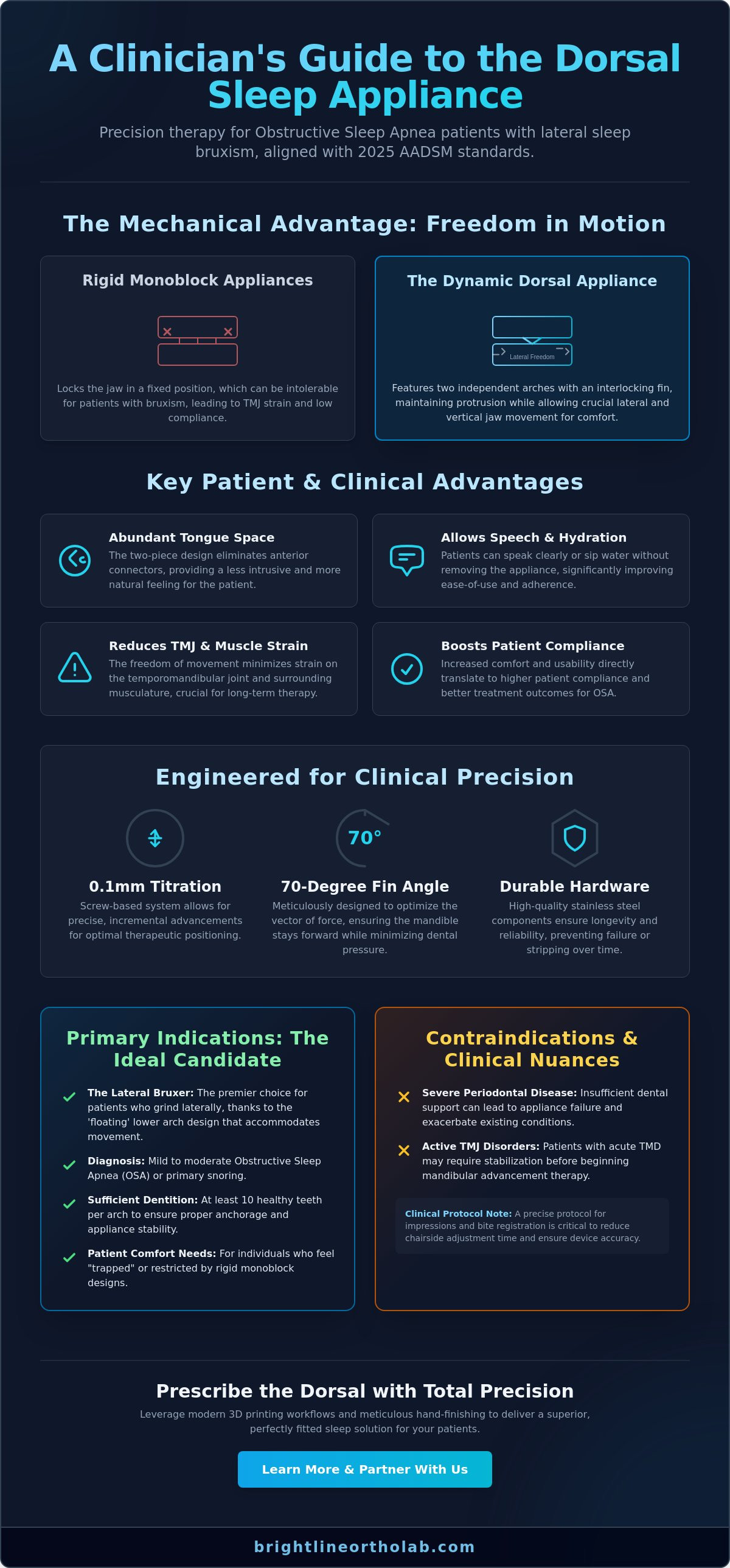
Understanding the indications for dorsal appliance therapy begins with its mechanical design. The Dorsal appliance is a sophisticated mandibular advancement splint that prioritizes patient comfort without sacrificing clinical efficacy. It consists of two independent arches that work in tandem through an interlocking "fin" system. This unique design is specifically engineered to maintain the mandible in a protrusive position throughout the night. Unlike traditional monoblock devices that lock the jaws into a fixed relationship, the Dorsal allows for a dynamic range of motion. This flexibility is a key factor for clinicians who need a reliable solution for patients who find rigid devices intolerable.
The mechanism relies on the relationship between the upper and lower components. The upper arch features adjustable fins that engage with the lower arch as the jaw closes. This engagement prevents the mandible from dropping back posteriorly, which keeps the airway open and reduces obstructive events. These mechanical features often define the primary indications for dorsal appliance selection in complex OSA cases. Because the pieces aren't physically joined, the patient can move their jaw laterally and vertically. This freedom reduces the strain on the temporomandibular joint and the surrounding musculature, making it a reliable choice for long-term therapy.
Anatomical Advantages of the Two-Piece Design
One of the most significant benefits of this design is the abundance of tongue space. By eliminating anterior connectors, elastics, or bulky hinges, we've created a device that feels less intrusive. Many patients report a "claustrophobic" feeling with one-piece appliances; the Dorsal effectively solves this problem. It also accommodates basic needs during the night. If a patient needs to speak or take a sip of water, they can do so easily without removing the device. This accessibility directly improves patient compliance and long-term success rates.
Titration and Incremental Advancement
Precision is at the heart of this appliance's success. It utilizes a screw-based titration system located in the upper component. This allows you to make incremental 0.1mm advancements at the chairside or instruct the patient on how to make adjustments at home. The 70-degree fin angle is meticulously designed to optimize the vector of force. This specific angle ensures that the mandible stays forward while minimizing the pressure on the dentition. We use high-quality stainless steel hardware for these components to ensure longevity. In high-use clinical settings, you need hardware that won't fail or strip over time. This reliability allows you to focus on the patient's progress rather than equipment maintenance.
Primary Indications for Dorsal Appliance Therapy
Selecting the right device for your patient requires a precise understanding of their clinical presentation. While many patients qualify for oral appliance therapy, the specific indications for dorsal appliance use focus on those who need mechanical durability and lateral freedom. Ideally, you should prescribe this device for patients diagnosed with mild to moderate Obstructive Sleep Apnea (OSA) or primary snoring who possess at least 10 healthy teeth per arch. This sufficient dentition ensures the tooth-borne appliance has the necessary anchorage to maintain advancement without causing localized stress on individual teeth. Given that OSA affects approximately 34% of adult men and 17% of adult women, having a reliable tool for these specific profiles is essential for any growing sleep practice.
The decision to move forward with this style often hinges on the patient's unique jaw mechanics. You'll find that the Dorsal is particularly effective for patients who require a high degree of mandibular lateral excursion for comfort. If a patient feels trapped or restricted by their appliance, they're far more likely to abandon therapy. By providing a design that accommodates movement, you're directly supporting their long-term health and adherence to the treatment plan.
The Lateral Bruxer Profile
Managing a patient who grinds their teeth during sleep presents a unique challenge in dental sleep medicine. The Dorsal appliance is often the premier choice for these individuals because of its "floating" lower arch design. Unlike the Herbst mechanism, which uses fixed metal rods that can be restricted or prone to breakage under heavy lateral forces, the Dorsal's interlocking fins allow for natural side-to-side movement. This freedom prevents damage to the appliance hardware and significantly reduces TMJ strain. If your patient has a significant history of lateral sleep bruxism, this design accommodates their grinding patterns while keeping the airway secure. It's a supportive solution that protects the patient's dentition while treating their underlying respiratory issues.
Anatomical Considerations: Tongue Space and Arch Width
Anatomical constraints like macroglossia or narrow dental arches often lead to failure with other devices. Some patients struggle with the EMA appliance because the lateral elastics can interfere with tongue space or irritate the buccal mucosa. In contrast, the Dorsal's two-piece construction maximizes the internal volume of the oral cavity. This is particularly beneficial for patients with restricted oropharyngeal dimensions who need every millimeter of room for the tongue to rest comfortably. By providing a stable midline and avoiding anterior obstructions, the device supports long-term occlusal health and improves overall compliance. If you are dealing with a complex anatomical case, our team at Brightline can help you evaluate the best path forward for your patient's specific arch dimensions. We prioritize meticulousness in every build to ensure the fins engage smoothly, even in the narrowest of arches.
Contraindications and Selection Nuances
While identifying the right indications for dorsal appliance therapy is vital for success, recognizing when to avoid this design is equally critical for patient safety. Every clinical consultation should begin with a thorough screening against established clinical guidelines for oral appliance therapy. Some patients present with anatomical or physiological conditions that make a rigid interlocking system like the Dorsal a secondary or even contraindicated choice. We want to help you avoid the frustration of a failed fit or, worse, a patient who experiences increased pain because the device wasn't the right match for their physiology.
In extreme cases of micrognathia, the required advancement may exceed the physical height of the appliance fins. If the fins cannot maintain engagement during mouth opening, the device loses its efficacy. Similarly, patients with chronic nasal obstruction might struggle with this design. If a patient must breathe primarily through their mouth, they may require a device with larger oral breathing ports to prevent feelings of suffocation during the night. Precision in your initial assessment ensures that the treatment plan you develop is both safe and effective.
Evaluating Periodontal and Dental Support
A Dorsal appliance exerts significant force on the dentition to maintain mandibular advancement. Because of this, severe periodontal disease or insufficient tooth anchorage are strict contraindications. You must evaluate crown height and the availability of undercuts to ensure proper retention. Check the stability of existing dental restorations before taking impressions. If a patient has mobile teeth, the high-force advancement can exacerbate periodontal issues or lead to tooth movement. We recommend a minimum of 10 stable teeth per arch to provide a reliable foundation for the appliance fins.
TMJ Health and Mandibular Range of Motion
Screening for "clicking," "popping," or "locking" in the joint is a mandatory step before prescribing any interlocking device. Active Temporomandibular Joint (TMJ) disorders or acute jaw pain often require a more flexible approach. Use a George Gauge to determine if the patient has the required 5mm or more of protrusive range. If the patient has a limited range of motion or a highly sensitive joint, a rigid Dorsal might cause unnecessary discomfort. In these specific scenarios, you might consider pivoting to a more forgiving EMA Sleep Appliance. This allows for a softer, more flexible advancement that accommodates sensitive joints while still addressing the patient's OSA needs. Our goal is to be your reliable ally in these selection nuances, ensuring every patient receives a device that supports their health without compromising their comfort.
Clinical Protocol: Impressions and Bite Registration
Success in dental sleep medicine depends entirely on the quality of your clinical records. Even when you have clearly identified the indications for dorsal appliance therapy for your patient, the final outcome relies on a meticulous impression and bite registration. We recommend using high-quality PVS materials or digital STL scans that capture every tooth surface along with 3 to 5mm of the surrounding gingival tissue. This extra detail is necessary for the proper retention of the appliance and the long-term stability of the interlocking fins. Without this level of precision, the device may lack the "snap-fit" required for patient confidence and comfort.
You must also ensure a minimum of 4mm vertical clearance in the molar region during the registration process. This space is required to house the expansion screws and the acrylic base without creating a bulky, uncomfortable experience for the patient. Verifying the midline position during the bite registration is another critical step you cannot skip. If you overlook a lateral shift at this stage, the final appliance will force the jaw into an unnatural position, potentially causing the very TMJ strain we aim to avoid. A stable midline ensures the vector of force remains centered, supporting better airway patency and occlusal health.
Digital Workflow for Dorsal Fabrication
Capturing the distal surface of the terminal molars is essential for maximum retention, as these teeth provide the primary anchorage for the device. Transitioning to STL files can significantly reduce lab turnaround time and improve the precision of fin alignment across both arches. To ensure adequate clearance for the fin hardware, you must scan the buccal vestibule to a depth that captures the full contour of the alveolar process. This digital approach allows us to visualize the final fit before fabrication even begins, ensuring a smoother delivery appointment for you and your patient.
Bite Registration Best Practices
Using a George Gauge or a Protrusion Gauge provides the consistent, repeatable results you need for a predictable fit. We suggest recording the protrusive bite at 60 to 70% of the patient's maximum advancement to strike a balance between airway patency and muscle comfort. Avoid the temptation to "over-advance" in the initial bite; doing so often leads to lower patient compliance and significant muscle fatigue. Remember the "Vertical Rule": you must maintain enough inter-occlusal space for both the structural acrylic and the metal screw housing. If you are ready to start your next case with a lab that values precision as much as you do, send your digital scans to Brightline today for a seamless and supportive fabrication experience.
Precision Engineering: The Brightline Dorsal Advantage
Choosing a lab shouldn't be a source of stress for your practice. When you've identified the specific indications for dorsal appliance therapy in a patient, you need a partner who understands the technical nuances of the design. At Brightline, we view ourselves as a direct extension of your team. We utilize meticulous hand-finishing on every case to ensure those interlocking fins engage smoothly without snagging or catching. This attention to detail reduces the need for frustrating chairside adjustments and ensures your patient leaves with a device they'll actually wear. Our goal is to provide a supportive experience that alleviates the logistical pressure of sleep apnea therapy.
We offer both custom-milled and 3D-printed versions to accommodate your preferred digital or traditional workflows. Whether you're sending PVS impressions or digital STL files, we verify every case against your specific titration requirements. This rigorous check ensures an out-of-the-box fit that respects the vertical and lateral parameters you've established during the bite registration. We also support advanced materials, including clear acrylics for a discreet look and thermoplastic linings for patients with sensitive teeth or extensive restorations. We require a scan depth that captures the full depth of the buccal vestibule to ensure the fin hardware has sufficient clearance from the soft tissue.
Our Meticulous Fabrication Process
Reliability starts with the right hardware and a master's touch. We calibrate the 70-degree fin angle with absolute precision to provide optimal mandibular stability throughout the night. This specific angle is crucial for maintaining the airway without placing excessive strain on the patient's dentition. We use only high-grade stainless steel components to prevent corrosion and hardware failure over the life of the appliance. If you're facing a particularly complex case, you have direct access to our senior technicians for consultations. We've seen nearly every anatomical challenge and are here to help you troubleshoot before the fabrication begins.
Partnering for Patient Success
Our goal is to simplify your sleep medicine workflow and support your long-term clinical goals. We perform a comprehensive digital case review for every order to identify potential issues before they reach your chair. This proactive approach significantly reduces lab remakes and helps you maintain a profitable, efficient practice. You can rely on our fast national shipping and predictable lead times for all your sleep medicine cases. We're proud to be the partner who never misses a detail and always follows through on our promises. Submit your Dorsal appliance case to Brightline Orthodontic Lab today and let us help you deliver the high-quality outcomes your patients deserve.
Elevate Your Practice Outcomes with Precision Therapy
Mastering the specific indications for dorsal appliance therapy allows you to treat lateral bruxers and patients with limited tongue space with much higher confidence. You now have the clinical framework to identify ideal candidates and navigate the nuances of patient anatomy. By following a meticulous protocol for impressions and bite registration, you significantly reduce the risk of remakes and chairside adjustments. This methodical approach leads to improved patient compliance and more predictable OSA outcomes for your practice. It's about providing a solution that balances mechanical durability with the lateral freedom your patients need for a restful night.
We invite you to partner with a laboratory that acts as a true extension of your clinical team. With over 18 years of industry expertise, we ensure every device is precision-engineered in the USA to meet your exact titration requirements. Our modern digital workflow is fully compatible with STL files, which simplifies the fabrication process and improves the accuracy of the final fit. We are ready to support your next case with the meticulousness and dependability you expect from a seasoned expert. Download our Sleep Appliance Rx and start your Dorsal case today. Let's work together to provide your patients with the reliable, high-quality sleep therapy they deserve.
Frequently Asked Questions
What are the primary indications for a Dorsal sleep appliance?
The primary indications for dorsal appliance therapy include mild to moderate OSA or primary snoring in patients who benefit from lateral jaw movement. It is especially useful for patients who experience claustrophobia with one-piece designs or those with a documented history of lateral bruxism. You should ensure the patient has at least 10 stable teeth per arch to provide the necessary anchorage for the interlocking fins. This foundation ensures the device remains stable throughout the night.
Can a Dorsal appliance be used for patients with heavy bruxism?
Yes, the Dorsal appliance is specifically engineered to accommodate patients with heavy lateral bruxism. The interlocking fin design allows the lower arch to move side-to-side without putting excessive stress on the appliance hardware. This prevents the breakage often seen in rigid or rod-based systems. It protects the patient's dentition while maintaining the necessary mandibular advancement for airway patency. It's a durable choice for patients who grind aggressively during sleep.
How much vertical clearance is needed for a Dorsal appliance?
You need a minimum of 4mm of vertical clearance in the molar region to accommodate the appliance hardware. This space is required to house the expansion screws and the acrylic base securely. If the vertical dimension is too shallow, the appliance may become thin and prone to fracture. Ensuring this clearance during the bite registration phase is vital for a durable and comfortable final fit. We recommend verifying this measurement before sending your records to the lab.
Is the Dorsal appliance more effective than the EMA for OSA?
Neither appliance is universally more effective, as the choice depends on the specific patient profile. The EMA is often preferred for patients with sensitive joints due to its flexible elastics, while the Dorsal is superior for heavy bruxers who need more mechanical stability. We recommend evaluating the patient's lateral movement needs and joint health to determine which device will provide the best long-term compliance. Both are excellent tools when matched to the right clinical scenario.
What is the typical titration range for a Dorsal appliance?
The typical titration range for a Dorsal appliance allows for approximately 5mm to 7mm of total advancement. Most systems utilize an expansion screw that provides 0.1mm increments per turn, allowing for very precise adjustments. This level of granularity helps you find the ideal position where airway patency is maximized without causing muscle fatigue. Understanding these indications for dorsal appliance titration is essential for achieving the best clinical results and patient comfort during therapy.
Can I use digital scans for Dorsal appliance fabrication?
Yes, digital STL scans are highly recommended for the fabrication of Dorsal appliances. Using digital workflows improves the precision of the fin alignment and reduces the total lab turnaround time. When scanning, ensure you capture at least 3-5mm of gingival tissue and the distal surfaces of the terminal molars. This high-quality data allows our technicians to create a device with a superior snap-fit out of the box. It's an efficient way to streamline your workflow.
How do I adjust the advancement on a Dorsal appliance?
You adjust the advancement by turning the expansion screws located in the upper component of the appliance. Each turn typically advances the mandible by 0.1mm, though you should verify the specific hardware manufacturer's instructions. We provide a titration key with every case to make these adjustments simple for you at the chairside. You can also instruct your patients on how to perform these incremental steps at home to achieve optimal results over time.
Is the Dorsal appliance suitable for patients with a limited range of motion?
The Dorsal appliance may not be the ideal choice for patients with a significantly limited range of motion, specifically those with less than 5mm of protrusive capability. Because the mechanism relies on interlocking fins, the patient must be able to move into the protrusive position comfortably to engage the device. In these scenarios, you might consider a more flexible option like the EMA. You can always consult with our technicians to evaluate your patient's specific jaw mechanics before starting the case.