
Achieving a perfect mid-palatal suture separation requires more than just a few turns of a screw; it demands a meticulous understanding of how orthopedic forces translate into skeletal change. You've likely seen cases where inconsistent expansion results or patient discomfort during activation turned a routine procedure into a clinical challenge. Understanding how RPE appliances work on a physiological level is the key to moving beyond simple tooth movement and achieving true maxillary widening. It's about balancing the heavy forces needed to overcome sutural resistance with the precision of a custom-engineered fit.
In this guide, we'll dive into the clinical biomechanics and design variations that define modern palatal expansion. You'll discover how to optimize patient outcomes by selecting the right banded or bonded configurations for specific skeletal needs. We also explore how partnering with Brightline Orthodontic Lab for digital 3D scans and custom fabrication can streamline your workflow and improve appliance accuracy. By the end, you'll have the insights needed to refine your lab communication and ensure every expansion case is as predictable as it is effective.
Key Takeaways
- Understand the physiological mechanisms of the Hyrax screw and learn exactly how RPE appliances work to separate the mid-palatal suture.
- Compare banded and bonded designs to select the most effective appliance for correcting posterior crossbites and alleviating dental crowding.
- Establish reliable activation schedules and identify clinical markers, such as the midline diastema, to confirm successful orthopedic expansion.
- Discover how meticulous lab fabrication and digital 3D scans minimize chairside troubleshooting while optimizing the precision of your results.
Understanding the Role of Rapid Palatal Expanders (RPE) in Orthodontics
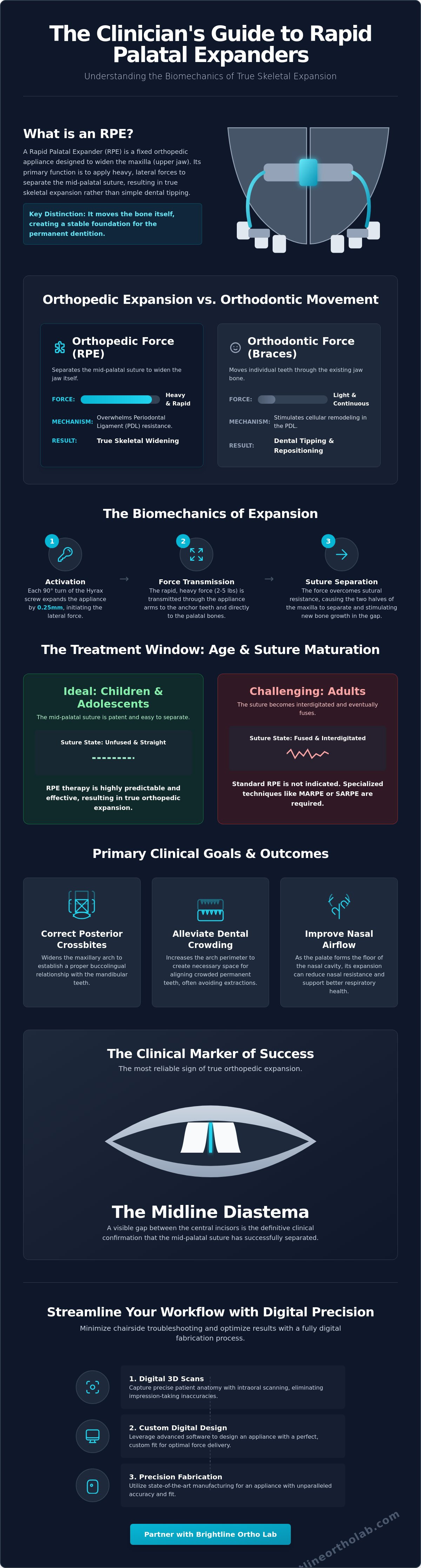
The Rapid Palatal Expander (RPE) is a fixed orthopedic appliance engineered to widen the upper jaw by targeting the midpalatal suture. Unlike traditional braces that focus on tooth movement, the RPE applies heavy, rapid pressure to achieve true skeletal expansion. This distinction is critical. While simple dental tipping can temporarily mask a narrow arch, skeletal expansion provides a stable, foundational change that accommodates the permanent dentition and balances the facial profile. Clinicians must understand how RPE appliances work to distinguish between orthopedic force and orthodontic tipping, ensuring the maxilla itself is widened rather than just the teeth being pushed outward.
Through the process of Palatal expansion, clinicians can correct transverse discrepancies that might otherwise require complex surgical intervention in adulthood. The RPE remains the gold standard for treating these deficiencies because it provides a predictable, controlled method for increasing arch perimeter. It's a reliable tool that supports your goal of creating a functional, healthy occlusion for growing patients.
Clinical Indications for Maxillary Expansion
Posterior crossbites, whether unilateral or bilateral, are the primary indicators for RPE therapy. If left untreated, these crossbites can lead to asymmetrical jaw growth or functional shifts that complicate future orthodontic phases. Beyond correcting the bite, RPEs are invaluable for managing severe dental crowding. By widening the arch, you create the necessary perimeter space to align permanent teeth without resorting to extractions. Many clinicians also utilize RPEs to improve nasal airflow. Because the floor of the nasal cavity is formed by the palate, widening the maxilla can reduce nasal resistance and support better respiratory health.
The Anatomy of the Maxillary Arch
The midpalatal suture is the focal point of treatment. In younger patients, this suture is relatively straight and easy to separate. As patients age, the suture becomes increasingly interdigitated and eventually fuses. This biological timeline dictates your treatment window. It's vital to remember that the maxilla is also connected to the rest of the craniofacial complex via the circummaxillary sutures. How RPE appliances work depends on overcoming the resistance of these secondary sutures as well. While RPEs are highly effective in children and adolescents, the FDA has noted that safety and effectiveness for fixed expanders in adults haven't been established due to suture fusion. For adult patients, skeletal changes typically require specialized techniques like MARPE or SARPE to avoid potential injury.
The Biomechanics of Expansion: How RPE Appliances Work
The mechanical foundation of how RPE appliances work centers on the central Hyrax screw. This component acts as the engine of the device. Each 90 degree activation typically expands the appliance by 0.25mm, creating a direct lateral force against the maxillary halves. Because these activations occur daily, the force builds up quickly. This rapid application is intentional. It's designed to overwhelm the resistance of the periodontal ligament (PDL) and the midpalatal suture before the teeth have a chance to move within their sockets. If the pressure was applied at a slower rate, the teeth would respond through orthodontic tipping, moving through the alveolar bone rather than moving the bone itself.
The distribution of stress is equally critical. When the screw is turned, the force is transmitted through the appliance arms to the anchor teeth. This creates a high-pressure zone along the PDL. In a rapid expansion protocol, this pressure exceeds the threshold for capillary blood flow, temporarily halting the cellular remodeling required for tooth movement. Instead, the force is shunted directly to the midpalatal suture. Understanding how RPE appliances work on this cellular level helps you troubleshoot cases where expansion seems stalled. You can find helpful ways to communicate this process to your clients by referencing a patient's guide to palatal expanders, which helps manage expectations regarding the sensation of pressure.
Orthopedic vs. Orthodontic Movement
Orthopedic expansion is the separation of the midpalatal suture. To achieve this, the appliance must generate heavy forces, often ranging from 2 to 5 lbs. This level of force is significantly higher than the light, continuous forces used in traditional braces. The goal is to prioritize skeletal widening while minimizing dental tipping. A well-constructed appliance acts as a rigid framework, ensuring that the force is directed laterally against the palatal shelves. If the appliance lacks rigidity, the force will dissipate into the teeth, causing them to flare outward without achieving the desired skeletal change. To ensure your designs provide the necessary structural integrity, you can rely on custom lab-engineered RPEs that are built to handle these specific orthopedic loads without flexing.
The Osteogenesis Process in the Suture
Once the suture separates, the body initiates a complex biological sequence to fill the void. The initial activation stretches the sutural connective tissue, which triggers an immediate inflammatory response. This response recruits osteoblasts to the site. In the widened gap, a temporary fibrovascular bridge, or callus, begins to form. This is the first step in creating a stable, wider maxilla. Over the following months, this callus undergoes mineralization, gradually turning into mature bone. This is why the retention phase is so critical; it takes approximately three to six months for the new bone to achieve sufficient density. Removing the appliance too early, before this mineralization is complete, almost guarantees a relapse as the soft tissues and circummaxillary sutures push the maxilla back toward its original position.
Banded vs. Bonded RPE: Selecting the Right Design
Selecting the appropriate RPE design is a critical decision that influences the overall success of the expansion. While the underlying mechanical principle remains the same, the delivery method changes how RPE appliances work to manage secondary effects like molar tipping or vertical face height. You need to weigh the patient's skeletal needs against their ability to maintain oral hygiene during the active phase. Every case presents a unique set of challenges; your choice between a banded or bonded appliance reflects your strategy for balancing force and stability. By understanding the nuances of each design, you can tailor your approach to the specific anatomical requirements of the patient.
The Banded RPE: Durability and Hygiene
The four-banded Hyrax is the traditional choice for clinicians seeking maximum rigidity. By anchoring directly to the first molars and premolars, it provides a stable platform for high-force transmission. One major advantage is hygiene. Because the appliance doesn't cover the occlusal surfaces, patients can brush and floss more effectively, reducing the risk of decalcification or gingival inflammation. This design is often the preferred route for mixed dentition cases where you want to avoid interfering with erupting teeth. It's a dependable, time-tested option that simplifies the maintenance process for both you and the patient.
The Bonded RPE: Vertical Dimension Control
For patients with a high mandibular plane angle, a bonded RPE offers a distinct clinical advantage. The acrylic occlusal coverage acts as a posterior bite block, which helps prevent unwanted molar extrusion during the expansion process. A key part of how RPE appliances work in these high-angle cases is by providing a mechanical stop that limits vertical growth, preventing a clockwise rotation of the mandible. Bonding the appliance requires a dry field and meticulous technique, but it provides excellent retention, especially in cases with short clinical crowns. When it's time for removal, the acrylic can be carefully sectioned, making the process straightforward.
Precision Through Custom Fabrication
Achieving a precise fit starts with a high-quality 3D scan. Brightline Orthodontic Lab uses these digital models to engineer custom expanders that seat perfectly on the first try. Whether you choose a banded or bonded design, the accuracy of the lab work determines how efficiently the force is distributed across the arch. Meticulous fabrication reduces the need for chairside adjustments, allowing you to focus on the clinical progress of the expansion. Partnering with a seasoned lab ensures that the appliance you receive is a precise extension of your treatment plan, supporting your clinical goals from the first turn of the screw.
Clinical Protocols for Successful RPE Activation
Success in maxillary expansion depends on a disciplined activation protocol and vigilant clinical monitoring. While the mechanical design handles the force, your guidance ensures the patient applies that force correctly. Most protocols involve either once or twice daily turns of the expansion screw. A twice daily schedule, typically one turn in the morning and one in the evening, is often preferred for younger patients with more flexible sutures. This maintains a constant orthopedic load. If you opt for a once daily turn, ensure the patient understands that consistency is vital to prevent the "back-turning" effect. This occurs when the key is not pushed fully to the back of the slot, making the next activation difficult or impossible to engage.
Monitoring the development of a midline diastema is the most reliable clinical marker of success. This gap between the central incisors confirms that the midpalatal suture has actually separated. It demonstrates exactly how RPE appliances work to achieve skeletal widening rather than just dental tipping. If a diastema fails to appear after several days of activation, it may indicate sutural fusion or appliance failure. In these cases, re-evaluating the patient's age and the rigidity of the appliance is necessary. To ensure you have the most rigid and reliable tools for these cases, consider ordering custom-engineered RPEs built to your exact specifications.
The Activation Phase: Timing and Force
Each turn of the Hyrax screw provides 0.25mm of expansion. During the initial 24 to 48 hours, patients will experience significant pressure across the bridge of the nose and the zygomatic bones. Reassure them that this sensation is a normal part of the adaptation process. Continue the activation until you reach the desired "stop point." This is typically when the lingual cusps of the maxillary molars are in contact with the buccal cusps of the mandibular molars. This over-correction is essential; it accounts for the inevitable dental relapse that occurs once the active force is removed.
Stabilisation and Retention Requirements
The passive retention phase is just as critical as the active expansion phase. You must leave the appliance in place for at least 4 to 6 months to allow for bone deposition in the suture gap. This timeframe is non-negotiable for long-term stability. Radiographic verification can confirm the presence of new bone, showing a radio-opaque line where the suture once was. After this period, you can safely transition the patient to secondary appliances like hawley retainers to maintain the arch width. Understanding how RPE appliances work throughout the entire cycle, from initial pressure to final mineralisation, allows you to manage the transition with confidence.
Precision Fabrication: Partnering with Brightline Orthodontic Lab
The clinical success of maxillary expansion hinges on the seamless transfer of force from the appliance to the skeletal structure. If the fit is imprecise, the force dissipates, leading to dental tipping rather than the desired sutural separation. Meticulous fabrication is the bridge between your treatment plan and the patient's physiological response. Understanding how RPE appliances work requires recognizing that the appliance itself must be a rigid, perfectly adapted extension of the patient’s anatomy. When the fit is exact, the orthopedic load is distributed evenly, ensuring the midpalatal suture responds predictably to every turn of the screw.
At Brightline Orthodontic Lab, we prioritize this level of accuracy to help you reduce chairside adjustment time. A well-engineered RPE should seat with minimal effort, allowing you to begin the activation phase immediately. By combining traditional craftsmanship with modern digital workflows, we provide appliances that are as dependable as they are precise. This partnership simplifies your logistics, giving you more time to focus on patient care while we handle the technical complexities of appliance design.
The Value of Custom Lab Engineering
Achieving optimal force vectors starts with accurate band seating and screw placement. We utilize 3D Printed Models derived from your digital scans to ensure the highest degree of precision. These models allow our technicians to verify the fit of every component before the appliance ever reaches your office. This process eliminates the guesswork often associated with traditional stone models. We view our role as an extension of your clinical team, providing the technical support you need to manage even the most complex transverse deficiencies. If you use digital impressions, our workflow is designed to accommodate your technology, speeding up the turnaround time from submission to delivery.
Ordering and Case Submission Tips
A successful case starts with a clear lab prescription. Include specific details regarding screw placement and the preferred type of expansion screw. If you are taking traditional impressions, ensure they capture the full depth of the vestibule and the entire palatal vault. For those using digital scanners, verify that the scan includes the distal surfaces of the last erupted molars. These details are essential for creating a stable, high-performance appliance. Contact Brightline Orthodontic Lab for your next custom RPE case; we're ready to support your practice with the meticulousness and reliability your patients deserve. Understanding how RPE appliances work in practice means having a partner who never misses a detail.
Refining Your Approach to Maxillary Expansion
Mastering the biomechanics of the midpalatal suture ensures your treatments achieve stable skeletal widening rather than simple dental flaring. By carefully selecting between banded and bonded designs and following a disciplined activation protocol, you can provide predictable results for even the most challenging transverse cases. A deep clinical understanding of how RPE appliances work helps you manage patient expectations and troubleshoot potential issues before they impact the final outcome. It's about combining biological knowledge with the right mechanical tools.
When you're ready to integrate this level of accuracy into your practice, we're here to support you. Brightline Orthodontic Lab offers precision-engineered custom RPE appliances backed by over 18 years of industry expertise. As a US-based partner, we provide specialized support for your most complex orthodontic designs, acting as a reliable extension of your clinical team. Partner with Brightline Orthodontic Lab for Your Next RPE Case to experience the difference that meticulous craftsmanship makes in your workflow. We look forward to helping you achieve exceptional, lasting results for every patient in your care.
Frequently Asked Questions
How long does a patient typically need to wear an RPE appliance?
Patients typically wear the appliance for four to six months. While the active expansion phase often concludes within two to three weeks, this passive retention period is essential for bone mineralization. If you remove the device too early, the newly formed bone won't have sufficient density to resist the soft tissue forces that cause relapse.
Can rapid palatal expansion be performed on adult patients?
Traditional fixed RPEs aren't recommended for adults because their midpalatal sutures are already fused. The FDA has raised concerns about potential injuries when these devices are used in adults for conditions like sleep apnea or jaw remodeling. Skeletal changes in mature patients usually require specialized techniques like MARPE or SARPE to achieve true separation safely.
What is the difference between an RPE and a Quad Helix?
The primary difference lies in the magnitude and type of force applied to the arch. An RPE generates heavy, orthopedic force designed to separate the midpalatal suture. A Quad Helix utilizes light, continuous orthodontic force, which primarily results in dental tipping or slow expansion in very young children rather than skeletal widening.
Why does a gap form between the front teeth during expansion?
A midline diastema forms because the two halves of the maxilla are physically moving apart at the suture. This gap is the most reliable clinical indicator of how RPE appliances work to achieve skeletal change rather than just moving teeth. Once activation stops, transeptal fibers typically pull the incisors back together within several weeks.
What happens if a patient misses an activation turn?
Instruct the patient to simply resume their normal schedule without attempting to "double up" on turns. Doubling the activation can cause significant discomfort and place excessive stress on the anchor teeth. If they miss several days, the appliance might feel tighter because minor dental relapse can occur, making it harder to turn the screw.
How do you clean a fixed RPE appliance?
Patients should use a water flosser and antimicrobial mouthwash to clear debris from the screw mechanism and the area against the palate. Since the device is fixed, food can easily become trapped. While banded designs offer better access for brushing, bonded versions require extra care around the acrylic margins to prevent gingival inflammation.
Is a bonded RPE better for patients with an open bite?
Bonded RPEs are often superior for open bite cases because the acrylic occlusal coverage acts as a posterior bite block. This design helps prevent the molars from extruding during the expansion process. By controlling the vertical dimension, you prevent the mandible from rotating clockwise, which would otherwise worsen the patient's open bite.
What are the risks of over-expanding the maxillary arch?
Excessive expansion can lead to buccal fenestration or periodontal recession if the roots are pushed through the thin cortical plate. While some over-correction is a standard part of how RPE appliances work to account for relapse, applying too much force can compromise the long-term health of the anchor teeth and the surrounding bone.