
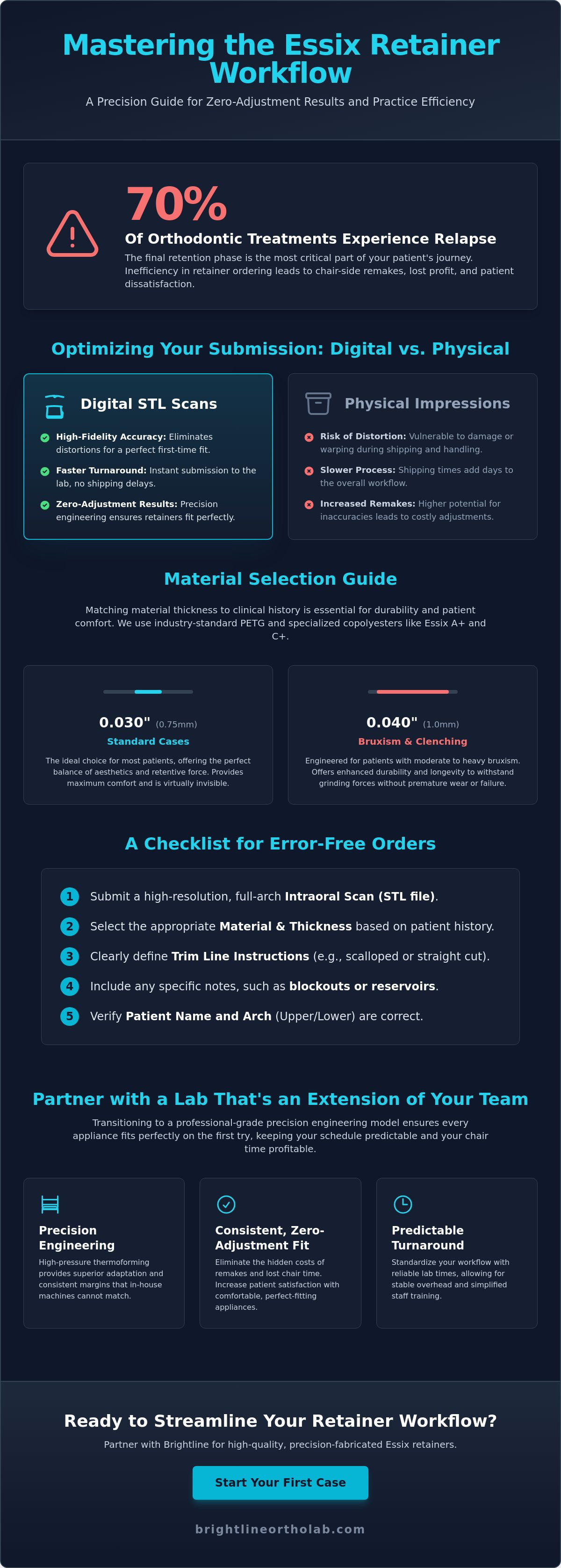
Approximately 70% of orthodontic treatments experience some degree of relapse, making the final retention phase the most critical part of your patient's journey. You likely know the frustration of a chair-side delivery that turns into an unexpected remake because of a distorted margin or an inconsistent fit. It's a drain on your schedule and your practice's profitability. When you're ordering essix retainers for practice, you need a workflow that's as precise as the clinical work you've already performed.
We understand that a lab should feel like an extension of your own team, supporting you with reliability and technical expertise. This guide will show you how to streamline your submission protocol to achieve zero-adjustment results and faster turnaround times. We'll explore how to master the transition from physical to digital impressions and how to select the ideal material thickness for patients who struggle with bruxism. By the end, you'll have a clear path to predictable lab costs and superior patient comfort every time you open a delivery box.
Key Takeaways
- Identify common bottlenecks in your current lab workflow to eliminate the hidden costs of lost chair time and patient dissatisfaction.
- Select the ideal material thickness based on clinical history to provide durable retention for bruxers and standard cases alike.
- Leverage the high-fidelity accuracy of intraoral scans and STL files to ensure your thermoformed retainers fit perfectly on the first try.
- Implement a standardized internal checklist for ordering essix retainers for practice to bridge the communication gap with your lab.
- Discover how a collaborative partnership focused on precision engineering can lead to consistent, zero-adjustment delivery appointments.
The Strategic Value of Streamlining Essix Retainer Ordering
Essix retainers remain the gold standard for post-orthodontic retention because they successfully bridge the gap between clinical necessity and patient desire. While traditional orthodontic retainers have served the industry for decades, the modern patient prioritizes aesthetics. A clear, comfortable appliance drives significantly higher compliance rates, which is the only way to prevent the relapse that affects approximately 70% of orthodontic cases. When you focus on ordering essix retainers for practice efficiency, you aren't just buying plastic; you're securing the results of months or years of hard work.
Inefficiency in your ordering workflow carries heavy hidden costs that go far beyond the lab invoice. Every time a retainer requires a heavy chair-side adjustment or a complete remake, you lose valuable production time. You're also forced to manage patient dissatisfaction and the logistical stress of rescheduling. Transitioning to a professional-grade precision engineering model allows your team to move away from the limitations of basic in-house thermoforming. This shift ensures that every appliance fits perfectly on the first try, allowing your schedule to remain predictable and your chair time to stay profitable.
Standardizing your lab partnership is a foundational step for any practice looking to scale in 2026. A reliable partner acts as an extension of your team, providing the meticulousness required to handle complex cases without constant oversight. By establishing a clear protocol for ordering essix retainers for practice, you simplify the training for new clinical staff and create a repeatable system that produces consistent, high-quality results across every patient arch.
Aesthetics vs. Durability in Practice
Patients crave an "invisible" look, but you need structural integrity to maintain tooth position. Professional lab fabrication achieves this balance by using high-pressure forming techniques that chair-side machines can't match. This process produces more consistent margins and a closer adaptation to the interproximal spaces. These precise details are especially critical in minor tooth movement cases where the retainer must provide enough force to finalize alignment while remaining virtually undetectable.
The Economics of Professional Lab Outsourcing
Calculating the true cost of in-house fabrication reveals the drain on your resources. When you account for the labor hours spent trimming and polishing, the maintenance of thermoforming equipment, and the cost of wasted materials, outsourcing becomes the clear financial winner. It frees your clinical staff to focus on high-value patient care and diagnostic tasks. Predictable lab fees and shipping schedules allow you to stabilize your overhead and provide patients with a faster, more reliable turnaround time.
Selecting the Right Material and Thickness for Clinical Success
Achieving a perfect fit starts with understanding the chemical foundation of the appliances you prescribe. Polyethylene Terephthalate Glycol (PETG) has established itself as the industry standard for clear orthodontic retention since 2026. This material provides the ideal balance of optical clarity and tensile strength, ensuring the retainer holds its shape without becoming brittle over time. When you're ordering essix retainers for practice, you'll often choose between standard PETG and specialized copolyester materials like Essix A+ or C+. A+ is specifically engineered for its high clarity and resistance to cracking, while C+ offers increased durability and stain resistance for patients who may be less meticulous with their cleaning routine.
The precision of the thermoforming process significantly impacts the final product's longevity. If the material is overheated during fabrication, it loses its clarity and becomes more porous, which leads to rapid staining and bacterial buildup. Professional labs use controlled heating environments to preserve the material's integrity and ensure a smooth surface finish. This meticulousness ensures that the appliance remains virtually invisible for the duration of its lifespan. If you want to see how these high-grade materials can improve your clinical outcomes, consider partnering with Brightline Orthodontic Lab for your next case.
Material Thickness Selection Guide
Matching the gauge of the material to the patient’s clinical history is essential for preventing premature wear and appliance failure. Consider these standard options:
- 0.030" (0.75mm): This is the standard choice for most patients. It offers maximum comfort and is virtually undetectable, making it perfect for standard retention or minor tooth movement cases.
- 0.040" (1.0mm): We recommend this thickness for patients with a history of moderate clenching. The extra 0.25mm provides a significant boost in structural integrity for long-term wear.
- Custom laminates: For heavy bruxers, a single layer may not suffice. In these cases, a dual-layer approach or a hard/soft laminate provides the necessary cushion and durability to protect the dentition.
Ensuring Biocompatibility and Patient Safety
Your patients rely on you to provide appliances that are safe for long-term intraoral use. We ensure all materials are BPA-free and latex-free to prevent allergic reactions or hormonal disruption. Using medical-grade plastics is the only way to avoid oral mucosal irritation and ensure the appliance remains biocompatible throughout its use. Providing patients with a clear patient care guide for Essix retainers is a great way to help them maintain the hygiene of these materials. When you prioritize these technical details during the process of ordering essix retainers for practice, you build a reputation for quality and patient-centered care.
Digital STL vs. Physical Impressions: Optimizing Your Lab Submission
The dental industry is rapidly moving toward a digital-first approach, and for good reason. Transitioning from traditional PVS impressions to intraoral scans simplifies the entire process of ordering essix retainers for practice efficiency. When you submit an STL file, you're providing a data set that is far less prone to the dimensional distortion common in stone models. We use these digital files to create high-precision 3D Printed Models, which serve as the perfect foundation for meticulous thermoforming. This digital workflow doesn't just improve accuracy; it also cuts days off your turnaround time by eliminating the need to wait for a courier to deliver physical models to the lab.
Physical impressions, while still a viable method, often suffer from subtle errors that lead to frustrating remakes. Common issues like small bubbles on the occlusal surface or drags near the gingival margin can prevent that satisfying "snap-fit" delivery. If a physical impression misses the distal extension of the terminal molar, the resulting retainer won't provide the full arch stability your patient needs. By moving to a digital workflow, you can verify your scan quality in real-time. This ensures every detail is captured before the patient even leaves the chair, which supports a more collaborative and professional patient experience.
Our lab is designed to accommodate both workflows, but we've seen that digital submissions consistently lead to higher precision and fewer chair-side adjustments. Whether you're sending a physical impression or a digital scan, our focus remains on providing a reliable extension of your team. This meticulousness is what makes ordering essix retainers for practice success a predictable part of your monthly routine.
Best Practices for Intraoral Scanning
To get the best results, focus on a comprehensive capture of the gingival margins. A retainer is only as good as its adaptation to the cervical area of the teeth. Always check for occlusal clearance in your digital bite registration to prevent the appliance from causing a posterior open bite once delivered. When you're ready to submit, export your STL files using a clear naming convention that includes the patient's name and the specific arch. This simple step helps our team integrate your case into our production queue without any unnecessary delay.
Maximizing Accuracy with Physical Impressions
If your practice still relies on traditional methods, selecting the right tray size is the most important first step. Ensure the tray extends far enough back to capture the terminal molars entirely. We recommend using high-quality PVS or alginate substitutes rather than standard alginate to minimize dimensional distortion during transit. Before shipping to our US-based lab, follow proper disinfection protocols and pack the impressions securely. Using a sturdy box with plenty of padding prevents breakage and ensures the craftsmanship we provide isn't compromised by the shipping process.
A Step-by-Step Checklist for Error-Free Essix Orders
Standardizing your internal office protocol is the most effective way to eliminate communication gaps that lead to costly delays. When your clinical team follows a repeatable system, you remove the guesswork from the lab's perspective. It's not just about sending a file; it's about providing a complete diagnostic package. By refining your approach to ordering essix retainers for practice efficiency, you ensure that every appliance returning to your office is ready for immediate delivery without the need for time-consuming modifications.
The Essential Lab Rx Checklist
A complete lab prescription (Rx) serves as the blueprint for our technicians. Missing information is the leading cause of "on-hold" cases, so we recommend verifying these details before finalizing your submission:
- Patient Identification: Include the full patient name and a unique office ID to ensure accurate record keeping and tracking throughout the fabrication process.
- Arch and Material: Specify whether you need an upper, lower, or both. Be sure to indicate the desired material thickness based on the patient's history of wear.
- Trimming Preferences: Clearly state if you prefer a scalloped cut that follows the gingival margin for maximum aesthetics or a straight cut for increased structural retention.
- Tooth-Moving Resets: If the case requires minor alignment corrections, provide specific instructions on which teeth require movement and the desired final position.
Pre-Submission Quality Control
Consistency in your clinical results depends entirely on the quality of the data you provide. Before you package a physical impression or upload a scan, take a moment to evaluate the capture. Ensure the terminal molars are fully visible, as these are the primary anchors for clear retention. Approximately 90% of lab remakes are preventable through a 30-second pre-submission visual audit. If you spot a drag in the PVS or a hole in the digital mesh, it's always faster to re-take the impression while the patient is still in the chair than to wait for a lab rejection notice.
Managing your cases shouldn't be a source of stress for your administrative team. Our digital portal allows you to track your orders in real-time, providing total transparency from the moment we receive your files to the day the package arrives at your door. This level of oversight helps you schedule delivery appointments with confidence, knowing the appliance will be there when the patient arrives. If you're ready to experience a more streamlined workflow, you can create your professional account today and start your first case with our expert team. Mastering the process of ordering essix retainers for practice growth allows you to focus on what matters most: your patients' smiles.
Partnering with Brightline for High-Quality Essix Fabrication
Choosing a lab partner is about more than just finding a vendor for appliances. It's about finding a reliable ally that understands the logistical pressures of a busy clinical environment. Brightline Orthodontic Lab has become the preferred national partner for clear retention because we prioritize the same outcomes you do: accuracy, speed, and patient satisfaction. When you're ordering essix retainers for practice consistency, you need a team that views every case as a reflection of your clinical reputation. We've designed our service to be an extension of your own staff, providing the technical support you need to eliminate remakes and keep your chair-side deliveries moving smoothly.
We've built our workflow to be as adaptable as possible to meet the needs of modern dentistry. Our systems integrate seamlessly with all major intraoral scanner brands, including iTero, 3Shape, and Medit. This digital compatibility means you can send a scan directly from your chair-side station and have our technicians reviewing the high-fidelity STL files within minutes. It eliminates the friction of physical shipping and provides a level of 3D model accuracy that traditional stone models simply cannot match. By embracing this digital-first approach, we help you reduce turnaround times and provide a more modern experience for your patients.
Precision Manufacturing Meets Traditional Craftsmanship
Our fabrication process combines the latest 3D printing technology with the meticulousness of traditional craftsmanship. Every 3D Printed Model we produce serves as a high-fidelity foundation for the thermoforming process. While advanced machines provide the base accuracy, our skilled technicians perform hand-finished trimming to ensure every margin is perfectly smooth and anatomically correct. This hybrid approach ensures a "snap-fit" every time, reducing the need for chair-side adjustments. You can easily integrate these clear retainer orders with your existing Hawley retainers workflow, allowing you to manage all your retention needs through a single, reliable digital portal.
Getting Started with Your First Case
Starting your first case with us is a straightforward process designed to respect your time and simplify your administration. Simply visit our digital portal to set up your practice account in just a few minutes. From there, you can immediately request pre-paid shipping labels for physical impressions or access our digital upload instructions for your intraoral scans. We're here to support your team at every step, ensuring that ordering essix retainers for practice growth becomes a seamless and predictable part of your daily routine. Streamline your practice today by opening a professional account with Brightline and experience the difference that precision engineering makes.
Elevating Your Clinical Results through Precision Retention
Transitioning to a streamlined workflow for ordering essix retainers for practice efficiency is one of the most effective ways to reclaim lost chair time and ensure long-term orthodontic stability. By matching material thickness to specific patient needs and embracing the accuracy of digital intraoral scans, you eliminate the uncertainty that leads to lab remakes. Implementing a standardized checklist protects your production schedule while providing the high-quality aesthetics your patients expect after months of treatment.
Brightline Orthodontic Lab supports your team with over 20 years of expertise and meticulous US-based manufacturing. Our digital portal integrates with all major intraoral scanners, making it easier than ever to submit cases and track their progress in real-time. We act as a reliable extension of your team, ensuring that every appliance meets our high standards for craftsmanship and durability. Start your first Essix case with Brightline Orthodontic Lab to see how precision engineering can transform your delivery appointments. We're ready to help you provide the dependable, comfortable results your patients deserve.
Frequently Asked Questions
What is the best material thickness for a standard Essix retainer?
The standard thickness for a standard Essix retainer is 0.030 inches (0.75mm), which provides the best balance of patient comfort and retention. For patients who require more durability or have a history of moderate clenching, a 0.040 inch (1.0mm) material is the preferred choice. Selecting the right thickness ensures the appliance remains virtually invisible while maintaining the necessary structural integrity for long-term tooth position stability.
How long does it take to receive an Essix retainer from a national lab?
You can typically expect a fast turnaround time when ordering essix retainers for practice through our US-based lab. While shipping times vary across the country, our efficient internal workflow ensures your cases are processed and fabricated within a few business days of receipt. Using our digital portal for STL uploads can reduce this timeline by eliminating the days required for physical model transit.
Can I send STL files from any intraoral scanner to Brightline?
Yes, our lab is fully compatible with STL files from all major intraoral scanner brands, including iTero, 3Shape, and Medit. You can upload these files directly through our secure digital portal to initiate the fabrication process immediately. This open-platform approach allows your practice to leverage its existing technology to achieve the highest level of precision in every clear retainer we produce for your patients.
How should I clean and maintain Essix retainers for my patients?
Patients should clean their retainers daily using cold water and a mild, non-abrasive liquid soap or a specialized retainer cleaner. It's critical to avoid hot water or harsh chemicals, as these can warp the PETG material or cause it to become cloudy. Instruct your patients to store their appliances in a protective case when not in use to prevent accidental damage or loss during their daily routine.
What is the difference between a straight cut and a scalloped cut for Essix retainers?
A scalloped cut follows the gingival margin for a more aesthetic look, while a straight cut extends slightly past the margin for increased retention. Scalloped cuts are often preferred for patients with high aesthetic demands. Straight cuts provide more structural strength and are less likely to irritate the soft tissue if the margins are meticulously hand-finished to a smooth, rounded edge by our laboratory technicians.
Are Essix retainers suitable for patients with heavy bruxism?
Standard Essix retainers are generally not recommended for patients with heavy bruxism because the thin material can wear through quickly under intense grinding forces. In these cases, we suggest using a thicker 0.040" material or transitioning the patient to one of our Hard/Soft Night Guards. These specialized appliances provide the necessary cushion and durability to protect the dentition while still maintaining the patient's orthodontic alignment.
How do I handle a fit issue if a retainer doesn’t snap into place?
If a retainer doesn’t snap into place, first inspect the appliance for any internal blebs or distortions that may have occurred during the thermoforming process. You should also verify that the patient's dentition hasn't shifted since the impression was taken. If the fit issue persists, we recommend reviewing your original scan or model for "drags" or incomplete captures that might have affected the precision of the 3D printed model.
Does Brightline offer 3D printed models with the Essix retainer order?
Yes, we provide 3D Printed Models with your Essix retainer orders to ensure the highest level of accuracy and to serve as a physical record for your practice. These models are fabricated directly from your STL files, providing a more durable and precise foundation than traditional stone. Having the model on hand also simplifies the process of ordering essix retainers for practice if a patient loses their appliance and needs a replacement.