
Precision in orthodontic manufacturing is a "garbage in, garbage out" process. Your appliance is only as good as the data you provide. You likely know the frustration of a Hawley retainer or RPE arriving only to require heavy chairside adjustments or a complete remake. These setbacks don't just stall your workflow; they impact the patient experience and your bottom line. Refining your orthodontic lab case submission protocol is the most effective way to reclaim that lost time and ensure a seamless fit on delivery day.
We're here to help you master the clinical and logistical steps necessary to eliminate remakes and guarantee precision. Whether you're navigating the transition to digital workflows or looking to sharpen your current systems, this guide provides a clear roadmap for success. We'll walk through optimizing digital file compatibility for systems like iTero and MEDIT Link, adhering to the latest QMSR quality standards, and organizing your clinical notes to ensure our team can function as a true extension of yours. By the end of this article, you'll have the tools to achieve faster turnaround times and a stress-free integration between your chair and our lab.
Key Takeaways
- Understand why a standardized orthodontic lab case submission protocol is essential for reducing chairside adjustments and maximizing practice ROI.
- Learn how to capture high-resolution intraoral scans and export compatible STL files to ensure a perfect fit for appliances like Essix retainers and RPEs.
- Discover best practices for pouring high-quality stone models and packing impressions to prevent distortion during transit.
- Master the art of the detailed prescription by specifying wire thickness and clasp types to eliminate ambiguity for the laboratory technician.
- Explore the benefits of partnering with a US-based boutique lab that acts as a collaborative extension of your clinical team.
What is a Professional Orthodontic Lab Case Submission?
A professional orthodontic lab case submission is the clinical handshake between your practice and our laboratory. It represents the formal transfer of patient data, anatomical records, and specific fabrication instructions required to create a custom appliance. Think of this process as a critical clinical protocol rather than a simple logistical chore. The quality of your submission directly dictates the accuracy of the final fit, the comfort of the patient, and the overall profitability of the procedure. Standardizing these steps within your office reduces the constant "lab-to-office" communication loops that cause delivery delays. Whether you use a traditional "box and mail" method or have transitioned to a fully digital workflow using Intraoral scanners, precision remains the non-negotiable standard for every case.
The Anatomy of a Perfect Case Submission
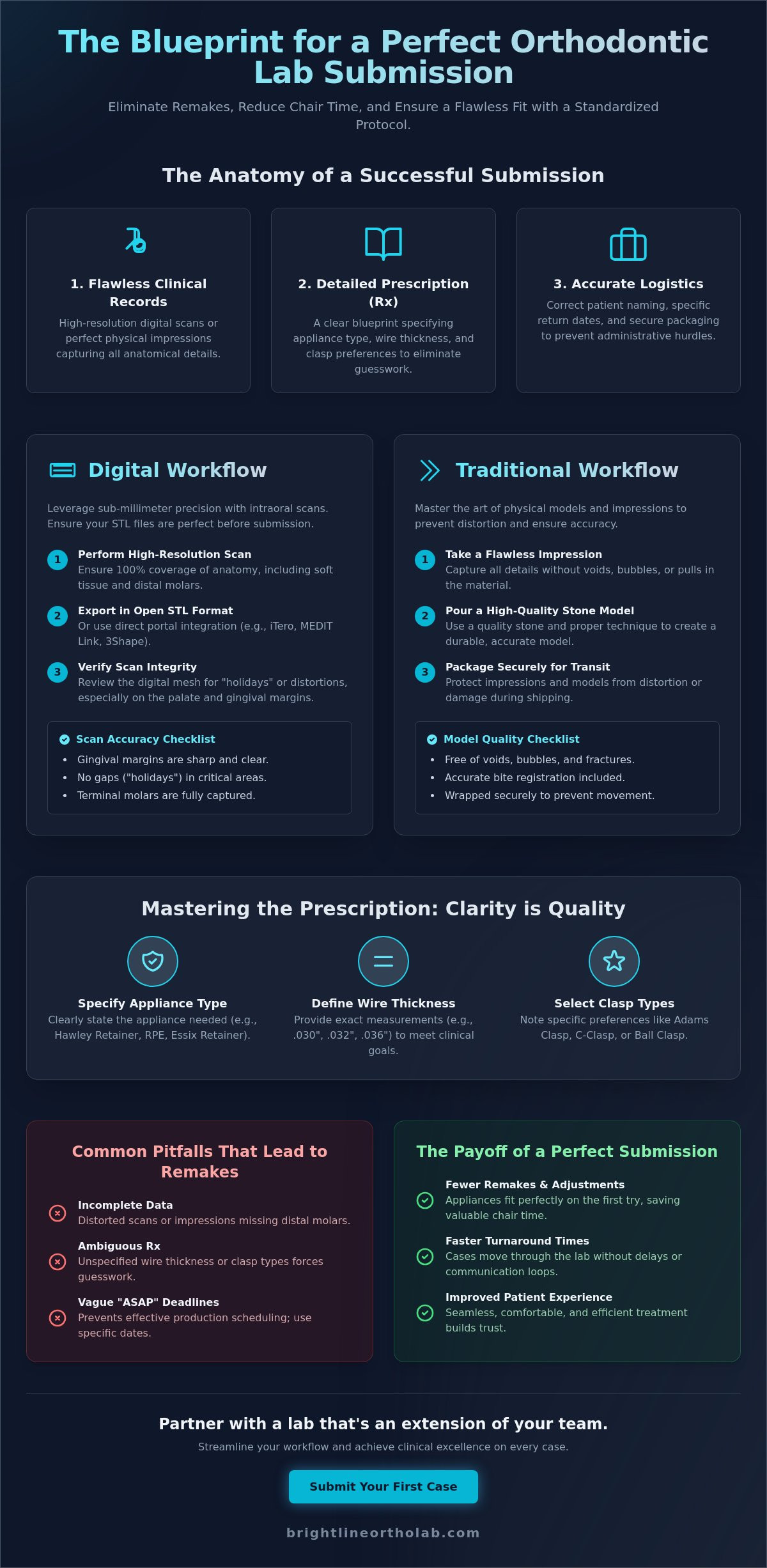
High-quality outcomes aren't accidental; they're the result of a methodical data transfer. A successful submission rests on three distinct pillars:
- Clinical Records: This includes high-resolution digital scans or flawless physical impressions that capture every anatomical detail, including the soft tissue and distal molars.
- The Prescription (Rx): This is your blueprint. It should clearly specify the appliance type, such as a Hawley retainer or RPE, along with wire thickness and clasp preferences.
- Logistics: Accurate patient naming, requested return dates, and secure packaging ensure the case moves through the lab without administrative hurdles.
When you provide a complete data set, you eliminate technician guesswork. We view ourselves as an extension of your team, not just a vendor. This collaborative philosophy ensures that we understand your clinical preferences before the first wire is bent, allowing us to support your practice's goals for efficiency and excellence.
Common Pitfalls in the Submission Process
Identifying the root cause of lab remakes often leads back to the very beginning of the process. Distorted impressions or incomplete digital scans are the primary reasons an appliance fails to seat. If the anatomy of the distal molars is missing or the stone model has a void, the appliance won't fit the patient's mouth. This "missing data" carries a high price in the form of lost chair time and patient frustration. Another frequent error is using "ASAP" as a requested return date. This isn't a valid clinical instruction for complex items like Rapid Palatal Expanders or sleep appliances. Specific dates allow us to manage our production queue effectively, ensuring your patient's schedule remains uninterrupted and your workflow stays on track.
The Digital Workflow: Submitting STL Files and Scans
Embracing a digital approach to your orthodontic lab case submission protocol transforms the way your practice interacts with the laboratory. It moves you away from the mess of alginate and into a world of sub-millimeter precision, a level of detail comparable to the high-resolution imaging standards maintained by Electron Optics Instruments, LLC. To ensure your digital cases are processed without delay, we recommend a methodical five-step upload process. First, perform a high-resolution intraoral scan, ensuring 100% coverage of the patient's anatomy. Second, export those files in an open STL format or utilize direct portal integration for systems like iTero or 3Shape. Third, review the digital mesh for "holidays" or distortions in critical areas like the palate or terminal molars. Fourth, upload these files to our laboratory portal alongside a complete digital prescription. Finally, receive your confirmation and estimated ship date through the digital dashboard to keep your patient schedule synchronized.
As you implement the steps to a full digital workflow, you'll find that the quality of the initial scan is the most significant predictor of success. If you're ready to modernize your office, our digital submission portal simplifies the entire upload process for your team, allowing for faster communication and fewer errors.
Verifying Scan Accuracy Before You Click Send
Don't let a small gap in data lead to a large gap at the chairside. Before finalizing your submission, use a checklist to verify the integrity of the scan. Look specifically for "holidays," which are small areas of missing data, particularly along the gingival margins. These gaps can lead to ill-fitting Essix retainers or night guards. If you're ordering a Rapid Palatal Expander (RPE), capturing the full depth of the palate is essential for proper appliance seating. Finally, verify that the bite registration is accurately reflected in the digital file. If the arches don't occlude correctly in your software, they won't occlude correctly in the final appliance.
Digital Record Keeping and Archiving
Digital workflows offer benefits that extend far beyond the initial fabrication. By maintaining a digital library of scans, you can streamline the replacement process for lost or broken retainers without needing the patient back in the chair for a new impression. We can use these files to generate 3D Printed Models whenever a physical reference is required. This transition significantly reduces the physical storage burden in your practice, as you no longer need to find shelf space for hundreds of dusty stone models. It is a cleaner, more efficient way to manage long-term patient records while ensuring the soul of traditional craftsmanship is preserved through modern technology.
Traditional Submissions: Impressions, Models, and Packing
While digital scans offer speed, many practices still rely on physical records for their orthodontic lab case submission. Moving from the chair to the shipping box requires meticulous attention to detail to prevent material distortion. If you use alginate, wrap your impressions in a damp paper towel and seal them in a plastic bag. This maintains necessary humidity without causing the material to swell. For maximum stability, PVS impressions are the superior choice for long-distance transit. When pouring models in-office, high-quality dental stone is non-negotiable. Inferior plaster often leads to model breakage or surface abrasion during the fabrication of Hawley retainers or expanders. This small detail ensures the final appliance fits the patient's mouth, not just a degraded stone model.
Implement a "Triple Check" protocol before any case leaves your facility. First, inspect the model for voids or bubbles on the occlusal surfaces. Second, ensure the terminal molars are fully captured, as these teeth are critical for secure clasping. Third, verify that the physical prescription matches the patient's records exactly. Taking three minutes at the bench saves hours of chairside frustration later. Proper packing is your final safeguard. Use sturdy boxes and enough bubble wrap to ensure models don't rattle during transit. A well-protected shipment is the best way to honor the clinical work you've already performed at the chair.
Clinical Requirements for Specialized Appliances
Specific appliances demand unique clinical data that goes beyond a standard impression. For a Hawley retainer, we cannot accurately bend Adams or Ball clasps without the full anatomy of the terminal molars. If you're submitting a case for a Rapid Palatal Expander (RPE), a deep, full palatal impression is essential to ensure the appliance seats properly against the soft tissue. Sleep apnea cases, such as Dorsal or EMA Sleep Appliances, are the most demanding. These require a protrusive bite registration. Without this specific measurement of the patient's mandibular advancement, we cannot accurately calibrate the appliance for therapeutic success.
Logistics and Shipping Best Practices
Reliable logistics are the backbone of a successful orthodontic lab case submission. We recommend partnering with established national carriers like UPS or FedEx to ensure your clinical work arrives safely. To save your front desk team time, keep a stock of pre-printed shipping labels ready for immediate use. You can also manage your lab costs more effectively by consolidating multiple patient cases into a single shipment. This simple change in office habit reduces shipping fees and ensures all your cases arrive in one organized batch, allowing our technicians to begin work immediately upon arrival.
Mastering the Prescription (Rx): Clarity Leads to Quality
Clarity is the antidote to clinical frustration. A complete prescription acts as a blueprint for your orthodontic lab case submission; it bridges the gap between your clinical vision and our technical execution. While it might seem like a simple administrative task, the details you provide on the Rx dictate the longevity and performance of the final appliance. Every submission must include the patient’s name, the specific appliance type, and a firm requested return date. If these fundamentals are missing, the case enters a holding pattern while we wait for clarification, which inevitably delays your patient's treatment timeline.
Precision requires specific instructions for components like wire thickness and clasp types. When ordering Hawley retainers, for example, specifying whether you prefer Adams, Ball, or C-clasps allows us to design for maximum retention based on the patient's unique tooth morphology. You should also consider patient compliance; adding a personal touch through acrylic colors or glitter can make a significant difference in how a younger patient feels about their new appliance. For complex cases involving mixed dentition, provide clear instructions on which teeth to use for anchorage to avoid interfering with erupting permanent teeth. If you are ready to experience the difference that detailed communication makes, you can submit your next digital prescription through our streamlined portal.
Designing for Success: Clasping and Retention
Your insight into the patient's oral environment is invaluable. Use the prescription to indicate specific undercuts where you want the clasps to seat; this ensures the appliance stays firmly in place. When requesting Rapid Palatal Expanders (RPE), communicate your preference for expansion screw placement. A more anterior or posterior position can change the force distribution depending on your treatment goals. Moving beyond "Standard" instructions to "Custom" specifications allows our technicians to accommodate unique clinical challenges, such as tilted molars or high vaulted palates, ensuring the appliance works exactly as you intended.
Managing Dates and Turnaround Times
Effective scheduling relies on a clear understanding of laboratory logistics. It is vital to distinguish between the "Ship Date" and the "In-Office Date." The ship date is when the appliance leaves our facility, while the in-office date is when you need it ready for the patient. To calculate a safe seat date, always account for transit time and a one-day buffer for office processing. We also ask that you provide a direct phone number or email on the Rx. If a technician has a question about a scan or a specific wire placement, a quick conversation can prevent a remake and keep the case moving forward without interruption.
Partnering with Brightline Orthodontic Lab
Choosing a laboratory is one of the most consequential decisions for your practice's workflow. Brightline Orthodontic Lab operates as a boutique extension of your clinical team; we bridge the gap between chairside treatment and technical manufacturing. By keeping our production US-based, we maintain strict control over material quality and ensure that communication remains clear and responsive. You won't find the impersonal "factory" feel here. Instead, you'll find a group of seasoned experts dedicated to supporting your clinical outcomes through precision engineering and reliable service.
Our commitment to excellence applies to every appliance we craft. Whether you need a Rapid Palatal Expander (RPE), a Hawley retainer, or specialized sleep appliances like the Dorsal or EMA, our team applies the same level of meticulousness to every case. We understand that your reputation is on the line every time you seat an appliance. That's why we focus on getting the orthodontic lab case submission right the first time. We simplify the process so you can focus on patient care while we handle the technical heavy lifting.
The Brightline Difference: Meticulous Craftsmanship
Our 18 years of history in the industry have taught us that precision is the only way to avoid the frustration of remakes. We've seen the evolution of orthodontics from traditional plaster to advanced digital workflows. This history allows us to remain unfazed by complex cases that might overwhelm less experienced labs. We verify every submission for anatomical accuracy and prescription clarity before the first step of fabrication begins. If we spot a potential issue with a scan or a bite registration, we reach out to you immediately. This collaborative approach provides the peace of mind that comes from having a dependable, national partner who acts as a final safeguard for your clinical data.
Next Steps: Simplified Submissions
Transitioning to a new lab partner should be a seamless experience. We've created a digital starter kit that includes everything your team needs to begin working with us immediately. You can download our latest prescription forms or integrate your intraoral scanner with our portal in just a few minutes. If you're facing a unique clinical challenge or need advice on clasping for a difficult orthodontic lab case submission, our senior technicians are available for a professional consultation. We're here to accommodate your needs and ensure your appliances, from Essix retainers to Hard/Soft Night Guards, arrive on time and fit perfectly.
Ready to experience precision? Submit your first case to Brightline Orthodontic Lab today.
Elevate Your Practice Standards with Precision Submissions
Mastering your clinical protocols transforms the way you interact with your laboratory. By refining your digital scan verification and tightening your prescription details, you eliminate the communication gaps that lead to chairside frustration. A high-quality orthodontic lab case submission is the foundation of every successful delivery. It ensures your patients receive the care they deserve without the wait of unnecessary remakes or adjustments. When your office standards align with laboratory precision, the result is a more efficient, profitable practice.
At Brightline Orthodontic Lab, we bring over 18 years of industry experience and US-based manufacturing to every case. Our specialized expertise in RPE and Sleep appliances means we've seen every clinical scenario and remain ready to support your most complex designs. We're proud to act as a reliable ally and a seamless extension of your clinical team. You can count on us to maintain the soul of traditional craftsmanship while embracing the speed of modern digital workflows.
Start Your First Case Submission with Brightline today. We look forward to helping you achieve perfect appliance fit and streamlined chairside experiences for every patient in your care.
Frequently Asked Questions
How do I send an STL file to your lab?
You can send STL files through direct portal integration or via email. We accept digital scans from iTero, MEDIT Link, DS Core, and 3Shape systems to ensure your orthodontic lab case submission is as seamless as possible. This flexibility allows your team to upload records quickly without worrying about proprietary file constraints.
What is the standard turnaround time for a Hawley retainer?
Our standard in-lab turnaround time is 5 business days from the moment we receive your clinical records. If you have a patient with an urgent need, rush service is available for cases required in under 2 days. This consistent schedule helps you plan your seating appointments with total confidence in our reliability.
Do you provide shipping labels for national accounts?
We provide pre-printed shipping labels to simplify the mailing process for all our national partners. You can request these labels through our office to ensure your physical records are routed correctly and efficiently. Consolidating multiple patient cases into a single shipment is a great way to manage your practice's logistics and reduce incoming box volume.
What type of bite registration is needed for a Dorsal sleep appliance?
A protrusive bite registration is mandatory for the fabrication of a Dorsal sleep appliance. This specific record allows our technicians to calibrate the advancement of the mandible according to your therapeutic goals. Providing an accurate protrusive bite ensures the final appliance is both comfortable for the patient and clinically effective.
Can I submit a case if I only have a traditional impression and no digital scanner?
You can absolutely submit cases using traditional alginate or PVS impressions. While we embrace modern digital workflows, we remain masters of traditional craftsmanship and accommodate practices that prefer physical impressions. Simply ensure your impressions are packed securely to prevent distortion during transit and include your detailed prescription form.
What happens if the lab finds an issue with my scan or impression?
We will contact your office immediately by phone or email if we identify distortions, "holidays," or missing anatomical data. Our goal is to function as a supportive ally, and we believe it is better to clarify a detail early than to deliver an appliance that requires a remake. This proactive communication saves you valuable chair time and protects the patient experience.
Do you offer 3D printing services for digital models?
We provide high-precision 3D Printed Models as a core part of our digital service offerings. These models serve as an accurate physical foundation for building your custom retainers and expanders while allowing you to maintain a digital-only archive in your office. This service significantly reduces your physical storage needs without sacrificing the accuracy of your patient records.
How do I track the status of my case submission?
You can track the progress of your orthodontic lab case submission through our digital dashboard or by calling our service team. Every case is logged upon arrival, giving you clear visibility into the production stage and the estimated ship date. This transparency allows your front desk to manage the patient schedule with precision and ease.