
What if the very materials you prescribe to straighten teeth are the silent culprits behind a patient's persistent soft-tissue inflammation? It's a frustrating reality when a perfectly planned treatment is derailed by an unexpected allergic reaction to nickel or a residual monomer. You prioritize patient safety above all else, but staying current on the biocompatibility of orthodontic materials is becoming increasingly complex in 2026. With the FDA expressing reservations about the new ISO 10993-1:2026 standards and the EU MDR in full force, the old checklist approach to material safety is no longer enough to protect your patients or your practice.
This guide provides the clinical clarity you need to handle these regulatory changes and technical challenges with confidence. You'll learn how to verify material safety data from your lab partners and understand the long-term stability of modern 3D-printed resins. We will break down a risk-based framework for material selection that reduces chairside irritation and ensures the appliances you deliver, from RPEs to Essix retainers, are as safe as they are effective. By the end, you'll have a clear path to choosing materials that support both patient health and appliance longevity.
Key Takeaways
- Learn to evaluate biocompatibility as a dynamic interaction within the oral cavity rather than a simple material property.
- Identify the specific risks associated with the biocompatibility of orthodontic materials, including nickel leaching and residual monomers in dental-grade acrylics.
- Recognize the early clinical warning signs of material hypersensitivity to proactively reduce the incidence of soft-tissue irritation.
- Establish a clear framework for verifying lab safety data and ensuring your appliances are sourced from reputable, compliant suppliers.
What is Biocompatibility in the Orthodontic Context?
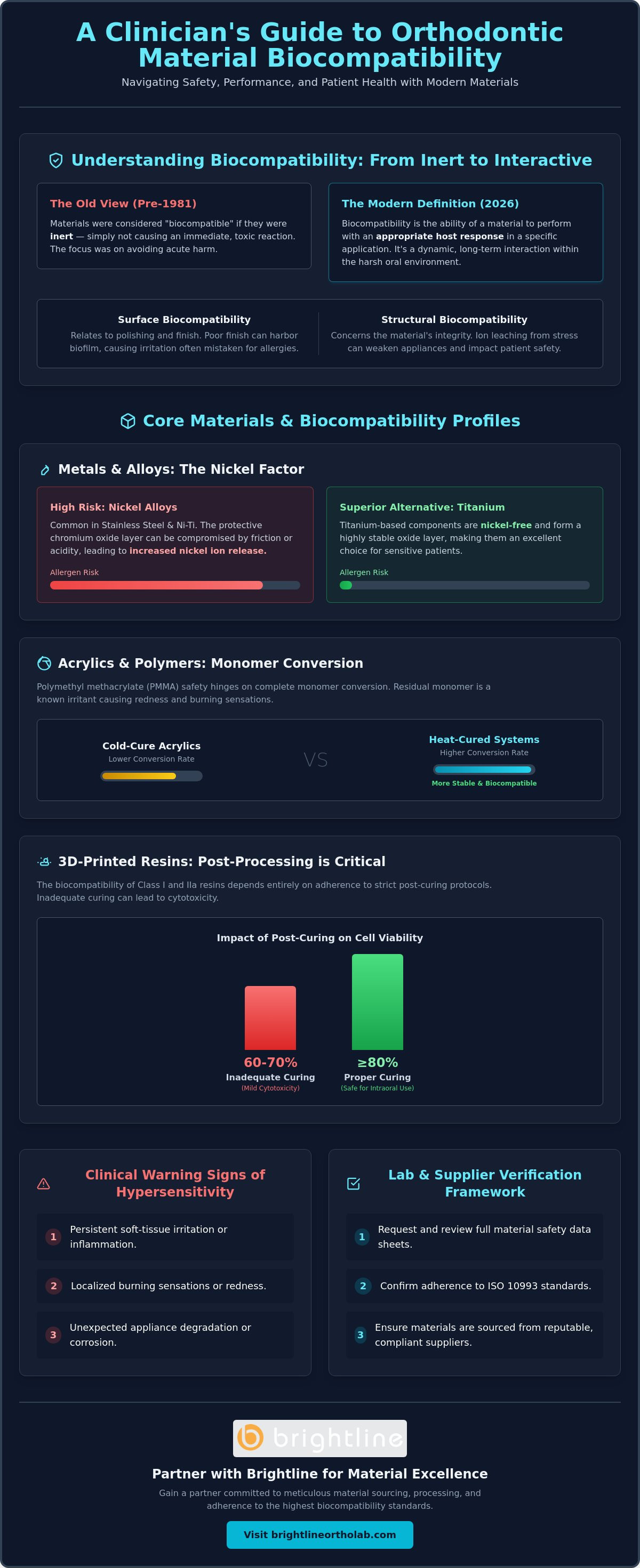
Defining What is Biocompatibility starts with the concept of a "non-harmful host response." In your daily practice, this is the silent foundation of every successful treatment. If a material doesn't harmonize with the biological environment, the most precise treatment plan can still fail. We look beyond acute toxicity, which is the immediate cell death often measured in laboratory tests. Instead, our focus is on the long-term biocompatibility of orthodontic materials as they interact with saliva, fluctuating pH levels, and constant mechanical friction over years of use.
The oral cavity is one of the most demanding environments in the human body. Unlike an orthopedic implant shielded by muscle and bone, orthodontic appliances face a harsh cocktail of enzymes, varying temperatures, and acidic challenges from food. Clinical success is the ultimate measure of material harmony. It's that state where the appliance performs its mechanical duties without triggering an immune response or losing its physical properties. When we achieve this balance, we ensure both patient comfort and appliance longevity.
The Williams Definition and Modern Adaptations
Back in 1981, D.F. Williams defined biocompatibility as the ability of a material to perform with an appropriate host response in a specific application. It was a revolutionary shift from "inertness" to "interaction." By 2026, we've expanded this significantly. We don't just ask if a material is safe; we ask if it supports the intended clinical outcome without degradation. Modern standards define biocompatibility as the synergy between material safety, mechanical performance, and biological stability within the dynamic oral environment.
Surface vs. Structural Biocompatibility
Think about the difference between how a material looks on the outside and how it holds up on the inside. Surface biocompatibility is heavily influenced by finishing. If a retainer isn't meticulously polished, it becomes a reservoir for biofilm and bacteria. This leads to soft-tissue irritation that clinicians often mistake for a metal allergy. Structural biocompatibility is equally vital, especially for force-bearing devices. Understanding how RPE appliances work shows why material integrity matters. If an expander's metal components leach ions due to stress corrosion, the structural strength of the appliance diminishes. This impacts both patient safety and the long-term success of the expansion.
Core Materials and Their Biocompatibility Profiles
Selecting the right components requires more than just checking a box. The biocompatibility of orthodontic materials is governed by the ISO 10993 standards, which provide a rigorous framework for testing everything from cytotoxicity to systemic toxicity. These standards ensure that the alloys and polymers we use don't just work mechanically but also protect the patient's biological health over months or years of contact. When you choose to partner with Brightline, you gain a team committed to meticulous material sourcing and processing that adheres to these high standards.
Metals and Alloys: Managing the Nickel Factor
Nickel remains the most common allergen in the orthodontic office. Stainless steel and nickel-titanium alloys rely on a chromium oxide passivation layer to prevent corrosion and limit ion release. If this layer is compromised by friction or acidic environments, ion release increases. Titanium-based components in expanders offer a superior biocompatible alternative for sensitive patients. These components lack nickel entirely and form a more stable oxide layer, providing peace of mind for both the clinician and the patient.
Acrylics and Polymers in Lab Fabrication
Polymethyl methacrylate (PMMA) remains the gold standard for many appliances. Whether we are fabricating a hard soft night guard or a standard Hawley, complete monomer conversion is essential. Residual methyl methacrylate monomer is a known irritant that can cause localized burning or redness. Heat-cured systems generally offer higher conversion rates than cold-cure acrylics. This results in a more stable and biocompatible final product that stands up to the long-term challenges of the oral environment.
The Biocompatibility of 3D-Printed Resins
3D printing has introduced a new variable into the modern lab workflow. While Class I and Class IIa resins are certified for intraoral use, their safety depends heavily on post-processing protocols. A systematic review of studies from 2015-2025 found that cell viability remains at or above 80% under standard conditions. However, inadequate post-curing can lead to mild cytotoxicity, with cell viability dropping to 60-70%. Strict adherence to curing times and temperatures is non-negotiable for clinical safety. For more on how these materials are integrated into your workflow, see our guide on 3D printed dental models.
Managing Patient Sensitivities and Adverse Reactions
Clinical vigilance is your first line of defense against adverse reactions. While the biocompatibility of orthodontic materials is generally high, individual patient responses vary. You'll often see hypersensitivity manifest as diffuse erythema, swelling, or even small vesicles on the oral mucosa. Identifying these signs early prevents a minor irritation from becoming a reason to terminate treatment. It's helpful to remember that nickel hypersensitivity affects approximately 10% to 20% of the general population. This prevalence is significantly higher in females, often due to early exposure through jewelry piercings.
Distinguishing between mechanical irritation and an allergic reaction is a critical diagnostic skill. Look at the pattern of inflammation. If the redness is confined to a specific spot where a wire is poking, it's likely mechanical. If the inflammation spreads across the gingiva or follows the exact footprint of an acrylic plate, you're likely dealing with a biocompatibility issue. When you suspect a sensitivity, follow a clear protocol. Document the symptoms, patch test if necessary, and transition to alternative materials that offer a more favorable biological profile.
Nickel Hypersensitivity: Clinical Strategies
Managing nickel-sensitive patients requires a proactive approach to material selection. You can swap standard stainless steel for titanium-based alloys or cobalt-chromium wires. Ceramic brackets and composite tubes also provide excellent nickel-free alternatives for the fixed portion of treatment. If a patient develops a reaction mid-treatment, some labs can apply specialized coatings like rhodium or gold plating. These serve as a temporary biocompatible barrier, though they may wear down over time. For long-term stability, transitioning to a completely nickel-free appliance remains the most reliable solution.
Acrylic Monomer Sensitivity and Cross-Reactivity
Contact stomatitis is the most common reaction to acrylic appliances. Patients often report a burning sensation or persistent redness under the base of a Hawley retainer or a functional appliance. This is usually caused by residual methyl methacrylate monomers that didn't fully convert during the curing process. If a patient is sensitive to PMMA, consider switching to copolyester materials like those used in Essix retainers. To support clinicians, many labs utilize a leaching protocol. This involves soaking the finished appliance in warm water for 24 to 48 hours to significantly reduce the concentration of residual monomers before the appliance ever reaches your chair.
Lab Standards and Quality Control Protocols
A laboratory's role extends far beyond simply following a prescription. We act as the final gatekeeper for the biocompatibility of orthodontic materials, ensuring that every component remains safe from the moment it enters our facility to the moment it reaches your chair. Even the highest-grade titanium can become a source of irritation if it's handled poorly. Cross-contamination is a significant risk in a busy lab environment. We use dedicated polishing wheels for different alloys and maintain strict separation between acrylic and metal processing areas. This prevents unwanted particles from embedding into the surface of an appliance, which could otherwise trigger a localized reaction.
Material Sourcing and Traceability
Clinicians should feel empowered to ask for Material Safety Data Sheets (MSDS) for every material used. These documents provide the verifiable proof of a material's chemical composition and safety profile. Sourcing from reputable, FDA-compliant suppliers is the only way to avoid the dangers of 'gray market' materials. These low-cost alternatives often lack the necessary purity and may contain trace amounts of heavy metals. At Brightline, we maintain full traceability for every batch of acrylic and wire. This meticulous record-keeping means we can immediately identify every patient who received an appliance from a specific batch if a manufacturer ever issues a safety update.
Precision Finishing: Polishing and Passivation
The final finishing stage is where a material's biological potential is fully realized. For hawley retainers, mechanical polishing isn't just for aesthetics. It creates a surface so smooth that bacteria and plaque cannot easily adhere. Metal components benefit from electrolytic polishing, which removes microscopic surface layers to enhance the protective chromium oxide passivation layer. We finish every appliance with a multi-stage ultrasonic cleaning to remove any residual oils or polishing compounds. If you want to ensure your patients receive the safest possible care, partner with a lab that treats material science with the same precision you bring to your clinical work.
Partnering with Brightline for Material Excellence
Managing the biological safety of your appliances doesn't have to be a source of clinical stress. While the science behind the biocompatibility of orthodontic materials is constantly evolving, our commitment to your patients remains a constant. We don't just see ourselves as a vendor; we function as a collaborative extension of your team. By handling the technical complexities of material sourcing and regulatory compliance, we free you to focus on what matters most: achieving exceptional clinical results. If you encounter a patient with a rare sensitivity or a complex medical history, we're here to consult on the best material pathways for their specific needs.
Trust is built on transparency and consistent performance. We take pride in our role as a seasoned expert and reliable ally. Whether you're prescribing a simple Essix retainer or a complex EMA sleep appliance, you can rest assured that every component has been vetted for safety and precision. We remain unfazed by the growing complexity of global standards because our internal protocols have always prioritized patient health over high-volume shortcuts.
Our Commitment to Quality and Precision
Choosing a US-based orthodontic lab provides a level of oversight that is difficult to replicate with offshore alternatives. At Brightline, our meticulous approach combines modern adaptability with traditional craftsmanship. We apply rigorous internal standards to both our 3D-printed models and our hand-fabricated appliances. This ensures that every resin is fully cured and every metal component is properly passivated. If a material doesn't meet our strict criteria for biological stability and mechanical strength, it doesn't enter our workflow. This dedication to precision protects your patients from avoidable irritation and protects your practice from the logistical burden of appliance failure.
Next Steps for Your Practice
Ready to bring a higher level of material confidence to your chairside experience? We invite you to explore our full range of custom orthodontic solutions, from RPEs to dorsal sleep appliances. Starting a case is a straightforward process designed to accommodate your busy schedule. If you need specific Material Safety Data Sheets or want to discuss a custom biocompatibility protocol for a sensitive patient, our team is ready to support you. Contact us today to request more information or to begin your first case. We look forward to showing you how a true partnership can simplify your workflow and enhance your patient care.
Elevating Patient Care Through Material Science
Prioritizing the biocompatibility of orthodontic materials is more than a regulatory requirement; it's a commitment to the comfort and health of every patient in your chair. You've seen how a risk-based approach to material selection, combined with meticulous lab finishing, can significantly reduce the incidence of hypersensitivity reactions. From managing nickel leaching to ensuring complete monomer conversion in acrylics, these technical details define the long-term success of your clinical outcomes.
You don't have to navigate these complexities alone. We bring over 18 years of industry expertise in custom fabrication to every case you send our way. By sourcing exclusively from FDA-compliant, high-grade material suppliers and maintaining rigorous finishing protocols, we ensure your appliances meet the highest safety standards of 2026. This level of meticulousness allows you to prescribe with confidence, knowing the biological safety of your patients is protected.
Partner with Brightline Orthodontic Lab for Precision-Engineered Appliances and gain a reliable ally dedicated to your practice's success. We look forward to supporting your team with the dependability and craftsmanship your patients deserve.
Frequently Asked Questions
What are the most common biocompatible materials used in orthodontic labs?
Polymethyl methacrylate (PMMA), stainless steel, nickel-titanium, and medical-grade copolyesters are the industry staples. These materials are chosen for their stability in the oral environment and their ability to resist degradation. Labs also utilize Class I and Class IIa resins for 3D printing. Each material must meet strict ISO standards to ensure it performs without triggering a harmful host response.
How can I tell if a patient is having an allergic reaction to their retainer?
Look for localized redness, swelling, or a burning sensation that mirrors the shape of the appliance. Unlike mechanical irritation, which usually presents as a distinct sore spot from a sharp edge, an allergic reaction often involves diffuse inflammation across the mucosa. If the symptoms persist after adjusting the fit, you're likely dealing with a sensitivity to residual monomers or metal ions.
Are 3D-printed orthodontic resins as biocompatible as traditional acrylics?
Yes, provided they are processed with strict adherence to validated post-curing protocols. While traditional heat-cured acrylics have a long history of safety, modern Class IIa resins offer comparable biocompatibility when cured at the correct temperature and duration. The biocompatibility of orthodontic materials in the digital age depends entirely on the precision of the lab's equipment and the meticulousness of their post-processing steps.
What should I look for in a lab's material safety protocols?
Verify that the lab sources only from FDA-compliant suppliers and maintains full batch traceability. You should ask if they have a dedicated protocol for removing residual monomers, such as ultrasonic cleaning or a leaching bath. A reliable partner will be able to provide Material Safety Data Sheets (MSDS) upon request and demonstrate a clear separation between different material processing areas to prevent cross-contamination.
Is nickel-free stainless steel truly 100% nickel-free?
Not necessarily, as many "nickel-free" alloys still contain trace amounts below 0.1%. For patients with extreme sensitivities, titanium or cobalt-chromium alloys are safer choices. These materials are specifically engineered to eliminate nickel entirely, providing a more reliable solution for those who react to even minute levels of metal ion release. Always confirm the specific alloy composition with your lab before starting treatment for a sensitive patient.
How does the finishing process affect the biocompatibility of an appliance?
Meticulous polishing reduces the surface area available for bacterial adhesion and plaque buildup. A rough surface can harbor biofilms that cause localized soft-tissue inflammation, which clinicians sometimes mistake for a material allergy. Electrolytic polishing for metal parts and high-shine mechanical polishing for acrylics are essential steps. These processes ensure the appliance remains inert and comfortable throughout the treatment period.
Can I request specific biocompatible brands for my patient’s appliances?
Absolutely, and a collaborative lab should accommodate these requests for specialized cases. If you have a preferred brand of nickel-free wire or a specific medical-grade resin you trust, communicating this on the prescription ensures the final appliance aligns with your clinical standards. We recommend discussing these options during the treatment planning phase to ensure the materials are in stock and compatible with the appliance design.
What is the role of ISO 10993 in orthodontic material safety?
ISO 10993 provides the international framework for evaluating the biological safety of medical devices. It outlines specific tests for cytotoxicity, sensitization, and irritation that all materials must pass before clinical use. Understanding the biocompatibility of orthodontic materials through this lens helps you evaluate new products with scientific rigor. It ensures that every material, from 3D-printed resins to stainless steel, is safe for long-term intraoral contact.