
Imagine opening a shipping box only to find the stone model for your patient's Rapid Palatal Expander shattered into pieces. It's a frustrating setback that delays treatment and forces an awkward conversation about rescanning. You've likely felt the strain of managing fragile plaster, from the physical storage space it consumes to the high remake rates caused by model breakage. While about 15% of U.S. dental practices have already moved to in-office printing, many clinicians still wonder if 3d printed dental models provide the precision needed for complex appliances like Hawley retainers or RPEs.
If you're ready to leave the mess of stone behind, we're here to help you bridge the gap between traditional craftsmanship and modern technology. You'll learn how a digital workflow ensures a superior fit by achieving accuracy levels of ±50 µm; this makes these models comparable to the highest grade of dental plaster. We'll walk you through the essential steps to master your digital records, simplify your archiving process, and boost your practice efficiency. This guide covers everything from FDA-cleared resin selection to the critical post-processing steps that guarantee patient safety and appliance longevity.
Key Takeaways
- Transition from messy stone to additive manufacturing to streamline your lab operations and improve overall practice efficiency.
- Evaluate the differences between SLA and DLP technologies to understand how specific layer heights affect the final fit of your orthodontic appliances.
- Master the digital workflow from intraoral scanning to STL cleaning to ensure your 3d printed dental models are consistently accurate and ready for fabrication.
- Compare the dimensional stability of digital models against traditional plaster to reduce remake rates and eliminate the need for patient re-impressions.
- Identify why specialized lab expertise is critical for optimizing digital models specifically for high-precision appliances like Hawley retainers and RPEs.
What are 3D Printed Dental Models?
At its core, a 3d printed dental model is a high-precision physical replica of a patient’s teeth and gingiva. These models are created through additive manufacturing, a process that builds the structure layer by layer from liquid resin. This marks a significant departure from the subtractive milling processes of the past, where objects were carved out of a solid block of material. By using additive techniques, labs significantly reduce material waste while achieving a level of detail that traditional stone simply cannot match.
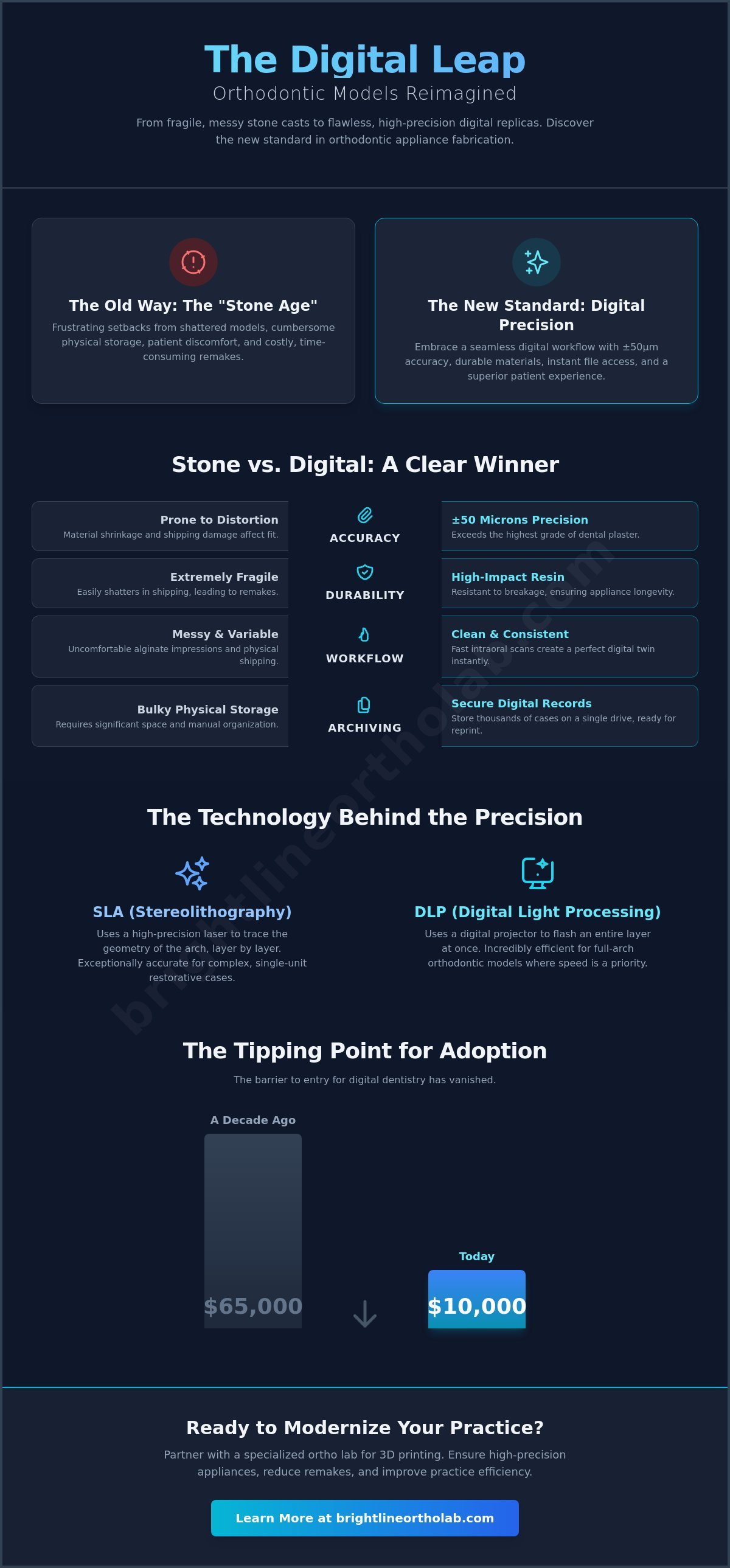
The foundation of this technology lies in Digital Dentistry. The process begins with an intraoral scan (IOS) that captures the mouth's geometry with incredible speed. This data is converted into an STL file, which serves as the digital blueprint for the printer. Using specialized, biocompatible resins, the printer translates that digital data into a durable physical form. As of May 2026, we've reached a true tipping point for adoption. With the average price of dental 3D printers dropping from $65,000 a decade ago to just over $10,000 today, the barrier to entry has vanished. Transitioning to digital workflows is no longer a luxury; it’s an operational standard for modern practices.
The Evolution from Alginate to Digital Scans
Traditional alginate impressions have long been a source of variability in the orthodontic workflow. They're prone to material shrinkage, distortion during shipping, and patient discomfort. Digital scanning eliminates these variables by capturing sub-millimeter detail in real time. This creates a "digital twin" of the patient’s anatomy, providing a stable, non-degradable record that you can use for precise treatment planning. You won't have to worry about a model breaking or losing its shape over time; the digital data remains perfect for as long as you need it.
Common Applications in the Orthodontic Office
While 3d printed dental models are excellent diagnostic tools for patient education, their primary value lies in appliance fabrication. These models serve as the master foundations for creating high-quality orthodontic solutions. Whether you're ordering Hawley Retainers, Rapid Palatal Expanders (RPE), or Essix Retainers, the printed model ensures a fit that matches the patient's actual anatomy with meticulous accuracy.
Beyond active treatment, these models simplify record archiving. Instead of filling storage rooms with dusty plaster boxes, you can store thousands of patient records on a single secure drive. If a patient loses their retainer years later, you can pull up the file and print a new model without requiring them to return for a fresh impression. This efficiency supports your team and accommodates the busy schedules of your patients.
The Science of Precision: How 3D Models are Fabricated
Creating a physical model from a digital file requires a meticulous approach to light and chemistry. 3d printed dental models aren't just plastic shapes; they're the result of highly controlled photopolymerization. This process uses light to turn liquid resin into a solid, durable structure. To achieve the precision necessary for orthodontic work, labs rely on specific technologies that balance speed with micron-level detail.
SLA vs. DLP: Which Delivers Better Orthodontic Accuracy?
Two primary technologies dominate the industry: Stereolithography (SLA) and Digital Light Processing (DLP). SLA uses a high-precision laser to trace the geometry of the arch. It's exceptionally accurate for complex, single-unit restorative cases. However, DLP uses a projector to flash an entire layer of the model at once. This makes DLP incredibly efficient for full-arch orthodontic models where speed and consistency are the priorities. Recent research on 3D-printed appliances vs. traditional methods indicates that these digital technologies provide a more reliable fit for bonding trays and aligners than stone-based workflows.
We measure this precision in microns. Most orthodontic labs print at a resolution of 50 to 100 microns. If the layer height is too high, you might notice "stair-stepping," which creates visible ridges on the model’s surface. These small imperfections can negatively impact the fit of a high-precision appliance. Maintaining a balance between print speed and fine detail is where a seasoned lab partner proves their value.
Resin Properties and Durability
Modern resins have moved far beyond the brittle materials of the past. Today’s 3d printed dental models are high-impact and moisture-resistant. Unlike traditional yellow stone, these models don't chip or fracture when handled in a busy office environment. They're also engineered with significant heat resistance. This is vital when you're thermoforming materials for Essix or Hawley retainers, as the model must maintain its dimensional stability under high temperatures.
Biocompatibility refers to the material's ability to perform with an appropriate host response in a specific application without causing harmful local or systemic effects. Even though diagnostic models aren't worn long-term, using high-quality, certified resins ensures no harmful residues transfer to the final appliance.
Printing is only half the battle. Every model must undergo a strict post-processing routine. We wash the models in high-purity isopropyl alcohol to remove unreacted resin and then cure them in a specialized UV chamber. This final step locks in the dimensions, ensuring the appliance you receive fits your patient perfectly on the first try. If you're ready to see how this precision impacts your practice, consider how a specialized lab can optimize your Hawley retainers and other appliances.
3D Printed Models vs. Traditional Plaster Stone
Traditional plaster stone has served the industry for decades, but it carries inherent physical limitations. When you pour a stone model, you're dealing with material expansion and contraction that can vary based on water temperature, humidity, and mixing technique. 3d printed dental models eliminate these variables by relying on a stable digital file. This consistency ensures that the appliance you receive matches your scan exactly, every single time. While Type IV dental plaster is governed by ISO 6873:2013 to minimize expansion, achieving a precision of ±50 µm with 3D printing provides a level of reliability that analog methods can't replicate.
One of the most significant advantages is the virtual elimination of the remake factor. If a stone model drops or cracks, the patient must return to your chair for a new impression. This wastes your time and creates a poor patient experience. With a digital workflow, the master model lives in the cloud. If a model breaks during fabrication or shipping, we simply reprint it from the original scan data. You don't have to ask the patient to come back; you just hit a button.
Logistically, the shift is transformative. Physical models require vast amounts of shelf space and careful organization. Digital STL archiving allows you to clear out storage rooms and access patient records with a few clicks. It's a cleaner, more organized approach that also reduces the environmental footprint of your practice. You'll significantly reduce the amount of stone dust in your lab and eliminate the need for bulky, single-use impression materials.
Durability and Handling in the Lab
Stone models are notoriously fragile, especially around the anterior teeth and thin gingival margins. It's common for a tooth to snap off during appliance removal or while bending heavy-gauge wires for a Rapid Palatal Expander. Resin models are much more resilient. They withstand the mechanical pressures of wire bending and the heat of acrylic curing without fracturing. We often use matte-finish resins because they provide better visual contrast, helping our technicians identify fine margin details with greater meticulousness.
Cost-Benefit Analysis for the Practice
The return on investment for moving to digital models is often found in the hidden hours of your workday. Think about the time your staff spends cleaning impression trays, pouring stone, and trimming models. By switching to digital scans, you reclaim that time for patient care. While dental labs report up to a 50% reduction in handling time for certain products when using 3D printing, the benefits for your practice are equally substantial.
Beyond orthodontics, understanding the financial and clinical value of digital transitions is crucial; for instance, Implantološki centar Smile - Centar Vrhunske Stomatologije explores how these digital investments impact the total cost and success of high-precision restorative work for the coming years.
- Instant Logistics: Send a file to the lab in seconds rather than waiting days for a physical box to arrive via courier.
- Reduced Remakes: Avoid the high costs of chair time lost to ill-fitting appliances or broken stone models.
- Digital Archiving: Store years of patient records on a secure server instead of paying for off-site physical storage.
When you look at the total cost of ownership, the efficiency of 3d printed dental models far outweighs the perceived simplicity of plaster. It's a move that supports your team and simplifies your daily operations, allowing you to focus on delivering excellent clinical results.
Integrating Digital Models into Your Practice Workflow
Successful integration begins with a shift in your chairside routine. While the technology is sophisticated, the steps to implement it are straightforward and designed to save you time. Start by capturing a high-quality intraoral scan. Ensure you record the entire arch and accurate occlusal data; this is the raw material for your 3d printed dental models. Once the scan is complete, export the STL file and perform a quick check for mesh integrity. Upload the file to our HIPAA-compliant portal, where we perform a "virtual seating" of your requested appliance. This digital verification allows us to catch fit issues before a single drop of resin is cured. Finally, perform a physical verification once the model and appliance arrive at your office.
The transition to a digital workflow supports your team by removing the mess of alginate and stone. It simplifies the communication between your clinic and the lab, ensuring that every detail is captured without the risk of distortion during transit. By following a methodical approach to data capture, you ensure that the final 3d printed dental models provide the precision required for high-performance orthodontic appliances.
Best Practices for Sending STL Files
Avoid common file errors like "holes" in the mesh or incomplete distal surfaces. These gaps can lead to inaccuracies during the printing process. If you are ordering a Rapid Palatal Expander, capturing the full depth of the palate is essential. Understanding how RPE appliances work highlights why this tissue-borne data is so critical for a successful outcome. Use clear naming conventions that align with your digital prescription to simplify tracking and ensure your lab partner has every detail needed to support your case.
Verifying the Accuracy of Your Printed Models
Inspect your models upon arrival for signs of "blooming" or layer separation. These issues are rare with high-quality resins but can occur if the print parameters are off. Use digital calipers to verify inter-canine and inter-molar widths against your scan data to confirm precision. This meticulousness ensures that any discrepancy is identified before the patient is in the chair.
If you encounter a fit issue, check the scan first. If the digital model fits the virtual scan perfectly but not the patient, the error likely occurred during the initial capture. If the model deviates from the scan, the issue may lie in the print or post-processing. Partnering with a lab that understands these nuances simplifies your troubleshooting and accommodates the complexities of your clinical cases. If you are ready to streamline your digital transition, submit your first digital case today and experience the difference of a precision-focused workflow.
Why Partnering with a Specialized Ortho Lab for 3D Printing Matters
Purchasing a desktop 3D printer is often seen as the final step in going digital, but the hardware is only one piece of the puzzle. There's a distinct difference between just printing a model and printing a model for appliance fabrication. A specialized orthodontic lab understands that 3d printed dental models must serve as a reliable foundation for complex mechanical devices. While a standard print might look accurate to the eye, it requires expert technician oversight to ensure the physical result accounts for the subtle material behaviors that occur during the printing and curing stages.
Outsourcing your digital cases to a high-end lab provides a level of consistency that in-house setups often struggle to maintain. We manage the environmental variables, resin shelf life, and calibration schedules that can otherwise lead to failed prints or ill-fitting appliances. This partnership allows you to focus on clinical care while we handle the technical meticulousness required to turn your scans into reality. It's about having a reliable ally who has seen every possible scenario and knows exactly how to navigate the digital to analog transition.
Expertise in Orthodontic Appliance Fit
Ensuring a snap-fit for Rapid Palatal Expanders or intricate wire work requires more than just high resolution. We meticulously adjust for resin expansion and contraction to guarantee your appliances seat perfectly on the first try. This is especially critical for Hawley retainers, where the intersection of digital precision and traditional hand-crafted wire work is most evident. When the model is optimized for the specific appliance, you'll see a significant reduction in chairside adjustment time; this supports your staff and accommodates your patients' busy schedules.
Scaling Your Practice Without the Hardware Overhead
Managing an in-house lab comes with hidden costs that go far beyond the initial purchase price. You have to account for ongoing maintenance, specialized resin handling, and the necessity of proper ventilation systems to manage fumes. By partnering with us, you gain access to industrial-grade 3D printers that far exceed the capabilities of entry-level desktop units. Brightline Orthodontic Lab is committed to meticulousness in every digital case, ensuring your 3d printed dental models meet the highest professional standards.
This approach simplifies your logistics and provides the dependability you need to grow your practice with confidence. We're here to serve as an extension of your team, providing the precision and support your clinical excellence deserves.
Embracing the Future of Orthodontic Precision
Moving from traditional stone to a digital workflow is more than just a technological upgrade; it's a commitment to better patient care and operational peace of mind. You now understand how 3d printed dental models eliminate the variables of material shrinkage and physical breakage, providing a level of consistency that analog methods simply can't match. By adopting digital archiving and precise scanning protocols, you simplify your office logistics and ensure a superior appliance fit on the first try.
Brightline Orthodontic Lab is here to support you in this transition. With over 18 years of orthodontic lab expertise and industrial-grade 3D printing technology, we provide the meticulousness your clinical cases require. Our US-based technicians specialize in custom appliance fit, ensuring that every digital file translates into a perfectly seating device. Ready to upgrade your practice workflow? Send us your first STL file today. We look forward to becoming a reliable ally and helping you navigate the modern digital landscape with confidence.
Frequently Asked Questions
Are 3D printed dental models as accurate as traditional stone models?
Yes, 3d printed dental models are often more accurate than traditional stone because they eliminate the variables of material expansion and manual mixing. High-end printers achieve a precision of ±50 µm, which matches or exceeds the quality of Type IV dental plaster. This digital consistency ensures that your appliances fit perfectly without the slight distortions often found in analog impressions.
What file format do I need to send to the lab for 3D printing?
You should send your files in the STL (Standard Tessellation Language) format, as it is the universal standard for 3D printing. Most intraoral scanners allow you to export these files directly. Ensuring your files are "watertight" and free of holes in the mesh helps our team process your order quickly and maintain the high level of meticulousness you expect for your patients.
Can I use 3D printed models for fabricating RPE appliances?
Absolutely. You can use these models for Rapid Palatal Expanders (RPE) and other high-force appliances. Modern resins are engineered to withstand the mechanical pressures of wire bending and the curing process for acrylics. This durability makes them a superior choice for complex orthodontic fabrications where stone models might otherwise fracture or lose detail during the lab process.
How long do 3D printed models last in storage?
These models are incredibly stable and will last for years if you store them away from direct sunlight and extreme heat. Unlike stone models, they don't become brittle or prone to chipping over time. This longevity makes them ideal for long-term clinical records or for patients who may need a replacement retainer in the future without a new scan.
Do I need to buy my own 3D printer to use digital models in my practice?
You don't need to purchase a printer to benefit from a digital workflow. Simply capture the scan in your office and upload the digital file to our portal. We handle the printing, post-processing, and appliance fabrication for you. This allows you to scale your practice and access industrial-grade precision without the overhead costs of hardware maintenance or resin management.
What is the turnaround time for getting an appliance back using a digital workflow?
Turnaround times are typically more efficient with a digital workflow because you eliminate the days spent shipping physical impressions. As soon as you upload your scan, our technicians can begin the virtual seating process. This streamlined communication simplifies your scheduling and helps you get appliances like Hawley retainers or night guards back to your patients much sooner.
Can 3D printed models withstand the heat of thermoforming Essix retainers?
Yes, models printed with specialized dental resins are designed to handle the temperatures required for thermoforming Essix retainers. These materials maintain their dimensional stability under heat and pressure, ensuring the resulting clear retainer fits the patient’s anatomy exactly. We use high-performance resins specifically to accommodate these common orthodontic procedures without any risk of model deformation.
Is there a difference between SLA and DLP printing for orthodontic models?
The main difference lies in how the light source cures the resin. SLA uses a laser to trace every detail, while DLP uses a projector to cure an entire layer at once. For full-arch 3d printed dental models, DLP is often preferred because it offers faster print speeds while maintaining the high level of accuracy needed for a perfect appliance fit.