
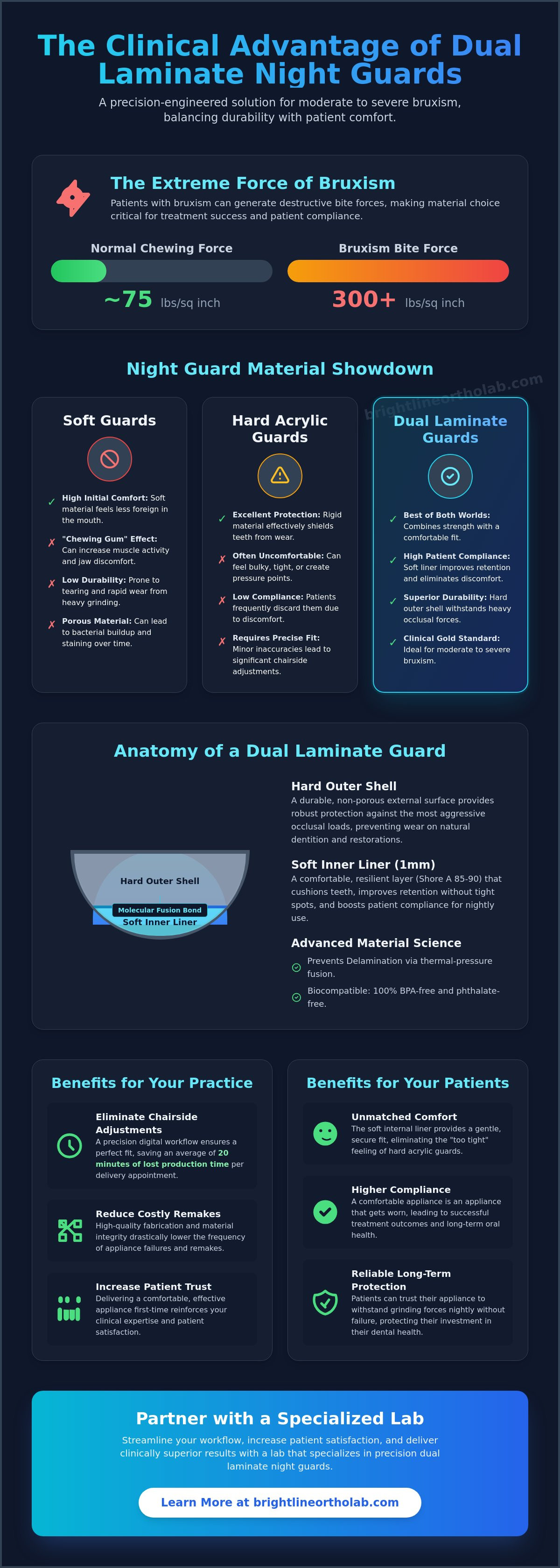
Did you know that a patient struggling with bruxism can generate bite forces of up to 300 lbs per square inch? That is more than four times the pressure of normal chewing. It is exactly why finding the right dual laminate night guard lab is so critical for your clinical outcomes. When you are dealing with those extreme forces, a standard guard often falls short, leading to material failure or a patient who refuses to wear a bulky, uncomfortable appliance.
You likely feel the frustration of losing valuable chairside time to tedious adjustments or managing the logistics of frequent remakes due to poor fit. We understand that your goal is to provide a solution that fits perfectly the first time. This guide will show you why dual laminate guards are the clinical gold standard for moderate to severe bruxism and how a precision-focused partnership can simplify your digital workflow. You will learn how to increase patient compliance and ensure every appliance you deliver offers the perfect balance of durability and comfort.
Key Takeaways
- Learn how selecting the right material directly impacts patient compliance by eliminating the discomfort often associated with rigid acrylic guards.
- Understand the hard-soft hybrid engineering that allows these appliances to withstand heavy occlusal loads without delaminating.
- Identify the clinical sweet spot for prescribing dual laminate guards to moderate bruxers while knowing when a different appliance is necessary.
- Streamline your chairside experience by partnering with a specialized dual laminate night guard lab that utilizes precise digital workflows to reduce remakes.
- Discover how over 18 years of specialized orthodontic expertise ensures that every appliance acts as a reliable extension of your clinical care.
The Clinical Challenge of Bruxism: Why Material Choice Dictates Compliance
Bruxism is more than just a mechanical wear problem; it's a complex clinical challenge that requires a nuanced approach to appliance therapy. When a patient presents with moderate-to-severe grinding, the stakes are high. These individuals don't just wear down their teeth; they can destroy restorations and appliances with incredible force. If the night guard you provide feels like a foreign object in their mouth, they won't wear it. This is the hidden cost of non-compliance. Every abandoned appliance represents a failure in the treatment plan and a potential risk to the patient's long-term oral health. Partnering with a specialized dual laminate night guard lab helps you bridge this gap between durability and patient comfort.
The Failure of Monolithic Materials
Traditional guards often force a compromise that leads to treatment failure. Soft guards are initially comfortable but frequently trigger a "chewing gum" effect. Because they are resilient, some patients find themselves clenching more frequently, which increases muscle activity and jaw discomfort. On the other end of the spectrum, hard acrylic guards offer excellent protection but are notorious for feeling "too tight" or bulky. If the fit isn't absolutely perfect, the patient experiences pressure points that lead to them discarding the guard by midnight. Dual laminate materials solve this paradox. By combining a hard outer shell with a soft internal liner, you provide the strength needed to resist occlusal forces while offering a gentle interface for the teeth. It's the ideal way to satisfy the patient's need for comfort without sacrificing clinical protection.
The Economics of Chairside Adjustments
Think about the last time a night guard didn't seat properly. The minutes spent grinding away at high spots or thinning out borders add up quickly. If you spend 20 minutes adjusting a guard at the delivery appointment, that's 20 minutes of lost production time. High-quality fabrication from a precision lab minimizes these post-delivery modifications. When a guard snaps into place with minimal effort, it reinforces the patient's trust in your clinical expertise. They leave the office feeling supported rather than frustrated. A reliable dual laminate night guard lab acts as an extension of your team, ensuring that the "chairside shuffle" becomes a thing of the past. By prioritizing a precision fit, you protect your schedule and your patient's investment simultaneously.
Understanding Dual Laminate Engineering: The Hard-Soft Hybrid
A dual laminate night guard is a vacuum- or pressure-formed appliance that represents the peak of hybrid engineering. It features a soft, resilient internal liner for comfort and a hard, durable external surface for protection. This specific design makes it a highly effective occlusal splint or orthotic device for patients who need more than a single-material solution. By combining these two distinct layers, you provide a tool that manages the physical forces of bruxism while remaining comfortable enough for nightly use. It's a sophisticated way to address the conflicting needs of durability and patient acceptance.
The science of the bond is where a specialized dual laminate night guard lab proves its value. Delamination is a common complaint with lower-quality appliances where the layers eventually peel apart. To prevent this, a precision-focused dual laminate night guard lab uses a controlled thermal-pressure process that fuses the layers at a molecular level. This ensures the guard stays intact even under the most aggressive occlusal loads. We also prioritize biocompatibility by using only BPA-free and phthalate-free materials. This commitment to safety ensures that your patients can wear their appliances long-term without concern about chemical exposure.
The Soft Internal Liner: Patient Comfort and Retention
The 1mm soft layer serves as the interface between the appliance and the patient's dentition. It cushions the teeth and provides a natural "grip" that significantly improves retention without requiring excessive undercuts. It's essential that this liner is non-porous to prevent the bacterial buildup and staining that often leads to abandoned therapy. Premium soft liners typically feature a Shore A hardness of approximately 85 to 90 to provide the necessary flexibility without sacrificing structural integrity. If you want to see how precision fabrication can improve your patient outcomes, consider exploring the specialized services at Brightline Orthodontic Lab.
The Hard External Shell: Deflecting Occlusal Forces
While the interior provides comfort, the 2mm hard external shell does the heavy lifting. This layer protects the dentition from attrition and is essential for allowing smooth lateral excursion. A hard occlusal surface ensures the jaw can move naturally without getting "stuck" on a soft material, which helps prevent muscle fatigue and joint strain. This layer is also specifically engineered to resist "burn-through" in patients with aggressive grinding patterns. We can also customize the overall thickness to accommodate specific vertical dimension requirements, ensuring the guard fits the patient's unique bite profile perfectly.
Clinical Indications: Dual Laminate vs. Hard vs. Soft Guards
Choosing the right appliance is a clinical decision that directly impacts treatment success. While soft guards are often too flimsy for serious grinders and hard acrylics can be too taxing on patient patience, the dual laminate occupies a vital middle ground. If you are working with a patient who shows moderate wear but complains of tooth sensitivity, this hybrid approach is your best tool. A specialized dual laminate night guard lab helps you tailor the appliance to these specific needs, ensuring a balance between protective strength and long-term compliance.
The Patient Selection Framework
The "sensitive" patient often struggles with the rigidity of a full hard guard. They may experience a feeling of "tightness" that leads to them removing the appliance mid-sleep. For these individuals, the soft internal liner provides the necessary "give" to encourage compliance. Conversely, for the extreme "heavy" bruxer who can generate massive forces, a full hard acrylic appliance remains the gold standard to prevent delamination. If you notice signs of severe attrition or broken restorations, the extra durability of a monolithic hard guard is usually preferred. For patients with specific anterior-only requirements or acute TMJ flare-ups, an NTI appliance might be the better choice to disengage the posterior teeth entirely.
Material Comparison Matrix
When comparing options, consider the balance of durability, comfort, and chairside time. Soft guards are budget-friendly but require frequent replacement. Hard guards are durable but often require extensive adjustments. The dual laminate offers high durability and superior comfort, making it the most cost-effective long-term solution for the majority of your patients. Much like the material logic discussed in our guide on Essix vs Hawley Retainers, the dual laminate provides a snug fit that prevents minor shifting while protecting the occlusal surfaces. This makes it an excellent choice for post-orthodontic patients who need both protection and retention.
Dual laminates also offer surprising benefits for joint stabilization. They provide a stable occlusal surface that allows the jaw to rest in a neutral position without the excessive bulk of traditional splints. This stabilization is key for patients experiencing mild TMJ discomfort associated with clenching. By partnering with a precision-focused dual laminate night guard lab, you ensure that the occlusal plane is perfectly balanced. This reduces the risk of muscle fatigue and helps your patients wake up without the typical jaw tension associated with nocturnal bruxism. It's about providing a solution that works for the patient's lifestyle while meeting your clinical standards.
Achieving Precision: Lab Requirements and Digital Workflows
Precision isn't just a goal; it's the foundation of every successful appliance delivery. The transition from your chairside scan to the dual laminate night guard lab requires a seamless transfer of data to ensure the final product meets your clinical expectations. While the materials themselves are engineered for performance, the accuracy of the fit depends entirely on the quality of the initial impression and the lab's fabrication process. Moving toward a digital workflow is the most effective way to eliminate the variables that lead to uncomfortable appliances and frustrating remakes.
When capturing a bite registration, always provide it in a slightly "open" position. This allows the lab to accurately calibrate the material thickness without guessing the patient's vertical dimension. If you are still using analog methods, pay close attention to capturing the distal of the terminal molars and the full palate. These areas are critical for the retention of the appliance. A dual laminate night guard lab relies on these landmarks to ensure the hard outer shell snaps into place securely without putting undue pressure on the soft tissues.
Digital Submission Best Practices
Optimizing your intraoral scan is the first step toward a perfect fit. Ensure you capture the gingival margins clearly and check for any "voids" in the occlusal data before sending the STL file. Brightline Ortho Lab prefers digital files because they allow us to leverage the accuracy of 3D printed dental models. Unlike traditional stone models, 3D printed versions do not suffer from expansion or breakage during the shipping process. This stability ensures that the pressure-forming process occurs on a perfect replica of the patient's dentition, leading to a guard that requires zero chairside adjustments. If you're ready to streamline your practice, you can send your digital scans to Brightline Orthodontic Lab today.
Troubleshooting Common Fit Issues
The most frequent complaint from patients is that a guard feels "too tight." This is often caused by minor distortions in an analog impression or improper block-out procedures at the lab level. We use advanced pressure-forming techniques rather than simple vacuum-forming to reduce internal stresses and prevent warping during fabrication. This results in a more consistent fit across the entire arch. If you encounter occlusal interference, it is usually a sign that the bite registration wasn't perfectly balanced. A well-engineered hard surface must be meticulously finished to allow for smooth lateral excursion, which prevents the muscle fatigue often associated with poorly balanced guards.
Partnering with a Specialized Dual Laminate Night Guard Lab
Selecting a dual laminate night guard lab is a decision that extends beyond simple manufacturing. It is about finding a partner that understands the nuances of your clinical workflow and the specific needs of your patients. Brightline Orthodontic Lab brings over 18 years of expertise in specialized orthodontic fabrication to every case we handle. We've spent nearly two decades refining our processes to ensure that the appliances you deliver are as reliable as they are precise. By positioning ourselves as an extension of your team, we help you bridge the gap between clinical intent and patient satisfaction.
Our commitment to US-based manufacturing ensures that every appliance is fabricated under strict quality standards. We believe that clear communication is the foundation of a successful partnership. If you have a complex case or a patient with unique anatomical challenges, you have direct access to our technicians. This clinician-to-technician dialogue eliminates the guesswork that often leads to errors in traditional lab environments. We don't just fulfill orders; we support your treatment plans with a deep understanding of material science and occlusal dynamics.
A Collaborative Extension of Your Team
We focus on helping you reduce the hidden costs of remakes and lengthy chairside adjustments. Every appliance undergoes a meticulous quality control process where we verify margins, occlusal balance, and the integrity of the thermal bond between the hard and soft layers. This attention to detail is why we are known for providing precision-engineered solutions for dental professionals across the country. When you know the appliance will fit perfectly upon delivery, you can schedule with confidence and focus on providing excellent patient care rather than troubleshooting fit issues.
Getting Started with Your First Case
Streamlining your practice workflow is our priority. We've designed an easy case submission process that accommodates both modern digital offices and traditional analog practices. If you've transitioned to a digital workflow, simply upload your STL files from your intraoral scanner directly to our portal. For analog cases, we provide reliable shipping logistics to ensure your impressions arrive safely at our facility. We maintain predictable turnaround times so you can give your patients accurate delivery dates without the stress of unexpected delays.
To begin, simply set up your account and submit your first scan or impression. We handle the technical complexities, from 3D printing your models to the final pressure-forming of the laminate material. Experience the difference that nearly two decades of specialized expertise can make for your practice. Partner with Brightline Ortho Lab today and discover how a precision-focused laboratory can simplify your bruxism therapy.
Elevating Your Clinical Standards with Precision Fabrication
Providing effective bruxism therapy doesn't have to be a logistical burden for your practice. By choosing a hybrid approach, you offer patients the durability they need and the comfort they'll actually wear. We've explored how understanding material science and embracing digital workflows can virtually eliminate the "too tight" complaints and tedious chairside adjustments that disrupt your schedule. These small clinical shifts lead to higher patient satisfaction and a more efficient office environment.
Partnering with a specialized dual laminate night guard lab ensures that every appliance is a perfect reflection of your clinical expertise. At Brightline Orthodontic Lab, we combine over 18 years of industry experience with precision pressure-forming technology to support clinicians nationwide. As a US-based laboratory, we're dedicated to being the reliable ally your team needs to deliver high-quality results every time. Our meticulous focus on craftsmanship ensures your patients receive the protection they deserve without the frustration of material failure or delamination.
Start Your First Case with Brightline Ortho Lab and see how a dedicated partnership can transform your appliance delivery process. We look forward to helping you simplify your workflow and enhance your patient outcomes.
Frequently Asked Questions
How long does a dual laminate night guard typically last?
A dual laminate night guard typically lasts between 1 and 3 years depending on the severity of the patient's bruxism. While the hard outer shell resists attrition effectively, the soft inner liner eventually loses its resiliency or may begin to show staining over time. Regular clinical evaluations during hygiene appointments help you determine when the material integrity has been compromised and requires replacement.
Can a dual laminate night guard be used for patients with TMJ disorders?
Dual laminate guards are excellent for joint stabilization in patients with mild to moderate TMJ discomfort. They provide a stable occlusal surface that allows the jaw to rest in a neutral position while the soft liner cushions the dentition. If a patient requires significant vertical repositioning or has acute joint pathology, a full hard acrylic appliance or a specialized sleep appliance might be more appropriate.
What is the best way for patients to clean a dual laminate guard?
Patients should clean their guard daily using cool water and a mild, non-abrasive soap or a designated appliance cleaner. Advise them to avoid hot water, as high temperatures can warp the laminate layers and compromise the fit. Using a soft-bristled toothbrush helps remove biofilm without scratching the hard external surface, which prevents the buildup of bacteria and unsightly staining over the life of the guard.
How do I know if my patient needs a 2mm or 3mm thickness?
Selecting the correct thickness depends on the patient's vertical dimension requirements and the intensity of their grinding. A 2mm guard is the standard choice for most moderate bruxers because it provides protection without excessive bulk. If your patient is an aggressive grinder or has a significant posterior open bite that needs filling, a 3mm thickness offers the additional material volume needed to prevent premature burn-through.
Does a dual laminate night guard protect against clenching as well as grinding?
Dual laminate appliances are specifically engineered to protect against both clenching and grinding forces. The soft internal liner acts as a shock absorber for clenchers, reducing the pressure on the periodontal ligaments and jaw muscles. Simultaneously, the hard outer shell provides the necessary durability to resist the lateral abrasive forces generated by active grinders, making it a versatile solution for multi-symptomatic patients.
What should I do if the guard feels too tight upon delivery?
If a guard feels slightly too tight, a brief 30-second soak in warm water can often soften the internal liner enough to help it seat comfortably. This minor adjustment usually resolves initial pressure points without compromising the long-term fit. If the tightness persists or causes significant pain, it typically indicates a distortion in the original impression or a need to contact your dual laminate night guard lab for a technical review.
Can you fabricate a dual laminate guard from an STL scan?
We can absolutely fabricate high-precision appliances directly from your STL scans. In fact, our dual laminate night guard lab prefers digital files because they eliminate the expansion and distortion risks associated with traditional stone models. This digital workflow allows us to utilize 3D printing technology for the foundation of the guard, ensuring a more accurate fit and reducing the need for chairside adjustments upon delivery.
Are dual laminate guards safe for patients with acrylic allergies?
Most dual laminate materials are safe for patients with minor acrylic sensitivities because they are often composed of PETG and TPU rather than traditional monomer-based resins. We use BPA-free and phthalate-free materials to ensure maximum biocompatibility for long-term wear. However, if a patient has a documented severe allergy to specific thermoplastic components, you should contact us to review the material safety data sheet before proceeding with fabrication.