
Approximately 1 in 10 adults in the United States grind their teeth, yet many of them struggle to find an appliance they can actually wear through the night. You've likely seen the same cycle: soft guards that heavy bruxers chew through in months or hard acrylic guards that patients find too uncomfortable to use. It's a frustrating trade-off that often leads to frequent remakes and lost chairside time. If you want to break this cycle, the secret lies in the precision of fabricating a hard soft night guard that offers the best of both worlds.
We believe that high-quality restorative care shouldn't be undermined by a poorly fitting appliance. This clinical guide is designed to help you master the technical nuances of dual laminate guards, focusing on the meticulous pressure-thermoforming process that prevents delamination and ensures long-term success. You'll learn how to improve patient compliance through superior comfort while significantly increasing the longevity of the appliance. We'll walk you through the essential manufacturing steps to help you deliver a more reliable, durable solution to your patients every time.
Key Takeaways
- Discover how dual laminate designs solve the compliance paradox by combining internal patient comfort with external occlusal durability.
- Learn the technical nuances of fabricating a hard soft night guard, including critical model preparation steps like blocking out undercuts to ensure a seamless fit.
- Understand the equipment gap between standard office vacuum formers and professional pressure-thermoforming to help you reduce chairside adjustment time.
- Identify common impression errors and learn why transitioning to digital STL files is the most efficient way to achieve high-precision retention.
- Gain insights into selecting biocompatible, high-grade materials that support long-term appliance integrity and protect patient health.
The Clinical Rationale for Hard-Soft Night Guards
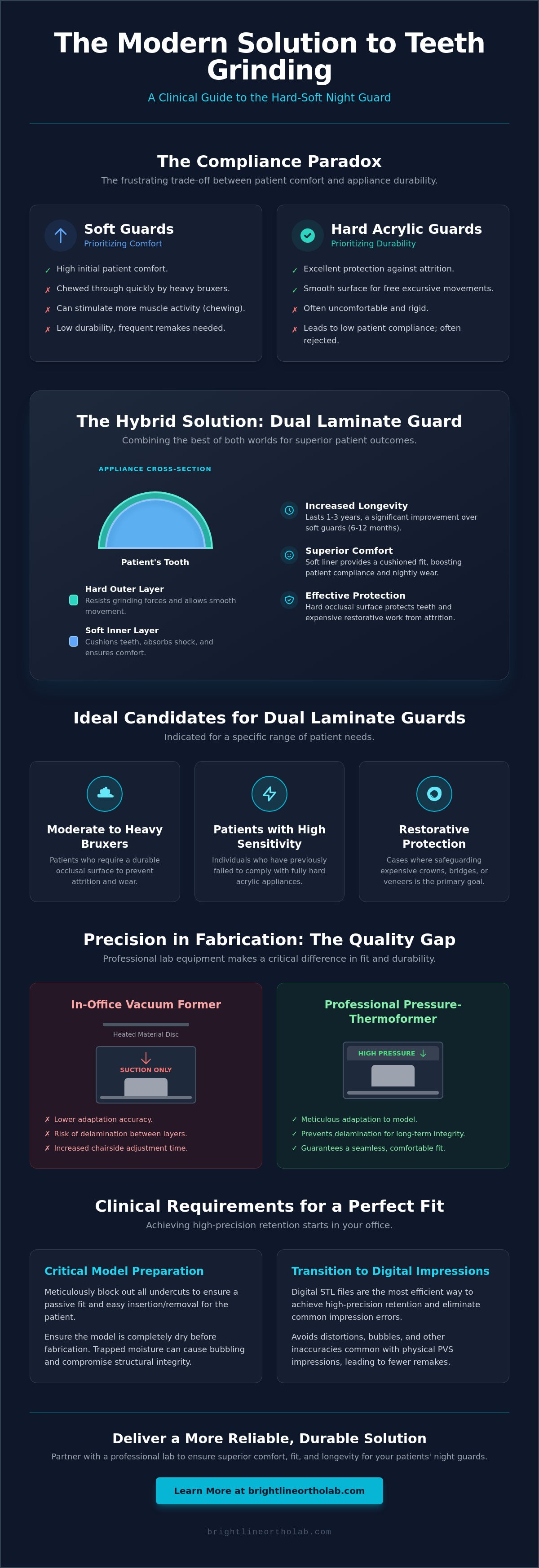
Clinicians frequently face a difficult choice when prescribing bruxism therapy: do you prioritize the patient's comfort or the appliance's durability? This tension creates what we call the "compliance paradox." A hard acrylic guard offers excellent protection for the teeth, but its rigid nature often leads to patient rejection. If the appliance isn't worn, it can't protect the dentition. The hard-soft guard, or dual laminate, serves as the modern hybrid solution to this clinical challenge. These occlusal splints provide a layered approach to treatment that addresses both mechanical wear and sensory tolerance.
By choosing this design, you're offering a sophisticated tool that manages the high-force environment of nocturnal bruxism. With approximately 1 in 10 adults in the United States suffering from this condition, the demand for effective, tolerable intervention is high. The hard outer shell resists the shearing forces of grinding, while the soft internal liner accommodates the unique contours of the patient's teeth. When you focus on fabricating a hard soft night guard for your patients, you're providing a reliable extension of your clinical care that works even when they are asleep.
Balancing Patient Comfort and Occlusal Protection
The internal soft layer does more than just feel good; it acts as a critical shock absorber. During intense clenching, this layer cushions the teeth and helps distribute vertical loads more evenly across the arch. This prevents localized pressure points that often lead to morning soreness. Contrast this with the hard outer layer, which is engineered for smooth excursive movements. A hard surface allows the opposing arch to slide freely, which is vital for preventing the destructive lateral forces that cause tooth fractures and muscle fatigue. Technically, a dual laminate is a fusion of two distinct thermoplastic materials that are bonded under high pressure to ensure they never delaminate during use.
Indications for Dual Laminate over Single-Material Guards
Selecting the right material depends heavily on the patient's bruxism severity. Purely soft guards are often tempting for their ease of fit, but they can be counterproductive for heavy grinders. Research suggests that the resilient nature of soft materials can actually stimulate increased masseter muscle activity, essentially giving the patient something to "chew" on. Conversely, purely hard guards can be difficult for patients with undercut-heavy dentition or sensitive teeth to tolerate. Mastering the nuances of fabricating a hard soft night guard allows you to address the specific biomechanical needs of heavy grinders while maintaining high levels of comfort.
The dual laminate guard is indicated for:
- Moderate to heavy bruxers who require a durable occlusal surface to prevent attrition.
- Patients with high sensitivity who have previously failed to comply with hard acrylic appliances.
- Restorative protection in cases where safeguarding expensive crowns or veneers is the primary goal.
The durability of these appliances also supports long-term success. While a soft guard may only last 6 to 12 months, a dual laminate appliance typically provides 1 to 3 years of service. This hybrid approach simplifies the transition into long-term wear, ensuring your clinical efforts aren't wasted on an appliance that ends up in a bedside drawer.
The Technical Process: Fabricating a Hard Soft Night Guard
Precision starts at the workbench. The technical process of fabricating a hard soft night guard requires more than just a heating element and a vacuum. If you want to avoid common pitfalls like delamination or poor fit, you must start with premium dual laminate thermoplastic discs. These materials are engineered to provide a soft, forgiving internal surface while maintaining a rigid occlusal exterior. Following a Diagnosis-First Approach to Occlusal Splints ensures that the physical model matches the clinical reality before the first disc is ever heated.
Model preparation is a critical, yet often overlooked, step in the workflow. You must meticulously block out undercuts and ensure all surfaces are completely dry. Moisture trapped between the model and the material can lead to unsightly bubbling or even compromise the structural integrity of the guard. While many offices rely on standard vacuum formers, professional dental laboratories utilize high-pressure thermoforming machines. This equipment applies several bars of pressure to force the material into every groove of the dentition. This results in a much higher density and a far more accurate fit than vacuum suction alone can provide.
Once the forming process is complete, the cooling cycle becomes the priority. It is tempting to speed this up, but rushing the process can introduce internal stresses into the material. If the guard cools too quickly, it may warp or lose its dimensional stability. We allow the appliance to reach room temperature naturally while still on the model. This patience ensures the guard retains its shape and provides the predictable retention your patients expect. If you are looking for a partner who understands these meticulous steps, our team is ready to support your practice with consistently high-quality appliances.
Material Selection: Heat-Cured vs. Vacuum-Formed Laminates
The strength of a dual laminate guard comes from the chemical bond created between the hard and soft layers. High-quality discs are manufactured to fuse these layers during the heating process, creating a single, inseparable unit. We prioritize biocompatibility and strictly use BPA-free materials to ensure patient safety. Temperature precision is vital during this stage. If the material is underheated, the bond will be weak; if it is overheated, the soft layer may "bubble" and lose its cushioning properties.
Precision Trimming and Border Finishing
An appliance is only as good as its finish. The ideal extension of a night guard should provide maximum retention without impinging on the soft tissue or muscle attachments. We carefully trim the borders to follow the gingival contours, followed by a multi-stage polishing process. This ensures smooth, glass-like edges that won't irritate the patient's cheeks or tongue. For more detailed insights on maximizing patient adoption, see The Clinician’s Guide to Dual Laminate Night Guards. Taking the time to refine these borders significantly reduces the need for chairside adjustments during the delivery appointment.
In-Office vs. Professional Lab Fabrication
While the convenience of a 15-minute chairside turnaround is appealing, the technical reality of fabricating a hard soft night guard in-office often reveals significant quality gaps. Standard office vacuum formers rely solely on atmospheric suction to pull material over a model. This process frequently results in uneven material distribution, leading to thin spots on the occlusal surface where protection is needed most. Professional laboratories utilize high-pressure thermoforming equipment that applies several bars of positive pressure. This force ensures the material adapts perfectly to every anatomical detail, creating a denser, more durable appliance that can withstand the heavy forces of bruxism.
If you have ever dealt with a patient returning for a remake within weeks, you know the true cost of fast fabrication isn't just the material; it is your lost chair time. DIY guards often lack the necessary occlusal equilibration, leading to patient discomfort and appliance rejection. Lab technicians bring specialized expertise in managing complex occlusal schemes. They ensure that every guard provides a balanced bite from the moment it is delivered, which significantly reduces the need for tedious chairside adjustments. For a deeper look at the technical evolution of these appliances, a Comprehensive Review of Dental Splint Fabrication highlights how traditional pressure methods still offer superior material density compared to basic vacuum techniques.
The Limitations of Chairside Vacuum Forming
Vacuum forming naturally causes the thermoplastic disc to stretch and thin as it is pulled over the model. This often leaves the occlusal surface thinner than intended, compromising the 1 to 3-year lifespan typically expected of a dual laminate guard. There is also a high risk of poor adaptation to the lingual and palatal surfaces, which are critical for retention. Without the high-pressure bond achieved in a lab setting, these in-office appliances are far more susceptible to delamination, where the soft liner begins to peel away from the hard shell after only a few months of use.
Why Precision Engineering Matters for Heavy Bruxers
Heavy grinders require more than just a physical barrier; they need an appliance that maintains their vertical dimension and prevents tooth migration. A lab-fabricated guard is engineered with accurate occlusal stops that distribute forces evenly across the arch. If the appliance is not precisely calibrated, the patient may experience unwanted tooth movement or increased muscle strain. By choosing professional fabrication, you are implementing a risk-mitigation strategy for your practice. You receive an appliance that fits right the first time, ensuring your patients remain comfortable and your schedule stays on track.
Clinical Requirements for a Perfect Fit
Precision in the laboratory is entirely dependent on the quality of the data captured in the chair. You can have the most advanced pressure-thermoforming equipment in the world, but if the initial impression is flawed, the final appliance will fail. When you are fabricating a hard soft night guard, even a microscopic distortion can lead to the "rocking" effect that frustrates patients and consumes your chairside time. Achieving a seamless fit requires a meticulous approach to both the dentition and the relationship between the arches.
The transition toward digital workflows has significantly reduced these variables. Digital STL files are now the gold standard because they eliminate the dimensional instability inherent in traditional stone models and alginate impressions. If you are looking to refine your digital process, The Clinician’s Guide to 3D Printed Dental Models offers practical tips for integrating these files into your restorative workflow. We recommend that you submit your next digital case to Brightline to experience the difference that precision digital modeling makes in appliance retention.
Digital STL Files vs. Physical Impressions
Intraoral scanning offers several advantages over traditional methods. There is no risk of tray selection errors, and you receive instant feedback if a scan is incomplete. If you prefer physical impressions, follow this strict checklist to ensure success:
- Capture the terminal molars: Always record the distal surface of the last tooth in the arch to prevent the guard from "flipping" at the posterior.
- Inspect for voids: Even small bubbles on the occlusal surface can prevent the soft liner from seating correctly.
- Ensure model accuracy: If pouring in-office, use a high-quality stone and wait for the full set time to prevent expansion errors.
Modern 3D printing technology allows us to bridge the gap between digital data and traditional craftsmanship. We use your STL files to print high-density models that serve as the foundation for our pressure-thermoforming process.
Capturing Accurate Occlusal Records
The opposing arch is not just a reference; it is the blueprint for the entire occlusal scheme. For heavy bruxers, a "mush bite" is rarely sufficient. We often recommend a centric relation bite registration to ensure the jaw is in its most stable position. Our technicians use these records to set the vertical opening, ensuring the guard is thick enough for durability but thin enough for comfort. It is also vital to capture the canine and incisal guidance. This data allows us to calibrate the hard outer layer so it facilitates smooth excursive movements, which protects the patient’s musculature and the appliance itself from excessive wear.
Partnering with Brightline for Custom Night Guards
Brightline Orthodontic Lab operates as an extension of your clinical team. We understand that your reputation rests on the fit and function of every appliance you deliver. For 18 years, we've focused on meticulousness and dependability to help clinicians navigate the complexities of bruxism and sleep therapy. When you choose us for fabricating a hard soft night guard, you're partnering with a team that values precision as much as you do. We don't just process cases; we support your practice by ensuring every guard is a long-term success.
Our commitment to quality begins with the materials we select. We use only high-grade, biocompatible dual laminate materials that meet strict safety standards. These materials are BPA-free and designed to resist the staining and odors often associated with long-term wear. Whether you're managing a straightforward bruxism case or a complex patient requiring sleep appliances like our Dorsal or EMA options, our clinical support team is available to help you select the best design for your patient's needs.
Our Meticulous Fabrication Standards
Every night guard that leaves our lab undergoes a multi-stage quality check. We don't settle for "good enough" fits. By utilizing high-pressure thermoforming instead of standard vacuum methods, we achieve maximum material density and a precise adaptation to your patient's unique anatomy. This process significantly reduces the risk of delamination and ensures that the hard occlusal surface provides the durability heavy grinders require. Our technicians bring nearly two decades of experience to every case, ensuring that occlusal stops and excursive pathways are calibrated with expert accuracy.
Streamlining Your Practice Workflow
We believe that working with a dental lab should simplify your day, not add to your administrative burden. Our easy digital submission portal allows you to upload STL files in seconds, eliminating the logistical stress of shipping physical impressions. This modern adaptability ensures that we can begin fabricating a hard soft night guard almost immediately after your patient leaves the chair.
Reliability is the cornerstone of our service. We maintain consistent turnaround times so your patient appointments stay on track and your schedule remains predictable. If you're ready to experience a higher standard of laboratory partnership, partner with Brightline for your next custom night guard. We're here to accommodate your needs and help you deliver appliances that your patients will actually wear.
Elevate Your Practice with Precision-Engineered Protection
Mastering the technical nuances of dual laminate guards allows you to stop the cycle of appliance remakes and patient discomfort. By prioritizing high-pressure thermoforming and embracing digital STL workflows, you ensure that every appliance offers the perfect balance of internal cushion and external durability. This meticulous approach to fabricating a hard soft night guard doesn't just protect your patients' dentition; it protects your chairside time and strengthens your clinical reputation.
At Brightline Orthodontic Lab, we act as a reliable ally to your practice. With over 18 years of technical expertise, our US-based laboratory specializes in creating appliances that are precision-engineered for even the heaviest bruxers. We focus on a true clinician partnership, providing the clinical support and modern adaptability you need to simplify your workflow. We're here to accommodate your specific needs and ensure your patients receive the highest standard of care.
Order Your Custom Hard-Soft Night Guards from Brightline Orthodontic Lab
We look forward to supporting your next case and helping you deliver the high-quality results your patients deserve.
Frequently Asked Questions
How long does it take to fabricate a hard-soft night guard in a professional lab?
Professional laboratories typically require 5 to 10 business days for fabrication. This timeline allows our technicians to perform the meticulous model preparation and high-pressure forming steps required for a superior fit. While in-office methods are faster, the professional cooling cycle ensures the appliance remains dimensionally stable. This patience prevents the warping that often occurs when rushing the manufacturing process.
Can I send digital STL files for hard-soft night guard fabrication?
Yes, we strongly encourage the use of digital STL files for all cases. This modern workflow simplifies the submission process and eliminates the inaccuracies associated with traditional alginate impressions. Once we receive your files, we use them to create high-precision 3D printed models. This digital approach is the most efficient way to begin fabricating a hard soft night guard while ensuring maximum retention for your patient.
What is the best way to clean a dual laminate night guard to prevent delamination?
Patients should clean their appliances daily using a soft-bristle brush and mild, non-abrasive soap with cool water. It's vital to avoid alcohol-based mouthwashes or boiling water. These harsh environments can degrade the thermoplastic material and weaken the chemical bond between the layers. Proper maintenance is the simplest way to prevent premature delamination and keep the soft internal liner comfortable for long-term use.
How long do hard-soft night guards typically last for heavy grinders?
A dual laminate guard typically lasts between 1 and 3 years for moderate to heavy bruxers. While soft EVA guards may fail in less than a year, the hard occlusal surface of a dual laminate provides much better resistance to attrition. The actual lifespan depends on the patient's grinding intensity and how well they maintain the appliance. Regular clinical check-ups help ensure the guard continues to provide adequate protection.
What is the difference between a vacuum-formed and pressure-thermoformed guard?
Pressure-thermoforming applies several bars of positive air pressure to force the material onto the model, whereas vacuum forming relies on simple suction. This increased pressure results in a much higher material density and a more accurate adaptation to the patient's dentition. Vacuum-formed guards often suffer from uneven thinning on the occlusal surface. Professional pressure machines ensure the guard maintains its intended thickness in critical wear areas.
Are hard-soft night guards BPA and monomer-free?
Yes, our dual laminate materials are high-grade, biocompatible, and BPA-free. We prioritize patient safety by using materials that meet strict FDA requirements for Class II medical devices. These thermoplastics are engineered for long-term oral use without the risk of leaching harmful monomers. This commitment to quality materials helps you reassure sensitive patients that their appliance is both safe and effective for nightly wear.
What happens if the hard-soft guard starts to peel or delaminate?
If an appliance begins to peel, it has reached the end of its clinical life and needs replacement. Delamination creates small gaps where bacteria and plaque can accumulate, leading to hygiene issues and potential tissue irritation. This failure is often the result of using low-pressure fabrication methods or exposure to harsh cleaning chemicals. Replacing the guard promptly ensures the patient remains protected without compromising their oral health.
Do I need to take an impression of both arches for a single night guard?
You must provide impressions or scans of both arches along with an accurate bite registration. Even if you are only ordering a single guard, our technicians need the opposing arch to calibrate the occlusal scheme. This data allows us to set the correct vertical opening and ensure smooth excursive movements. Providing a complete record is the best way to reduce your chairside adjustment time during the delivery appointment.