
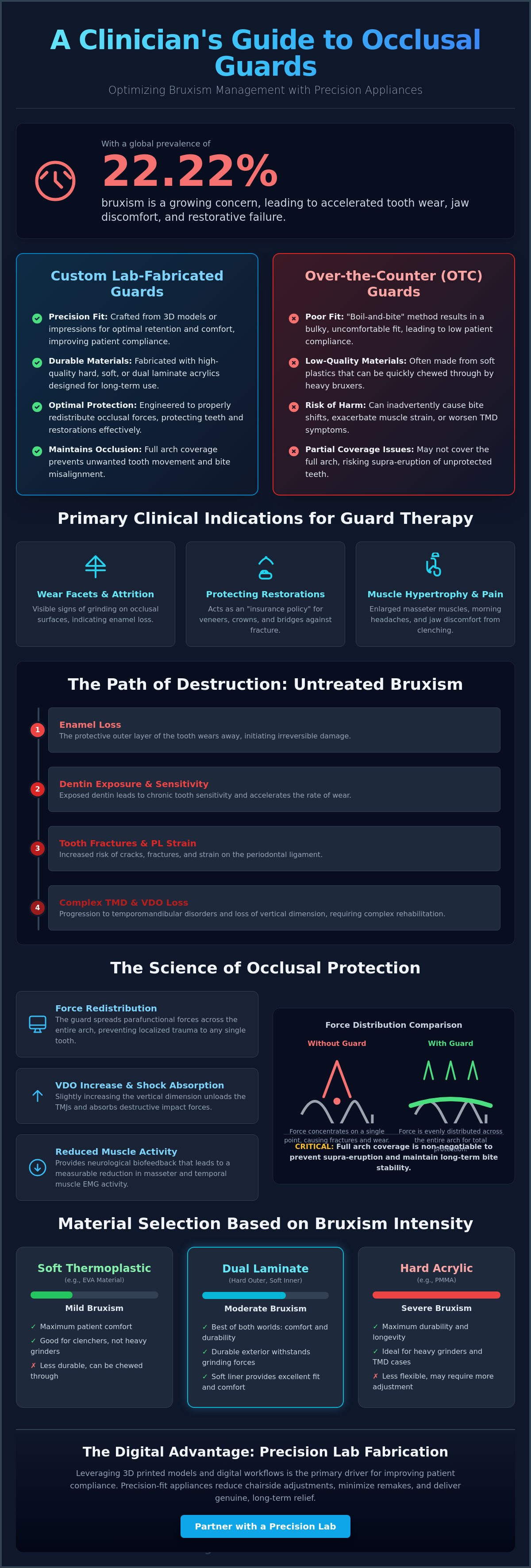
With the global prevalence of bruxism now reaching 22.22%, you're likely seeing a steady increase in patients presenting with accelerated tooth wear and jaw discomfort. You know that a successful treatment plan depends on more than just a clinical diagnosis; it requires a solution the patient will actually use. It's often frustrating when a custom occlusal guard requires multiple chairside adjustments or when a patient chooses a low-quality, over-the-counter guard that fails to provide the necessary protection.
We want to help you simplify these clinical decisions and eliminate the confusion surrounding thermoplastic options. This guide explores the essentials of appliance selection, from material science to patient-specific indications, to help you achieve better practice outcomes. You'll find clear criteria for choosing between hard, soft, and dual laminate materials. We'll also discuss how a more collaborative partnership with your lab can reduce remakes and improve patient compliance through precision-fit appliances that offer genuine, long-term relief.
Key Takeaways
- Identify specific clinical criteria for selecting hard, soft, or dual laminate materials based on the intensity of your patient’s bruxism habit.
- Understand the biomechanics of how a custom occlusal guard redistributes parafunctional forces to protect against attrition and restorative failure.
- Distinguish between standard protective appliances and therapeutic splints to ensure the correct diagnostic approach for patients with acute TMD symptoms.
- Discover why precision lab fabrication and the shift toward digital workflows are the primary drivers for improving long-term patient compliance.
- Learn how leveraging 3D printed models can streamline your appliance workflow and enhance the accuracy of every fit.
Understanding the Occlusal Guard in Modern Dental Practice
An occlusal guard is a removable dental appliance meticulously designed to protect the chewing surfaces of the teeth from the destructive forces of bruxism and clenching. While patients often use the colloquial term "night guard," the clinical reality is much broader. These appliances act as a sacrificial barrier, absorbing the mechanical stress that would otherwise cause irreversible damage to the natural dentition and expensive restorations. In a modern practice, the guard is a fundamental tool for maintaining long term oral health and protecting the integrity of your clinical work.
The difference between a custom fabricated appliance and an over the counter (OTC) alternative is significant. OTC guards are often bulky, poorly fitted, and can inadvertently cause shifts in the patient's bite or exacerbate muscle strain. A professional occlusal guard, however, is built for precision. By utilizing 3D printed dental models and high quality materials, we can ensure the appliance provides an accurate fit that supports patient compliance and clinical success.
Primary Clinical Indications for Guard Therapy
Identifying the need for therapy starts with a thorough clinical exam. You'll often look for telltale signs like wear facets on occlusal surfaces or masseter muscle hypertrophy. Occlusal splints and guards are also essential when you've placed high value restorations. If a patient has invested in veneers, multi unit bridges, or crowns, a guard serves as an insurance policy against restorative failure. It also helps mitigate the daily symptoms of clenching, such as morning headaches and chronic tooth sensitivity, by providing a stable surface for the arches to meet.
The Consequences of Untreated Bruxism
Leaving bruxism unmanaged leads to a predictable path of destruction. It starts with enamel loss, which eventually exposes the sensitive dentin underneath. This exposure doesn't just cause pain; it accelerates the rate of wear. As the condition progresses, you'll see an increased risk of tooth fractures and significant periodontal ligament strain. Without intervention, simple grinding can evolve into complex temporomandibular disorders (TMD). We recommend early intervention with a custom guard to stop this progression and preserve the patient's vertical dimension of occlusion before complex full mouth rehabilitation becomes the only option.
The Biomechanics of Occlusal Protection
An effective occlusal guard does more than just sit between the arches; it actively manages the physical stress of parafunctional habits by altering how forces interact with the dentition. Instead of allowing the full force of a clench to focus on a single tooth or restoration, the appliance spreads that energy across the entire arch. This redistribution is vital for preventing the localized trauma that leads to fractures or periodontal ligament strain. By ensuring that no single point bears the brunt of the pressure, you protect the patient's long term oral health and the stability of your clinical work.
The thickness of the appliance directly influences the vertical dimension of occlusion (VDO). By carefully increasing this dimension, the guard acts as a shock absorber for the entire masticatory system. This slight opening of the bite can help unload the temporomandibular joints and protect the underlying alveolar bone from the repetitive pounding of nocturnal grinding. Understanding The Value of Lab-Fabricated Precision is critical here, as an appliance with uneven thickness can actually introduce new occlusal interferences that worsen the patient's condition.
Force Distribution and Arch Integrity
Full arch coverage is a non-negotiable requirement for maintaining long term stability and preventing unwanted tooth movement. If an appliance only covers a portion of the arch, you risk the supra-eruption of the unprotected teeth, which eventually creates significant bite misalignments. A flat occlusal plane is another essential design feature because it allows for free mandibular movement during sleep. This prevents the locking effect that can exacerbate joint pain. Occlusal force redistribution is the strategic spreading of parafunctional pressure across the entire dental arch to prevent localized trauma and tooth fracture.
Impact on Muscular Activity
Guards often lead to a measurable reduction in the electromyographic (EMG) activity of the masseter and temporal muscles. This reduction isn't just about physical protection. It involves a fascinating neurological feedback loop. The biofeedback theory suggests that the presence of a foreign object like a guard can discourage the brain from initiating a high intensity clench. Clinically, many patients report significant muscle relaxation and a decrease in chronic morning pain shortly after beginning therapy. If you're looking to provide this level of relief, our Hard/Soft Night Guards are designed to balance durability with patient comfort.
Occlusal Splints vs. Guards: Navigating Terminology
Terminology in the operatory often blurs the line between different clinical objectives. While you might use "night guard" for simplicity during a patient consultation, your lab prescription requires a more nuanced distinction. A protective occlusal guard serves as a passive barrier. Its primary goal is to prevent attrition and protect restorations from parafunctional forces. In contrast, a therapeutic splint is an active appliance designed for orthopedic stability or mandibular repositioning. Understanding this diagnostic shift is vital for managing patient expectations and achieving the desired clinical outcome.
A standard guard is often insufficient for patients presenting with acute TMD symptoms or limited range of motion. While the materials used in fabrication may be similar, the functional design differs significantly. A protective appliance focuses on arch integrity and surface protection, whereas a splint incorporates specific occlusal schemes to manage joint and muscle pathology. Clear communication with your lab ensures the appliance design matches your diagnostic intent, whether you're prescribing a simple protective device or a complex therapeutic tool.
When to Prescribe a Protective Guard
You'll typically prescribe a protective appliance for asymptomatic patients who show visible wear facets or "potholing" on occlusal surfaces. These cases are often prophylactic. If you've just completed a case involving extensive crown and bridge work or finished an orthodontic treatment plan, a guard serves as a vital insurance policy. Most clinicians prefer a maxillary appliance for bruxism because it offers superior retention and covers more surface area. However, a mandibular guard can be a great alternative for patients who have a strong gag reflex or find maxillary appliances too intrusive for regular use.
Indications for Therapeutic Splints
Therapeutic splints are necessary when the clinical goal shifts from protection to pain management or joint stabilization. If a patient experiences disc displacement, joint clicking, or chronic myofascial pain, a standard guard might not provide enough relief. Appliances like the Michigan Splint utilize a specific cusp to flat plane relationship to encourage muscle relaxation. These cases require more precision and frequent clinical adjustments. We support these complex cases by providing highly accurate 3D printed dental models that ensure the initial fit is as close to the patient's actual anatomy as possible, reducing the time you spend on chairside titration.
Material Science: Hard, Soft, and Dual Laminate Fabrication
Selecting the right material for an occlusal guard isn't just about durability; it's about matching the appliance's physical properties to the patient's specific parafunctional habits. Hard acrylic appliances remain the gold standard for long term management. They offer superior longevity and allow you to refine the occlusion with a high degree of accuracy. Because hard acrylic can be added to or ground down easily, it's the most versatile choice for patients who require ongoing titration to maintain a stable bite. This material withstands the intense pressure of heavy grinding without losing its shape or compromising the patient's vertical dimension over time.
Soft appliances, typically made from flexible thermoplastic materials, offer a different set of benefits. They're often easier for patients to adapt to, especially if they have sensitive gingiva or mobile teeth. However, soft materials have a higher tendency to absorb odors and stains. They also lack the rigid support needed to prevent the teeth from shifting under heavy load. In many cases, a soft guard is a temporary solution rather than a permanent treatment for chronic bruxism, as the material can actually encourage some patients to chew or clench more frequently due to its "squishy" texture.
The Advantages of Dual Laminate Design
For many practitioners, dual laminate night guard lab services provide the ideal middle ground. These appliances feature a soft, heat-sensitive internal liner that simplifies the seating process and enhances patient comfort. This soft layer is chemically bonded to a hard, durable external surface. This combination ensures the appliance maintains precise occlusal contacts while remaining comfortable enough for nightly use. It's an excellent solution for heavy grinders who need the resistance of a hard guard but struggle with the rigidity of traditional acrylic. The dual laminate approach effectively bridges the gap between patient compliance and clinical durability.
Clinical Selection Criteria
Your choice depends largely on the clinical goals and the patient's history. Hard guards are the best choice when you anticipate the need for frequent occlusal adjustments or when managing complex bite relationships. Soft guards are often relegated to pediatric patients or short term relief for acute symptoms. When you're fabricating a hard soft night guard, the quality of the bond between layers is the primary factor in its lifespan. Poorly bonded appliances can delaminate, leading to early failure and patient frustration. If you're ready to upgrade your appliance offerings, consider our professional Hard/Soft Night Guards to see the difference that meticulous lab work makes in your practice.
The Value of Lab-Fabricated Precision
Precision fit isn't just a clinical preference; it's the primary driver of patient compliance. If an occlusal guard feels bulky or creates uncomfortable pressure points, your patient simply won't wear it. This leads to unresolved symptoms and the logistical stress of appliance remakes. Meticulous lab craftsmanship ensures that every appliance seats perfectly on the first try, which significantly reduces the time you spend on chairside adjustments. By viewing your orthodontic lab as a clinical partner, you gain access to a specialized extension of your team that simplifies complex case planning and improves the predictability of your restorative outcomes.
Modern workflows have evolved beyond traditional stone casts. The transition to 3d printed dental models allows for a level of accuracy that analog methods struggle to match. Digital models don't chip, wear down, or break during the fabrication process. This means the appliance you receive is a true reflection of the patient's intraoral environment. This precision is especially critical when dealing with the high strength materials required for heavy bruxers, as even a minor discrepancy can lead to occlusal instability.
Digital Workflow and Accuracy
Sending STL files directly to the lab eliminates the dimensional instability inherent in traditional impression materials. 3D printing ensures consistency across multiple orders, providing a reliable fit every time. This digital approach also streamlines the administrative side of your practice. Stored digital records allow for the rapid replacement of a lost or damaged guard without the need for a new impression appointment. This efficiency saves your staff time and provides a better experience for the patient who needs their protection restored quickly.
Partnering with a Specialized Lab
There's a significant difference between a general dental lab and a specialized orthodontic laboratory. A specialized lab focuses on the nuances of tooth position and arch integrity, ensuring that every appliance is fabricated using the highest grade, biocompatible thermoplastics. We understand that your reputation depends on the quality of the tools you provide to your patients. We're here to support your practice with appliances that fit right the first time. Ready to elevate your appliances? Partner with Brightline Orthodontic Lab and discover how a collaborative lab relationship can transform your clinical results.
Advancing Your Practice Outcomes Through Precision
Effective bruxism management relies on the perfect intersection of clinical diagnosis and appliance craftsmanship. We've explored how material science and biomechanics dictate the success of therapy, from selecting the right occlusal guard for heavy grinders to understanding the diagnostic shift required for therapeutic splints. By integrating digital workflows and prioritizing a precision fit, you can significantly reduce chairside adjustment time and improve long term patient compliance.
At Brightline Orthodontic Lab, we bring over 18 years of specialized expertise to every appliance we create. Our products are precision engineered in the USA and are fully compatible with all major intraoral scanners to ensure your digital transition is seamless. We're committed to being a reliable ally that simplifies your workflow and supports your clinical goals with meticulous attention to detail. View our full catalog of custom occlusal guards and night guards to find the ideal solution for your next patient. We look forward to supporting your practice with the reliability and expert craftsmanship you and your patients deserve.
Frequently Asked Questions
What is the primary difference between an occlusal guard and a night guard?
An occlusal guard is the clinical term for any removable appliance designed to protect teeth from parafunctional forces, while "night guard" is a colloquial term patients use. While the terms are often used interchangeably in the office, the clinical definition encompasses both daytime and nighttime protection. Using the professional term helps clarify that the appliance's goal is to manage the biomechanical forces of bruxism rather than just serving as a sleep aid.
How long does a custom lab-fabricated occlusal guard typically last?
A custom lab-fabricated appliance typically lasts between one and five years, depending on the material selected and the intensity of the patient's bruxism. Hard acrylic guards generally offer the most durability against heavy grinding. Regular clinical evaluations are necessary to check for material fatigue or changes in the patient's bite that might require a replacement to maintain proper protection and arch stability over time.
Can an occlusal guard also function as a post-orthodontic retainer?
Yes, a custom occlusal guard can be designed to maintain tooth position while providing protection against grinding. This dual-purpose approach is common for patients who have completed orthodontic treatment but still exhibit signs of sleep bruxism. It's important to specify this requirement to your lab so they can ensure the appliance provides the necessary retention while managing occlusal forces and preventing unwanted tooth movement.
Should I prescribe a maxillary or mandibular occlusal guard for my patient?
You should generally prescribe a maxillary guard because it offers superior retention and covers a larger surface area for force distribution. However, a mandibular guard is an excellent alternative if your patient has a significant gag reflex or finds a maxillary appliance too intrusive. The choice often comes down to balancing clinical stability with the patient's specific comfort needs to ensure long term compliance and consistent use.
What materials are used in the fabrication of a dual laminate guard?
A dual laminate guard is fabricated using a soft, heat-sensitive internal liner bonded to a hard external surface made of high-grade acrylic or copolyester. This combination provides the patient with a comfortable, forgiving fit against the teeth while maintaining a rigid, durable surface for the opposing arch. This design is particularly effective for heavy bruxers who need both internal comfort and high external resistance to prevent material wear.
How do I troubleshoot a poor-fitting occlusal guard from the lab?
Start by verifying the accuracy of your original impressions or intraoral scans, as most fit issues stem from minor distortions in the initial records. Check for any interfering soft tissue or high spots on the occlusal surface that may need a quick chairside adjustment. If the appliance still doesn't seat properly, contact your lab to discuss a remake using a new 3D printed model to ensure the highest level of precision.
Is an occlusal guard effective for treating diagnosed TMD?
An occlusal guard is highly effective for managing the dental symptoms of bruxism, but it may not be sufficient for treating complex, acute TMD. While it can reduce muscle strain and joint loading, patients with significant disc displacement often require a therapeutic splint for repositioning. You should evaluate the patient's joint health to determine if they need a simple protective barrier or an active therapeutic appliance for joint stabilization.
How should patients clean and maintain their custom occlusal guard?
Patients should rinse their appliance with cool water immediately after removal and clean it using a soft-bristle toothbrush and non-abrasive soap. It's vital to avoid hot water, which can warp the thermoplastic materials, and harsh chemicals that might degrade the guard's surface. Instruct your patients to store their appliance in a dry, ventilated case to prevent bacterial growth and maintain the integrity of the material for its full lifespan.