
Did you know that remake rates for traditional impressions in many dental offices sit between 12% and 18%? It's incredibly frustrating to seat a Hawley retainer only to find the palate doesn't flush or the acrylic feels loose against the lingual surfaces. You want to provide a seamless experience for your patients, but inaccurate captures turn a quick appointment into a stressful series of chairside adjustments. If your team is struggling with inconsistent results, you aren't alone; many clinicians find themselves caught between the upfront cost of materials and the hidden cost of lost chair time.
Finding the best impression material for hawley retainers isn't just about the price per tray. It's about ensuring your lab has the dimensional stability needed for a perfect fit, especially during the heat-intensive acrylic curing process. In this guide, we'll help you decide between the high precision of PVS and the traditional economy of alginate. You'll discover a clear protocol for your clinical staff that eliminates lab remakes and ensures a high-precision appliance fit for every patient who walks through your door.
Key Takeaways
- Learn why a high-precision capture of the palatal vault is essential for the "salt and pepper" technique to ensure a stable, flush fit.
- Compare the dimensional stability of PVS against the cost-efficiency of alginate to determine the best impression material for hawley retainers in your specific clinical workflow.
- Explore how transitioning to digital intraoral scans and STL files can streamline your lab communication and eliminate the risks associated with physical material distortion.
- Identify and prevent the most common impression errors, such as palatal voids and material pulls, that lead to poor acrylic fit and costly chairside adjustments.
- Understand how meticulous lab quality control and the right impression protocols work together to reduce remakes and improve patient satisfaction.
Why Impression Material Choice Dictates Hawley Retainer Success
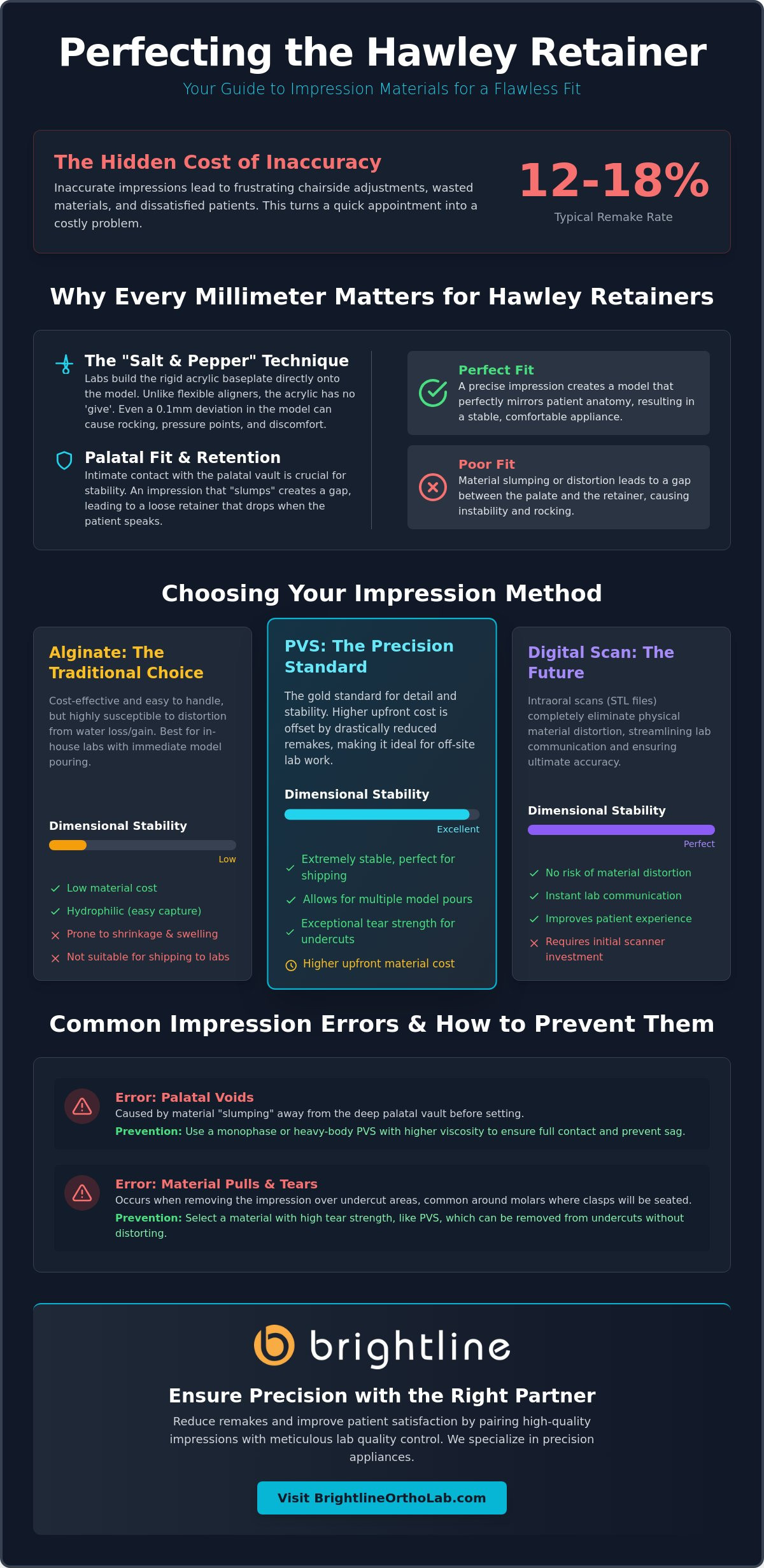
Hawley retainers are built on the foundation of a rigid acrylic baseplate. Unlike flexible clear aligners, the acrylic doesn't "give." It must mirror the patient's anatomy perfectly to provide retention. To achieve this, labs often use the "salt and pepper" technique. In this process, polymer powder and monomer liquid are meticulously layered directly onto the stone model. If that model is even slightly inaccurate, the resulting appliance will fail to seat correctly. Even a 0.1mm deviation in the palatal vault can lead to a rocking sensation or localized pressure points that cause significant patient discomfort.
Selecting the best impression material for hawley retainers depends on balancing clinical speed with the need for absolute dimensional stability. Historically, clinicians have navigated a wide variety of dental impression materials to find the right fit for their workflow. Today, this choice generally falls into three categories: traditional alginate, high-precision polyvinyl siloxane (PVS), or modern digital intraoral scans. Each has a direct impact on how the lab handles your case and the ultimate success of the finished appliance.
The Relationship Between Palatal Fit and Retention
The acrylic plate relies on intimate contact with the soft tissue of the palate for stability. If an impression material suffers from "slumping," it sags away from the deep palatal vault before setting. This creates a gap in the final retainer, leading to a loose appliance that "drops" when the patient speaks. Additionally, capturing the deep vestibule is essential. Without a clear capture of these areas, the lab cannot properly contour the acrylic or place retention clasps with the necessary precision.
Lab Fabrication: From Model to Acrylic
During fabrication, models undergo intense heat and pressure cycles to cure the acrylic. If the initial impression was grainy or lacked detail, the resulting stone model may be structurally weak and prone to breakage under these stresses. A precise impression also allows the technician to accurately position the labial bow. The lab uses the impression to set the labial bow's height and tension, ensuring it sits perfectly on the middle third of the teeth for optimal orthodontic control.
Alginate vs. PVS: Selecting the Best Material for Your Practice
Deciding on the best impression material for hawley retainers often comes down to a trade-off between immediate supply costs and long-term chairside efficiency. While alginate is a staple in most orthodontic practices, its limitations become clear when you are shipping cases to an off-site lab. Polyvinyl Siloxane (PVS), while more expensive per tray, offers the dimensional stability that ensures the rigid acrylic of a Hawley fits the first time. Choosing the right material requires an understanding of how each behaves once it leaves the patient's mouth.
When Alginate is Sufficient (And When It Isn't)
Alginate performs well if you have an in-house lab or pour your models immediately. It's hydrophilic and easy for staff to handle. However, it's highly susceptible to syneresis, where the material loses water and shrinks, and imbibition, where it absorbs water and swells. If you ship alginate impressions, even a slight delay or temperature change can distort the palatal vault. To maintain stability during short-term transport, wrap the impression in a damp paper towel and seal it in a plastic bag; however, realize this is only a temporary fix for a material not designed for long travel times.
The Clinical Advantages of PVS for Hawley Fabrication
PVS is the gold standard for capturing detail and ensuring longevity. It allows for multiple pours, which is a lifesaver if a stone model breaks during the lab's heat-curing process. For Hawley retainers, using a monophase or heavy-body PVS is often superior to light-body alone. The higher viscosity helps push the material into the deep palatal vault, ensuring the acrylic plate has full contact. PVS also boasts exceptional tear strength. This is vital when pulling the impression over undercut areas around molars where Adams clasps or C-clasps will be seated.
The data shows that while PVS supplies may cost more per case, the reduction in remakes provides a significant return on investment. With traditional remake rates reaching up to 18% in some offices, the time spent on a single redo appointment far outweighs the savings of cheaper material. Selecting a high-stability material simplifies the process for your staff and ensures a predictable outcome for every patient. Our technicians at Brightline Orthodontic Lab see the difference in fit when clinicians prioritize dimensional stability from the start.
The Digital Shift: Using STL Files for Hawley Retainers
Modern orthodontics is moving away from the physical tray toward the speed and precision of digital intraoral scanners. While PVS is often cited as the best impression material for hawley retainers in a traditional workflow, digital scans offer a level of consistency that is hard to match. By capturing the patient's anatomy as a digital data set, you eliminate the variables of mix ratios, setting times, and temperature fluctuations. Once the scan is complete, you can transmit the STL file to the lab instantly. This removes shipping costs and the need for physical storage space for stone models.
When we receive your digital files, we utilize them to produce high-resolution 3D printed dental models. These models are engineered to withstand the pressure of appliance fabrication while maintaining micron-level accuracy. However, digital success requires a shift in mindset. You must ensure the scanner captures soft tissue with the same meticulousness as the dentition. An "accuracy gap" often occurs when a scan is tooth-focused but neglects the palatal vault, which is the most critical area for a Hawley's stability.
Scanning Protocol for Removable Appliances
To ensure a perfect fit for a removable appliance, your scanning protocol must include the entire palatal vault. The acrylic baseplate of a Hawley retainer relies on this tissue contact for retention. Additionally, your staff should focus on capturing the distal surfaces of the terminal molars. These areas are essential for the proper seating of Adams clasps or C-clasps. Before clicking "send," rotate the 3D rendering on your screen to verify there are no "holes" or distorted data points in the palate or the gingival margins.
Digital Accuracy vs. Traditional PVS
Top-tier intraoral scanners provide accuracy that rivals or exceeds the finest PVS impressions. Digital workflows significantly reduce the risk of distorted models because there is no physical material to sag or tear during the process. This reliability leads to fewer remakes and more predictable seating appointments. For a deeper look at integrating these technologies into your practice, refer to our Hawley retainer clinical guide. Moving to a digital-first approach allows your team to focus on patient care rather than managing impression logistics.
Common Impression Errors and How to Prevent Them
Even when you invest in the best impression material for hawley retainers, clinical technique remains the deciding factor for a successful fit. The most frequent cause of Hawley failure is a void in the palatal vault. If the lab technician sees a bubble or a "hollow" area in the palate on the stone model, the resulting acrylic baseplate won't have the intimate contact required for retention. This leads to a rocking appliance that feels unstable and uncomfortable for the patient.
Tray selection is another critical variable that often goes overlooked. If the tray is undersized, it often cuts off the vestibular depth or the distal of the terminal molars. This makes it impossible for our technicians to bend Adams clasps or C-clasps with the necessary precision. A tray that's too small also forces the material to "pull" or "drag" as it sets, creating distorted tooth shapes. These distortions can lead to minor orthodontic relapse if the retainer doesn't hold the teeth in their exact, intended positions.
Mastering the Palatal Capture
Seating the tray correctly is an art that requires a methodical approach. To avoid air bubbles in the vault, seat the posterior portion of the tray first, then slowly roll it forward toward the anterior. This "squeegee" effect pushes air out rather than trapping it against the palate. For patients with exceptionally deep palates, use utility wax to extend the posterior border or build up the vault area of the tray. This ensures the material reaches every corner of the anatomy. Proper moisture control is also vital; use a quick blast of air to clear excess saliva before seating the tray, as pooled liquid will prevent the material from capturing fine surface detail.
Troubleshooting Distortions in Wire-Bearing Areas
Pay close attention to the interproximal areas. These are the "wire-bearing" zones where clasps must sit tightly against the tooth. If the tray shifts even slightly during the setting process, a "double-imprint" occurs. This makes the teeth appear wider or blurred on the model, leading to poor wire tension and a loose fit. For patients with strong gag reflexes, try having them tuck their chin to their chest and breathe deeply through their nose. Using a fast-set version of your chosen material can also minimize the time the tray needs to be in place. Before dismissing your patient, run through this quick inspection:
- Is the entire palatal vault captured without voids or bubbles?
- Are the gingival margins and interproximal spaces crisp and clear?
- Is the distal surface of the last molar fully represented?
- Are there any signs of "dragging" or blurred anatomy?
If you're seeing consistent fit issues in your practice, our team at Brightline Orthodontic Lab is here to help you troubleshoot your clinical protocols and ensure your impressions translate into perfect appliances.
Partnering with Brightline Orthodontic Lab for Precision Appliances
Selecting the best impression material for hawley retainers is a vital first step, but the final fit depends entirely on the craftsmanship of your laboratory partner. The true test of an appliance occurs during the seating appointment, where every micron of accuracy matters. At Brightline Orthodontic Lab, we understand the pressure you face to deliver perfect results while managing a busy schedule. Our role is to act as a reliable ally, ensuring the precision you capture at the chairside is preserved throughout the entire fabrication process.
Our meticulous quality control process begins the moment your case arrives. We don't just pour models; we analyze the integrity of the capture to ensure it meets our rigorous standards. Our technicians look for crisp definition and a smooth, void-free foundation. If we notice a minor distortion or a potential issue, we'll consult with you before proceeding. This proactive communication eliminates the guesswork that often leads to remakes. By catching potential problems early, we protect your chair time and maintain your patient's trust.
Streamlining Your Case Submissions
Simplifying your workflow is one of our primary goals. Our digital system allows for the seamless transmission of STL files, which we use to create high-resolution 3D printed models. When submitting a case, please include specific details regarding your preferred wire gauges and clasp configurations. This level of detail allows us to tailor the appliance to your specific clinical philosophy. If you're currently looking for a new laboratory partner, we recommend reviewing our guide on choosing an orthodontic lab to see how our values align with your practice's needs.
The Brightline Difference in Custom Fabrication
Every appliance we create is a testament to traditional craftsmanship enhanced by modern technology. We use premium, biocompatible materials that prioritize patient comfort and safety. Our team is well-versed in complex Hawley retainers, including specialized springs and unique baseplate modifications. We don't believe in a one-size-fits-all approach. Instead, we customize every detail to fit your patient's unique anatomy. We view our lab as an extension of your team, dedicated to supporting your clinical success and simplifying your practice logistics.
Start your next case with Brightline Orthodontic Lab today and experience the difference that professional partnership and precision engineering can make for your patients.
Achieving Long-Term Precision in Every Retainer Case
Mastering the foundation of your appliance starts with selecting the best impression material for hawley retainers, whether you rely on the dimensional stability of PVS or the modern speed of digital STL files. You've seen how meticulous palatal captures and precise tray selection eliminate the frustration of loose acrylic or rocking baseplates. Consistency at the chair translates directly to predictability in the lab. By refining these clinical protocols, you reduce chairside adjustments and ensure your patients leave with a comfortable, high-precision fit.
With over 18 years of industry experience, we understand that a successful retainer is the result of a collaborative partnership between the clinician and the lab. We utilize precision engineering to ensure every case, whether submitted through traditional impressions or digital scans, results in clinical efficacy you can depend on. Partner with Brightline Ortho Lab for High-Precision Hawley Retainers to simplify your workflow and support your team's commitment to excellence. We are ready to accommodate your specific clinical needs and look forward to helping you achieve reliable results for every patient in your care.
Frequently Asked Questions
Can I use alginate for a Hawley retainer if I pour the model immediately?
Yes, you can use alginate if you pour the stone model within 10 to 15 minutes of taking the impression. This immediate action prevents the material from shrinking due to syneresis. However, many clinicians still prefer PVS as the best impression material for hawley retainers because it offers better surface detail and removes the stress of a ticking clock. If you choose alginate, ensure you use a high-quality orthodontic version with a controlled water-to-powder ratio.
Is PVS always better than digital scanning for removable appliances?
Neither is objectively "better" in every scenario; they simply offer different clinical advantages. Digital scanning is superior for office efficiency and eliminating shipping costs, but PVS remains highly reliable for patients with excessive saliva or deep undercuts that might confuse optical sensors. We recommend digital workflows for most cases as long as your team is trained to capture the soft tissue of the palate with the same focus as the teeth.
What is the most common mistake clinicians make when taking Hawley impressions?
The most frequent error is selecting a tray that is too small to capture the full palatal vault and the distal surfaces of the terminal molars. If the tray doesn't extend far enough, the lab technician has to guess the anatomy, which often leads to a loose fit or improperly placed clasps. Always verify that your tray provides at least 2mm of clearance beyond the last molar and into the vestibular areas before seating it.
How do I ensure my intraoral scan captures enough palatal detail for the lab?
Use a methodical "S-curve" or zigzag pattern across the palate to ensure the software stitches the data points together without gaps. Start at the posterior molar on the left, move across the vault to the right, and work your way forward toward the anterior teeth. Before finalizing the file, rotate the 3D rendering on your screen to inspect the deep vault for "holes" or blurred areas that could compromise the acrylic fit.
Does the choice of impression material affect the durability of the retainer?
The material doesn't change the chemical strength of the acrylic, but it dictates the precision of the fit, which indirectly prevents breakage. A poorly fitting retainer creates uneven pressure points and stress zones that can cause the acrylic baseplate to crack during normal use. High-precision materials ensure the appliance sits flush against the tissue, distributing biting forces evenly and extending the overall life of the retainer.
What should I do if my patient has a severe gag reflex but needs a Hawley?
Switch to a fast-set PVS or a digital scanner to minimize the time the patient spends with a tray or wand in their mouth. You can also have the patient sit upright and tuck their chin toward their chest to prevent material or saliva from pooling near the soft palate. These small adjustments help manage the reflex while still allowing you to capture the high-quality data we need for meticulous fabrication.
Can a lab fabricate a Hawley retainer from a scan of an existing Essix retainer?
No, you cannot use an Essix scan because the scanner cannot "see" through the plastic to capture the palatal tissue. A Hawley requires a direct capture of the soft tissue and the dentition to ensure the acrylic baseplate mirrors the patient's actual anatomy. Always remove any existing appliances before scanning or taking a traditional impression to ensure the lab has an accurate foundation for the new retainer.
Why is capturing the vestibule so important for Hawley retention?
Capturing the vestibule allows the lab to contour the acrylic borders for maximum stability and patient comfort. Without this detail, the technician cannot accurately place the labial bow or the retentive clasps that keep the appliance from dropping during speech. When you provide a clear capture of the vestibular depth, you ensure the retainer has the necessary "grip" to resist displacement and stay securely in place.