
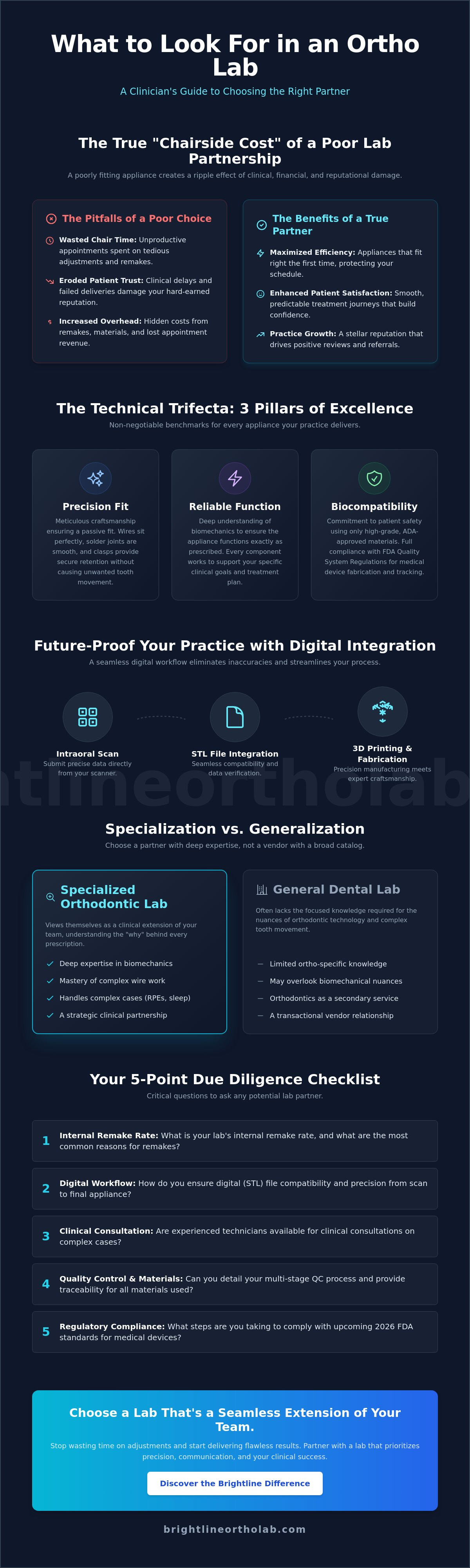
A poorly fitting appliance doesn't just waste a single chairside appointment; it erodes the hard-earned trust between you and your patient. You've likely felt the frustration of opening a lab box only to find an RPE or Hawley retainer that requires tedious adjustments or, even worse, a complete remake. When turnaround times lag and communication feels like a one-way street, your practice efficiency and patient satisfaction suffer. Understanding exactly what to look for in an ortho lab is the first step toward reclaiming your schedule and ensuring every case finishes as planned.
We believe your lab should function as a seamless extension of your clinical team rather than a distant manufacturer. It's about finding a partner that masters both traditional craftsmanship and the latest 2026 FDA regulatory standards for medical device listing and tracking. In this guide, you'll learn the technical benchmarks and communication habits that define a high-performing laboratory. We'll walk through how to audit a lab's digital workflow, from STL file compatibility to 3D printing precision, so you can focus on clinical excellence while your partner handles the meticulous details of appliance fabrication.
Key Takeaways
- Calculate the true "chairside cost" of appliance remakes and learn how a reliable lab partner protects your clinical reputation and patient trust.
- Evaluate the three pillars of technical excellence, fit, function, and biocompatibility, to ensure every appliance reflects a standard of meticulous craftsmanship.
- Discover what to look for in an ortho lab regarding digital capabilities, including the seamless integration of STL files to simplify your workflow and eliminate model inaccuracies.
- Use a five-point due diligence checklist to audit potential partners on critical metrics like internal remake rates and clinical consultation availability.
Beyond the Catalog: Why Your Lab Partner Defines Your Clinical Reputation
Your orthodontic lab is much more than a source for acrylic and wire. It's a silent partner in every successful treatment outcome you deliver. When you consider what to look for in an ortho lab, you aren't just shopping for a price list; you're selecting the technical foundation of your practice's reputation. A high-quality appliance ensures the patient's journey is smooth, while a subpar one creates a ripple effect of clinical and logistical headaches.
Most clinicians evaluate lab fees as a simple line item on a spreadsheet. However, the true "Chairside Cost" of an appliance includes the unproductive time spent grinding acrylic or re-bending wires to achieve a passive fit. If a retainer doesn't seat properly on delivery day, you lose the revenue potential of that chair time. You also risk the patient's confidence. They don't see a lab error; they see a clinical delay. Over time, these small inefficiencies can stall your practice growth and impact your referral rate.
The Hidden Costs of Inaccurate Fabrications
Inaccurate fabrications lead to a cycle of wasted resources. Think about the last time a palatal expander didn't fit. You've lost the appointment time, the cost of the original impression or scan, and the momentum of the treatment plan. Beyond the financial loss, there's a psychological toll on the patient. For a child or an anxious adult, a failed delivery appointment creates doubt. Choosing a lab based solely on the lowest invoice price often increases your annual overhead because remakes and adjustments consume your most valuable asset: time. Reliable labs minimize this friction by getting it right the first time.
Specialization vs. Generalization
A general dental lab might offer orthodontic services, but they often lack the deep expertise required for complex tooth movement. Orthodontic technology requires a specific understanding of biomechanics and force systems that general labs may overlook. Specialized technicians focus exclusively on the nuances of wire mastery and acrylic contouring. This focus is vital when handling complex cases like RPEs or sleep appliances. When you evaluate what to look for in an ortho lab, prioritize those who view themselves as a clinical extension of your team. They should understand the "why" behind your prescription, ensuring every appliance supports your specific clinical goals. This level of specialization transforms a vendor relationship into a strategic partnership.
The Technical Trifecta: Precision Engineering, Quality Materials, and Expertise
A reliable orthodontic appliance relies on three foundational pillars: fit, function, and biocompatibility. When you evaluate what to look for in an ortho lab, these technical standards should be your non-negotiable benchmarks. Precision engineering isn't just about making something that looks right; it's about ensuring the appliance performs exactly as your treatment plan intends, appointment after appointment. Achieving this requires a combination of high-grade materials and a technician's seasoned hands.
Meticulous craftsmanship is especially visible in the quality of wire work and acrylic adaptation. While automation has its place, the nuance of a perfectly contoured labial bow or a secure clasp still requires human expertise. To maintain these standards, a lab must implement a multi-stage quality control process. This ensures that every piece leaving the bench meets the FDA Quality System Regulation for medical devices. If a lab doesn't track its materials or audit its fabrication stages, your practice bears the risk of appliance failure.
Precision Solder and Wire Work
Examine the wire-to-acrylic adaptation on a Hawley retainer. The wire should sit passively against the teeth without creating unintended pressure points. Look for solder joints that are smooth, polished, and free of pits or sharp edges. Clean soldering isn't just for aesthetics; it's critical for patient comfort and hygiene, as rough surfaces can harbor plaque and irritate soft tissues. Accurate clasping is equally vital. If the appliance lacks proper retention, the treatment outcome is compromised, leading to patient frustration and additional chairside time.
Biocompatible and ADA-Approved Materials
The materials used in your appliances stay in a patient's mouth for months or years. Using non-certified alloys or low-grade acrylics can lead to allergic reactions or material degradation. High-quality labs prioritize ADA-approved, biocompatible materials to ensure longevity and safety. This is particularly important when fabricating a hard soft night guard, where the dual-laminate material must remain stable under significant occlusal forces. Verify that your partner uses IdentAlloy® certificates to track the exact composition of the metals used in your expanders and retainers.
Choosing a partner that values these technical details simplifies your clinical day. If you want to see how precision engineering transforms your workflow, consider partnering with a specialized team that treats every appliance as a custom piece of medical equipment. This commitment to quality ensures your patients receive the best possible care while you enjoy fewer remakes and more predictable results.
Digital Workflow and STL Integration: Future-Proofing Your Practice
The transition from analog impressions to a fully digital workflow isn't just about convenience; it's about the fundamental accuracy of the appliances you deliver. When assessing what to look for in an ortho lab, their digital infrastructure is just as important as their bench skills. A lab with a robust digital workflow can accept STL files from any intraoral scanner, giving you the flexibility to choose the technology that fits your practice. Organizations like the National Association of Dental Laboratories emphasize that staying current with these technologies is a hallmark of a professional, high-standard facility. It ensures your lab can grow alongside your practice as you adopt new scanning hardware and software.
The Accuracy of 3D Printed Dental Models
Traditional stone models are prone to "expansion error," where the material subtly changes size as it sets. This can lead to fit issues that aren't apparent until the delivery appointment. By utilizing 3d printed dental models, labs eliminate these physical variables. High-resolution 3D printing ensures that the printed model is an exact replica of the digital scan. Ask your lab about their calibration protocols. A well-calibrated printer maintains accuracy within microns, which is essential for the tight tolerances of an RPE or a sleep appliance. This precision reduces the need for chairside adjustments and ensures a passive fit from day one.
Streamlining the Case Submission Process
Efficiency starts at the point of entry. Understanding what to look for in an ortho lab involves evaluating their communication tools and how they handle your data. A streamlined orthodontic lab case submission process reduces administrative friction for your staff and speeds up turnaround times. Look for a partner that offers a secure digital portal where you can upload scans, track case status in real-time, and attach clinical photos.
Photos are particularly helpful for complex cases. They help technicians visualize the patient's occlusion and aesthetic goals, acting as a bridge between the chair and the lab bench. Digital archiving is another massive benefit of this integration. If a patient loses their retainer, you don't need to schedule a new scan. You simply request a replacement from the archived digital file. This saves your office time, reduces patient stress, and provides an immediate solution for long-term retention.
Due Diligence Checklist: 5 Critical Questions to Ask a Potential Partner
Selecting a laboratory partner is a high-stakes business decision that impacts your daily stress levels and your bottom line. Determining what to look for in an ortho lab requires a deep dive into their operational transparency. You need to know how they handle the inevitable complexities of orthodontic fabrication before you send your first case. Use these five questions to audit any potential partner:
- What is your internal remake rate, and how do you track it? A lab that doesn't monitor this metric cannot improve its quality. Look for a partner that maintains a low remake percentage and can explain their process for identifying recurring errors.
- Do you offer clinical consultations for complex cases? For intricate expanders or sleep apnea devices, having access to a master technician's perspective is invaluable. You want a partner who can discuss biomechanics, not just follow a template.
- Are your technicians trained in specific orthodontic philosophies? Understanding why a clinician prefers a certain wire sequence or acrylic trim is the difference between a vendor and an ally.
- What is your protocol for "unclear" prescriptions? A red-flag lab will guess and ship. A quality lab will pause production and call you to clarify a distorted scan or an ambiguous instruction.
- How do you maintain consistency? Ask how they approach managing orthodontic lab costs without sacrificing the quality of materials or the precision of the final fit.
Domestic vs. Overseas Fabrication
Transparency is the greatest benefit of working with a US-based laboratory. Domestic production ensures that your appliances are fabricated under strict local oversight, using materials that meet verified safety standards. It also significantly reduces turnaround times. When your lab is in a different time zone or country, communication barriers can lead to delays and misunderstandings. A local partner provides a level of accountability that overseas facilities simply cannot match. You gain peace of mind knowing exactly where and how your patient's appliance was made.
Technician Accessibility and Communication
Can you speak directly to the person at the bench? This is a vital factor in what to look for in an ortho lab. In a high-volume "order taker" lab, you're often stuck behind a customer service wall. You want a collaborative environment where proactive communication is the norm. If a technician identifies a potential fit issue with a 3D printed model, they should feel empowered to contact your office immediately. This level of accessibility prevents wasted chair time and ensures that the final product meets your exact clinical standards. If you're looking for a partner that prioritizes this level of direct support, reach out to our laboratory team to learn how we can support your specific workflow.
Choosing Brightline Orthodontic Lab as Your Practice Extension
When you determine what to look for in an ortho lab, you're ultimately seeking a partner that prioritizes your clinical success as much as you do. Brightline Orthodontic Lab brings over 18 years of specialized industry experience to your practice. We've spent nearly two decades refining the balance between traditional bench craftsmanship and the speed of modern innovation. We don't just ship boxes; we act as a reliable clinical extension of your team, dedicated to reducing your logistical stress and chairside time. Our commitment to meticulous precision is evident in every appliance, from standard hawley retainers to complex expansion therapy devices.
Our collaborative approach simplifies your workflow. We understand the pressure of a busy clinical schedule, so we focus on getting the fit right the first time. By combining seasoned expertise with a supportive service model, we accommodate the unique needs of your practice. You gain the quiet confidence that comes from knowing every case is handled by technicians who understand the nuances of orthodontic movement and patient comfort. This partnership allows you to focus on clinical excellence while we manage the technical details of fabrication.
Precision-Engineered Orthodontic Solutions
Meticulousness is the standard for every sleep apnea appliance and night guard we produce. We recognize that even a minor inaccuracy can compromise a patient's treatment or lead to an unproductive remake. Our deep technical understanding of how RPE appliances work ensures that every expander is engineered for maximum clinical efficacy. We use high-grade, biocompatible materials to ensure longevity and safety. This focus on precision engineering means you spend less time adjusting appliances and more time advancing your patients' treatment plans.
Your Digital Integration Partner
Transitioning to a digital workflow shouldn't be a hurdle for your staff. Understanding what to look for in an ortho lab means finding a partner ready for the future of dentistry. Brightline is fully equipped to handle your STL files and 3D printed model workflows with ease. We support clinicians as they move away from traditional stone models, providing a seamless bridge to digital record-keeping.
We utilize high-resolution 3D printing technology to maintain the tightest tolerances possible. This digital adaptability, combined with our foundation in traditional craftsmanship, provides the best of both worlds. If you're ready for a more supportive, professional laboratory experience, we invite you to see how our team can simplify your day. Let us handle the meticulous fabrication so you can enjoy more predictable clinical outcomes and a more efficient practice.
Elevating Your Clinical Standards with the Right Partner
Selecting a laboratory partner is a decision that shapes the daily rhythm of your practice. By prioritizing technical precision, digital adaptability, and open communication, you ensure that every appliance supports your clinical reputation. It's about more than just manufacturing. You've learned that what to look for in an ortho lab involves finding a team that values meticulous craftsmanship as much as you do. This alignment reduces chairside stress and protects your most valuable asset: your time.
Brightline Orthodontic Lab is ready to serve as that dedicated extension of your practice. Founded on over 18 years of specialized orthodontic expertise, we combine traditional bench skills with a modern, digital-ready workflow that accepts all major STL file types. Every custom appliance undergoes a meticulous multi-stage quality control process to ensure a passive fit and optimal function. We simplify your logistics so you can focus on clinical excellence.
Partner with Brightline Orthodontic Lab for Precision-Engineered Appliances and experience the difference that true collaboration makes for your clinical outcomes. We look forward to supporting your practice's growth and success.
Frequently Asked Questions
How do I know if an ortho lab uses high-quality, safe materials?
High-quality laboratories provide IdentAlloy certificates and use ADA-approved, biocompatible materials for all fabrications. You should verify that the facility is registered with the FDA and adheres to current Quality System Regulations. This ensures that the acrylics and alloys used in your retainers and expanders are safe for long-term intraoral use and have been tracked through a verified supply chain.
What is the average turnaround time I should expect from a professional ortho lab?
Most professional laboratories offer a turnaround time between 5 and 10 business days for standard appliances. This window allows for meticulous fabrication and multi-stage quality control checks. If a lab promises significantly faster times, it might be cutting corners on the curing process or final polishing. Always confirm if the time includes shipping or just bench time to keep your patient scheduling predictable.
Can I send digital STL files to most orthodontic labs today?
Most modern laboratories are fully equipped to accept digital STL files from any intraoral scanner. This capability is a core part of what to look for in an ortho lab as it eliminates the inaccuracies of traditional stone models. Digital workflows allow for immediate case submission and provide a secure way to archive patient records for future replacement appliances.
What should I do if my lab-fabricated appliances consistently need major adjustments?
You should immediately contact the lab's technical director to review your recent cases if you encounter consistent fit issues. Request an audit of their 3D printing calibration and internal remake rates. If the problems persist after a clinical consultation, it's a sign that their quality control protocols aren't meeting the standards required for your practice's efficiency and patient satisfaction.
Is it better to use a local ortho lab or a national one?
It's generally better to prioritize a lab's technical expertise and US-based fabrication over simple geographic proximity. While a local lab offers convenience, a national specialized lab often has better access to advanced 3D printing technology and a deeper pool of expert technicians. The most important factor is finding a partner that operates under domestic safety regulations and provides reliable, predictable shipping.
How does a specialized ortho lab differ from a full-service dental lab?
Specialized orthodontic labs focus exclusively on the biomechanics of tooth movement and appliance retention. Unlike full-service dental labs that handle crowns or dentures, specialized technicians spend their entire day mastering complex wire work and acrylic adaptation. This narrow focus is crucial for what to look for in an ortho lab because it ensures the technician understands how forces apply to the dentition.
What are the red flags to watch for when auditing a new lab partner?
Red flags include a lack of material traceability, inconsistent turnaround times, and an inability to speak directly with a technician. If a lab acts as a simple "order taker" and doesn't proactively flag distorted scans or unclear prescriptions, they aren't functioning as a true partner. These communication gaps often lead to high chairside adjustment times and frustrated patients.
Why is technician communication more important in orthodontics than in general dentistry?
Technician communication is vital in orthodontics because appliances involve active forces that must be precisely controlled. Unlike a static crown, an RPE or a sleep appliance must work in harmony with the patient's growth and occlusion. A direct line to your technician allows for clinical consultations on complex cases, ensuring that the final design aligns perfectly with your specific treatment philosophy.