
Achieving a perfect orthopedic expansion depends less on the force applied and more on the micron-level fit of the appliance against the anatomy. You've likely felt the frustration of a chairside delivery that requires extensive adjustments or a patient returning with an appliance that didn't achieve the skeletal widening you planned. It's a common struggle; research from Silver Lake Orthodontics indicates that approximately 30% to 45% of children worldwide require dental correction. When an arch expander doesn't seat perfectly, it compromises the predictability of the treatment plan and creates unnecessary stress for your team.
We believe your laboratory partner should serve as a seamless extension of your practice. This guide provides a clinical overview of arch expander mechanics and the technical nuances that ensure successful patient outcomes. We'll examine the critical differences between skeletal and dental expansion limits and look at how modern digital workflows are streamlining the fabrication of Rapid Palatal Expanders (RPE). You'll gain the insights needed to minimize laboratory remakes while improving patient airflow and alignment with confidence.
Key Takeaways
- Master the biomechanics of sutural opening to ensure your clinical protocols leverage natural osteoblastic activity for stable results.
- Compare the technical nuances of various appliance designs to select the ideal arch expander for correcting transverse discrepancies and crowding.
- Identify the critical diagnostic markers and the biological window of opportunity to achieve maximum skeletal widening in growing patients.
- Discover how precision lab fabrication, from 3D-printed models to meticulous screw placement, simplifies chairside delivery and reduces remakes.
- Optimize patient outcomes by integrating high-quality impressions with advanced appliance mechanics to improve both airflow and dental alignment.
Understanding the Arch Expander: Form, Function, and Clinical Necessity
Think of the arch expander as a precision-engineered foundation for comprehensive orthodontic care. This specialized appliance is designed to widen the dental arch by applying gentle, consistent pressure to the maxillary or mandibular structures. Its primary goal is to correct transverse discrepancies, ensuring the upper and lower teeth meet properly while creating the necessary space for permanent teeth to erupt. For a deeper look at the history and clinical indications of these techniques, this Palatal expansion overview provides valuable context on how these methods have evolved into modern practice.
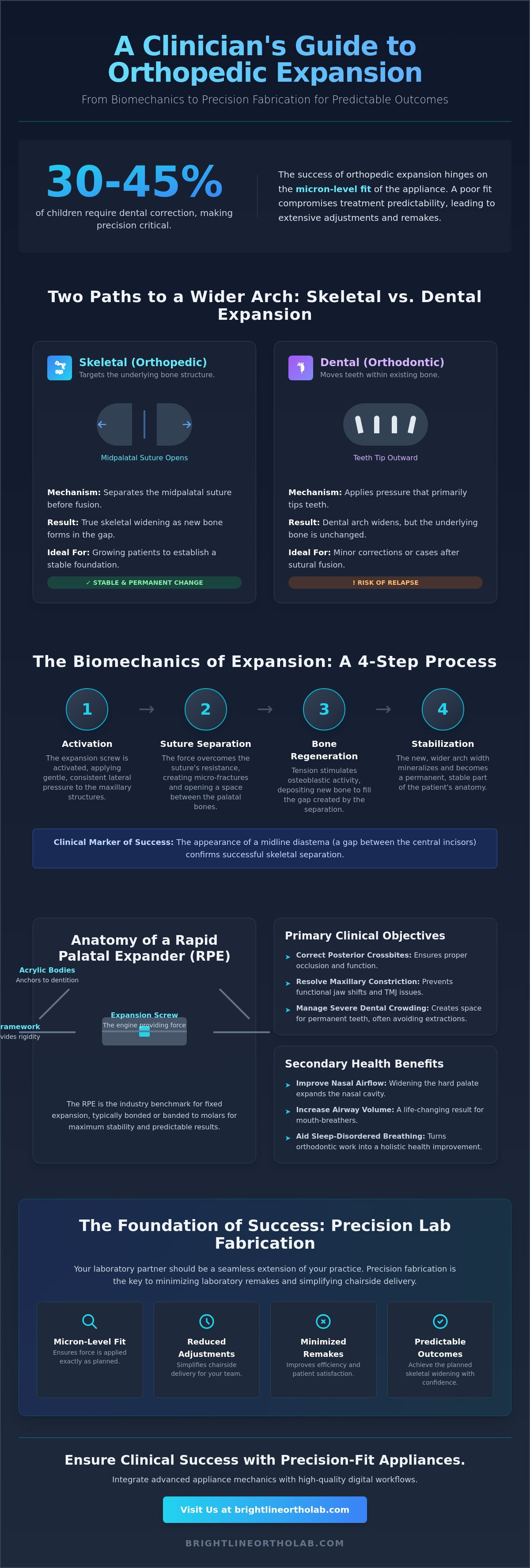
Success in expansion hinges on the distinction between orthopedic and orthodontic movement. Orthopedic expansion focuses on skeletal change, specifically the separation of the midpalatal suture before it fuses. In contrast, orthodontic expansion involves the tipping of teeth within the existing alveolar bone. Achieving true skeletal widening is often the goal in pediatric cases, as it provides a stable base for the entire dentofacial complex. Early intervention remains the gold standard because it's possible to leverage the patient's natural growth before the suture becomes too rigid for non-surgical methods.
What is an Arch Expander in Modern Orthodontics?
Every arch expander we fabricate consists of three core components: the expansion screw, the acrylic bodies, and a rigid support framework. The screw acts as the engine of the device, providing the incremental force needed for widening. The Rapid Palatal Expander (RPE) is the industry benchmark for fixed expansion; it's typically bonded or banded to the molars for maximum stability. While fixed appliances offer the highest predictability, removable strategies can be effective for minor dental tipping in cases where patient compliance is guaranteed. We focus on ensuring each component is meticulously placed to simplify your chairside experience and reduce the need for adjustments.
Primary Objectives of Maxillary and Mandibular Expansion
We primarily use expansion to correct posterior crossbites and resolve maxillary constriction. If the upper arch is too narrow, it often forces the jaw into a functional shift, which can lead to long-term TMJ issues and uneven dental wear. By widening the arch, you also manage severe dental crowding without necessarily resorting to extractions. Beyond dental alignment, expansion offers significant secondary benefits. Increasing the width of the hard palate often improves nasal airflow and increases airway volume. It's a life-changing result for patients struggling with mouth breathing or sleep-disordered breathing, turning a standard orthodontic correction into a holistic health improvement.
The Biomechanics of Expansion: How Arch Expanders Reshape the Palate
The efficacy of an arch expander relies on its ability to generate orthopedic force that overcomes the mechanical resistance of the midpalatal suture. This isn't merely a dental movement; it's a controlled separation of the two halves of the maxilla. When you activate the expansion screw, the appliance exerts lateral pressure against the teeth and alveolar bone. This pressure is transmitted directly to the suture, leading to micro-fractures in the connective tissue and the eventual opening of the sutural space. It's a delicate balance of force and biology that requires a deep understanding of craniofacial anatomy.
Once the suture opens, the body initiates a physiological repair process. Tension within the sutural gap stimulates osteoblastic activity, where new bone is deposited to fill the void. This process ensures the new, wider arch width becomes permanent as the bone mineralizes. To achieve this without excessive tipping, the appliance must be designed with the center of resistance in mind. If the force is applied too far from this center, you'll see more dental tipping than skeletal widening. A clear clinical marker of successful skeletal separation is the appearance of a midline diastema. This gap between the central incisors confirms that the bones have moved apart rather than just the teeth.
Skeletal vs. Dental Expansion: The Role of the Midpalatal Suture
Skeletal expansion targets the underlying bone structure before the midpalatal suture completely fuses, which typically happens in late adolescence. If you apply force after fusion, the arch expander will primarily cause dental tipping, which can lead to periodontal recession and poor long-term stability. Skeletal expansion is the orthopedic separation of the maxillary halves achieved by applying force that exceeds the threshold of sutural resistance. By focusing on the bone rather than just tooth movement, you create a broader foundation for the entire dental arch.
Rapid vs. Slow Expansion Protocols
Choosing between rapid and slow protocols depends on your clinical goals and the patient's age. Rapid Palatal Expansion (RPE) typically involves a twice-daily activation schedule, creating a large volume of space in a short timeframe. This protocol is highly effective for maximizing skeletal change but requires careful monitoring of the periodontal tissues to prevent trauma. Slow Maxillary Expansion (SME), often activated once or twice weekly, allows for more physiological adaptation of the tissues. For a detailed breakdown of these schedules, you can refer to our Clinician’s Guide to RPE Activation to ensure your patients stay on track. If you're looking to enhance the predictability of these biological movements, our team is ready to provide precision-crafted orthodontic appliances that respect these biomechanical principles.
A Comparative Analysis of Arch Expander Designs and Materials
Selecting the right arch expander is a balancing act between orthopedic efficiency and patient tolerance. While the fundamental goal of widening the arch remains constant, the materials and attachment methods you choose directly impact the predictability of your results. Traditional stainless steel remains the industry standard for its rigidity and biocompatibility, but we've seen a significant shift toward digital integration. Using 3D-printed models to fabricate these appliances ensures a higher degree of accuracy, which translates to a more intimate fit and fewer chairside adjustments during delivery.
Durability is a non-negotiable requirement for any expansion appliance. Because most protocols require the device to remain in the mouth for six months or longer to allow for bone mineralization and sutural stability, the framework must withstand significant occlusal forces. We focus on meticulous soldering and high-quality screw mechanisms to prevent mechanical failure during this critical retention phase. While patient comfort is always a priority, it shouldn't come at the expense of clinical efficiency; a well-designed fixed appliance provides the constant, reliable force necessary for skeletal change that removable options often struggle to match.
Fixed vs. Removable Expansion Appliances
Success with removable expanders, such as the Schwarz appliance, depends entirely on patient compliance. These are often excellent tools for the mandibular arch where the goal is typically dental tipping rather than skeletal separation. However, when your objective is predictable skeletal widening of the maxilla, fixed appliances like the Hyrax are the gold standard. They eliminate the "compliance variable" and ensure that the orthopedic force is delivered consistently to the midpalatal suture without the risk of the patient removing the device.
Banded RPE vs. Bonded RPE: Structural Differentiators
The Banded RPE utilizes precision-fit orthodontic bands on the permanent molars to anchor the expansion framework. It's a classic design that allows for excellent oral hygiene and minimal interference with the patient's bite. In contrast, the Bonded RPE features acrylic occlusal coverage that fits over the posterior teeth. This design is particularly useful for managing the vertical dimension in "high-angle" patients, as the acrylic blocks can help control tooth eruption during the expansion process. To help you decide which structural approach is right for your next case, explore our detailed guide on Banded RPE vs. Bonded RPE for specific selection criteria.
Clinical Indications and Patient Selection for Arch Expansion
Selecting the right candidate for an arch expander starts with a meticulous evaluation of the transverse dimension. You'll typically begin by measuring the inter-molar width and analyzing the arch form to identify any signs of constriction. If the maxillary arch is too narrow, it doesn't just affect dental alignment; it often forces the mandible into a functional shift. Identifying these diagnostic markers early allows you to capitalize on the "window of opportunity" during mixed dentition, usually between ages 7 and 10. While expansion remains effective in early permanent dentition, the predictability of skeletal change decreases as the midpalatal suture matures. For adult patients where the suture has fully fused, you'll need to evaluate the potential for Surgically Assisted Rapid Palatal Expansion (SARPE) to avoid excessive dental tipping.
We understand that every patient presents a unique anatomical puzzle. Our role is to provide the precision-crafted appliances that help you solve it. If you're ready to streamline your next case, you can order a custom Rapid Palatal Expander designed to your exact clinical specifications.
Correcting Transverse Deficiencies and Crossbites
A posterior crossbite is one of the most common reasons to prescribe an arch expansion protocol. If left untreated, a unilateral or bilateral crossbite can lead to asymmetrical jaw growth and significant dental wear over time. By using an arch expander to widen the maxilla, you eliminate the tooth-to-tooth interference that causes functional shifts. This correction stabilizes the occlusion and provides a more favorable environment for subsequent orthodontic phases. It's about more than just widening the smile; it's about establishing a functional foundation that supports long-term oral health.
Managing Severe Crowding and Impacted Teeth
Expansion is a powerful tool for managing tooth-size-arch-length discrepancy (TSALD). When you widen the arch perimeter, you create the necessary real estate for erupting permanent teeth, which is especially critical for crowded canines. This approach often reduces the need for extractions and helps guide teeth into their proper positions naturally. Every 1mm of expansion typically yields approximately 0.7mm of arch perimeter gain. This predictable relationship allows you to plan your space management with a high degree of mathematical accuracy, ensuring a more stable and aesthetic final alignment.
Optimizing Clinical Outcomes Through Precision Lab Fabrication
The technical success of an arch expander isn't decided during the activation phase; it's decided on the laboratory bench. A perfectly diagnosed case can still falter if the appliance lacks the structural integrity to deliver force where it's needed most. We prioritize meticulous soldering and precise screw placement to ensure that every turn of the key translates into predictable orthopedic expansion rather than appliance distortion. When you receive an appliance that fits perfectly the first time, you reduce chairside stress and minimize the need for painful adjustments that can alienate your patients.
We view ourselves as a strategic partner in your clinical workflow. Our goal is to simplify your day-to-day operations by delivering appliances that reflect the soul of traditional craftsmanship enhanced by modern technology. By focusing on the granular details of fabrication, we help you achieve the dental alignment and airway improvements discussed in previous sections with total confidence. It's about providing a reliable foundation so you can focus on what matters most: your patient's progress.
The Impact of Meticulous Impression and Model Accuracy
A successful delivery starts with the foundation of the case: the impression or digital scan. The transition to digital workflows has revolutionized how we approach fit, particularly through the use of 3D printed dental models. These models provide a level of accuracy that traditional stone models often struggle to match, virtually eliminating the risk of appliance 'rocking.' If an appliance doesn't seat firmly against the anatomy, the force delivery becomes uneven, which can lead to localized periodontal trauma or asymmetric widening. To avoid these issues, ensure your scans capture the full palate and the entire clinical crown of the anchor teeth.
Why Partnering with a Specialized US Orthodontic Lab Matters
Choosing a domestic laboratory partner ensures a level of quality control and material safety that's essential for appliances staying in the mouth for six months or more. We use only biocompatible materials and maintain strict oversight on every weld and solder joint. Direct communication with our technicians allows you to troubleshoot complex cases before the appliance ever reaches your office. We invite you to explore how RPE appliances work through our precision-engineering lens to see how we accommodate your specific clinical needs. This collaborative approach turns a standard laboratory order into a reliable, high-performance solution for your practice.
Advancing Practice Precision with Expert Appliance Fabrication
Successful orthodontic expansion relies on the perfect intersection of biological timing and mechanical accuracy. By prioritizing skeletal widening over simple dental tipping, you establish a more stable foundation for your patient's long-term oral health and airway volume. Utilizing a high-quality arch expander ensures that these clinical goals are met with minimal chairside friction and maximum predictability. We believe your laboratory should act as a seamless extension of your team, providing the quiet confidence that comes from reliable, consistent results.
If you're ready to elevate your practice standards, partner with Brightline Orthodontic Lab for precision-engineered expanders and experience the difference that meticulous US-based craftsmanship makes in your daily workflow. Our expert technicians bring decades of experience to every custom RPE, Hawley retainer, and 3D printed model we produce. We're here to simplify your logistics, reduce your chairside adjustments, and help you deliver the exceptional patient outcomes you plan for every day. Let's build a more predictable future for your patients together.
Frequently Asked Questions
What is the ideal age for a patient to receive an arch expander?
The ideal age for a patient to receive an arch expander is typically between 7 and 10 years old during the mixed dentition phase. This window allows you to capitalize on the patient's natural growth before the midpalatal suture begins to fuse. Starting early ensures more predictable skeletal widening and can often prevent more invasive procedures later in life. If you wait until late adolescence, the chances of achieving true orthopedic expansion decrease significantly.
Does a palatal expander cause a gap between the front teeth?
Yes, a temporary gap between the two front teeth is a common and positive sign of skeletal expansion. This midline diastema indicates that the midpalatal suture has successfully separated rather than just the teeth tipping. Most patients see this gap close naturally within a few weeks as the fibers of the gums pull the teeth back together. It's a reassuring marker that the appliance is achieving its orthopedic goal.
How long does a patient typically need to wear an arch expander?
Most patients wear an arch expander for approximately six to nine months in total. While the active expansion phase might only last a few weeks, the appliance must remain in place for several months to allow new bone to form in the sutural gap. This retention period is critical for stability. If you remove the device too early, the expanded arch is highly likely to relapse toward its original narrow state.
Can an arch expander be used on the lower jaw as well as the upper?
You can use an arch expander on the lower jaw, but the mechanics differ from those used in the maxilla. Because the mandible doesn't have a midline suture to separate, lower expanders primarily achieve dental tipping or uprighting of the teeth. Clinicians often prescribe the Schwarz appliance for this purpose. It creates more room in the arch by gradually pushing the teeth into a more upright, wider position.
What is the difference between a rapid palatal expander and a slow palatal expander?
The primary difference lies in the activation schedule and the resulting tissue response. A rapid palatal expander is typically turned once or twice daily, generating high forces that prioritize skeletal separation. Slow expansion involves turning the screw once or twice weekly, which allows more time for the surrounding periodontal tissues to adapt. While RPE is faster, slow expansion may be preferred in cases where you want to minimize the risk of sutural trauma.
Is an arch expander painful for the patient during activation?
Most patients describe the feeling as pressure across the bridge of the nose or under the eyes rather than sharp pain. This sensation usually lasts for about 20 to 30 minutes after the screw is turned. It's helpful to reassure parents that this pressure is a normal part of the widening process. If a patient experiences significant or lasting pain, it's a sign to re-evaluate the fit or activation schedule.
How do I know if my patient needs a banded vs. a bonded RPE?
Choosing between a banded or bonded RPE depends on the patient's oral hygiene and vertical dimension needs. Banded expanders are often easier to clean and have less impact on the bite. However, if your patient has a high-angle growth pattern, a bonded expander's acrylic occlusal coverage can help control the vertical dimension by preventing molar extrusion. We can fabricate both options to match your specific clinical requirements for each case.
Can adults benefit from arch expansion without surgical intervention?
Adult expansion is complex because the midpalatal suture is fully fused. While minor dental tipping is possible with a traditional appliance, achieving true skeletal widening usually requires Mini-implant Assisted Rapid Palatal Expansion (MARPE) or surgical intervention. Without these aids, applying high forces to an adult's fused palate often leads to periodontal recession or buccal tipping rather than the foundation-level widening needed for a stable clinical result.