
Choosing between a banded and a bonded RPE is often treated as a matter of personal preference, but the wrong choice can inadvertently compromise your patient's vertical dimension or periodontal health. When you're weighing banded vs bonded expander clinical considerations, the decision impacts everything from skeletal efficiency to chairside reliability. You've likely dealt with the headache of an acrylic appliance debonding at an inconvenient time or the struggle of managing gingival inflammation when hygiene becomes a hurdle. It's a balancing act that requires a deep understanding of how each design interacts with the patient's unique dental maturity.
We're here to help you navigate these tactical choices with confidence. This guide offers a comprehensive clinical comparison of banded and bonded RPE designs to help you optimize treatment outcomes and patient comfort. We will examine how to minimize unwanted dental tipping, manage vertical growth, and select the right appliance for every stage of development. By the end, you'll have a clear roadmap for choosing the design that best supports your clinical goals and your patient's smile.
Key Takeaways
- Understand the mechanical differences between traditional banded designs and acrylic-based bonded expanders to better match appliances to your patient’s dental maturity.
- Learn how to manage the vertical dimension in high-angle cases by utilizing the occlusal coverage of a bonded RPE to prevent unwanted molar extrusion.
- Master banded vs bonded expander clinical considerations to effectively balance skeletal expansion with the risk of dental tipping in mixed dentition.
- Discover practical hygiene protocols and maintenance tips to minimize gingival inflammation and patient discomfort during the active expansion phase.
- Streamline your workflow by leveraging digital scans and precision laboratory engineering to ensure a meticulous fit for every custom appliance.
Defining the Mechanics: Banded vs. Bonded RPE Designs
Maxillary constriction remains a common challenge in orthodontic practice, often requiring intervention to restore proper arch form and function. The Rapid Palatal Expander (RPE) is widely recognized as the gold standard for correcting maxillary constriction. While several variations exist, your choice usually narrows down to two primary tooth-borne designs. Understanding banded vs bonded expander clinical considerations begins with a clear grasp of their mechanical differences. Both appliances aim for the same skeletal objective: separating the mid-palatal suture to increase the transverse width of the maxilla through controlled mechanical force.
The decision to use one over the other isn't just about laboratory preference; it's about how that force is delivered to the underlying bone. While both designs utilize a central expansion screw, the interface between the appliance and the teeth dictates how much skeletal change you achieve versus how much dental tipping occurs. Choosing the right design requires a meticulous look at the patient's vertical growth pattern and their ability to maintain hygiene during the active phase of treatment.
The Role of Orthodontic Bands in Expansion
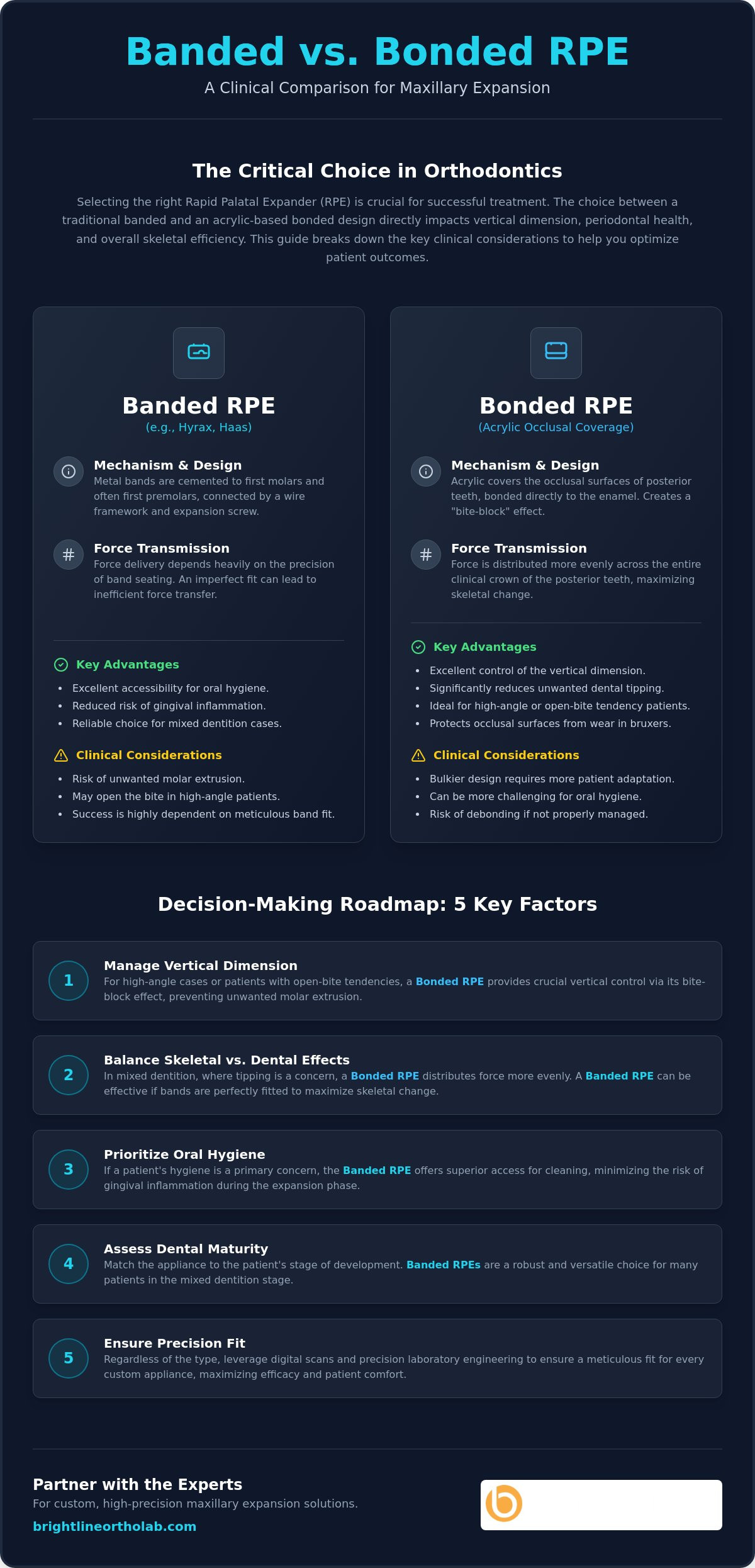
Banded RPEs, such as the Hyrax or Haas, rely on metal bands cemented to the first molars and often the first premolars. The success of these designs depends heavily on the precision of the band seating and fit. If the bands aren't meticulously fitted to the anatomy of the tooth, the force transmission from the expansion screw to the skeletal structures becomes inefficient. This can lead to localized pressure and discomfort rather than the desired orthopedic effect. One significant advantage of this traditional approach is the accessibility it provides for oral hygiene. Because the framework consists of metal wire and a screw, patients can easily clean around the gingival margins, which reduces the risk of inflammation. This versatility makes banded RPEs a reliable choice for patients in the mixed dentition stage. You can find more details on these variations in this Palatal Expanders Overview.
The Mechanics of Acrylic Bonded Appliances
Bonded RPEs take a different approach by utilizing acrylic coverage over the occlusal surfaces of the posterior teeth. This design creates a distinct "bite-block" effect, which is particularly useful for managing patients with a high mandibular plane angle or an open bite tendency. By bonding the appliance directly to the teeth, the force is distributed across the entire clinical crown. This distribution can significantly reduce unwanted dental tipping compared to banded versions. The acrylic acts as a protective layer for the occlusal surfaces during active expansion, preventing enamel wear in patients with heavy bruxing habits. While the bulkiness of the acrylic requires more patient adaptation, the control it offers over the vertical dimension makes it a powerful tool in your clinical arsenal. It's an effective way to simplify treatment in cases where vertical management is just as critical as transverse expansion.
Comparative Analysis: Selecting the Right Expander for Your Patient
Selecting the ideal appliance requires a deep dive into the patient's specific skeletal and dental morphology. While the mechanical goal of suture separation remains constant, the physiological response of the surrounding tissues varies. When evaluating banded vs bonded expander clinical considerations, you must look beyond the transverse deficiency and assess the vertical dimension. A patient's growth pattern often dictates which design will yield the most stable result. For instance, a high-angle patient with a tendency toward an open bite requires a different tactical approach than a low-angle patient with deep-bite tendencies.
Research into Bonded vs. Banded Expander Dental Effects suggests that while both designs achieve similar orthopedic results, their impact on dental tipping and vertical height differs. Banded designs, while excellent for hygiene, can sometimes lead to unwanted molar extrusion, which may inadvertently open the bite in sensitive cases. Conversely, bonded designs offer a more rigid connection to the dental arch, which can help distribute forces more evenly across the clinical crowns of the posterior teeth. This distribution is vital when your goal is to maximize skeletal change while minimizing the buccal tipping of the anchor teeth.
Hygiene and periodontal health also play a significant role in your selection. Bonded appliances cover the occlusal and axial surfaces with acrylic, which can protect against wear but also increases the risk of decalcification if the seal is compromised. Banded appliances leave more of the tooth surface exposed, making it easier for the patient to manage plaque. If you're managing a complex case where precision is paramount, consider how a high-quality custom RPE can simplify your clinical workflow and improve patient compliance.
Vertical Control and the High-Angle Patient
The acrylic thickness in a bonded RPE acts as a functional bite block. This coverage inhibits the eruption of the maxillary molars during the expansion phase, which is a significant advantage for "long face" or high-angle patients. By providing an intrusive force on the posterior teeth, you can effectively manage the vertical dimension and prevent the mandible from rotating downward and backward. In contrast, a banded RPE lacks this occlusal coverage, which can allow for molar extrusion and a subsequent increase in the lower anterior face height.
Deciduous vs. Permanent Dentition Considerations
Patient age and dental maturity are critical factors in appliance selection. Bonded RPEs are often the preferred choice for early interceptive treatment in young children. Their ability to bond to deciduous teeth provides a stable platform for expansion even when permanent molars aren't fully erupted. As patients move into their teenage years with a full permanent dentition, banded RPEs become the standard. They offer the durability needed for the higher forces required to open the suture in older patients while allowing for easier integration with full fixed braces later in treatment.
Clinical Management: Hygiene, Maintenance, and Patient Comfort
Managing the daily reality of an expansion appliance requires clear communication between the clinician and the patient. While your choice of design is rooted in banded vs bonded expander clinical considerations, the patient's experience is rooted in their ability to eat, speak, and keep the device clean. A meticulous approach to management ensures that the biological benefits of expansion aren't overshadowed by localized tissue issues or appliance failure. You're not just managing a suture; you're managing a patient's comfort and oral health over a multi-month retention phase.
Hygiene protocols vary significantly between the two designs. Banded RPEs offer a more open architecture, allowing for easier access to the gingival margins and the palatal vault. Bonded appliances, however, create a sealed environment that can trap food particles and plaque if the bond isn't perfectly intact. If a seal is compromised, the risk of decalcification increases beneath the acrylic. To mitigate this, establish a rigorous cleaning routine from day one. We recommend that patients use high-pressure water flossers and antimicrobial rinses to flush out debris that standard brushing can't reach.
Emergency management mid-treatment is another area where your choice impacts chairside time. A loose band on a traditional RPE often requires a quick recementation, whereas a de-bonded acrylic appliance might require a more involved repair or even a complete replacement if the fit is lost. When it's time for retrieval, use a methodical approach. For bonded designs, use crown-removing pliers to gently break the seal, taking care to avoid enamel trauma. For banded versions, standard band-removing pliers usually suffice, provided you've managed any gingival hypertrophy that may have occurred during the retention period.
Preventing Decalcification and Gingival Overgrowth
While research on Banded and Bonded RPE Treatment Outcomes doesn't show a clear winner in skeletal efficacy, the hygiene profile of each is distinct. Extended retention with acrylic coverage carries a clinical risk of gingival overgrowth if plaque isn't controlled. Encourage the use of fluoride-enriched mouthwashes to protect the enamel surfaces tucked under the acrylic. In contrast, the ease of cleaning a banded RPE using standard hygiene aids makes it a safer bet for patients with a history of poor oral hygiene or high caries risk.
Addressing Speech and Mastication Issues
Adaptation periods are a reality for every patient. Bonded RPEs significantly alter the occlusal plane initially, which can lead to temporary speech impediments and difficulty chewing. Reassure parents during the first week that these issues are transient. Most children adapt within three to five days as their tongue finds new positions for phonation. While the metal framework of a banded RPE is less bulky, it still requires an adjustment phase. Setting these expectations early helps alleviate the logistical stress families feel when starting treatment.
Laboratory Protocols: Ensuring Precision Fit and Efficacy
Success in the operatory begins with meticulous preparation in the laboratory. While your choice regarding banded vs bonded expander clinical considerations is based on the patient's morphology, the appliance's efficacy depends entirely on its fit. A poorly seated band or a loose-fitting acrylic cap can lead to uneven force distribution, which risks dental tipping rather than skeletal expansion. We rely on 3D printed dental models to provide a high-fidelity foundation for every build, ensuring that the final product mirrors the patient's intraoral environment with absolute precision.
The technical nuances of how RPE appliances work require specific laboratory inputs to achieve predictable results. When you submit a prescription, you aren't just ordering a device; you're directing the mechanical force that will reshape the maxilla. Specifying the correct expansion screw is a critical step in this process. You have several options depending on the desired activation schedule and arch form:
- Standard Screws: These are the reliable, time-tested choice for traditional daily activations.
- Memory Screws: These provide a more continuous, light force that can improve comfort for sensitive patients.
- Compact Screws: These are ideal for exceptionally narrow arches where palatal space is at a premium.
Clear communication regarding these components allows us to act as an extension of your team, supporting your clinical goals with technical expertise and dependable craftsmanship.
Digital Workflow and STL Submission
Transitioning to a digital workflow simplifies the submission process but requires a focus on scan quality. To ensure a perfect fit for bonded appliances, capture clear posterior margins and the full anatomy of the clinical crowns. If the molar anatomy is distorted or incomplete in the STL file, the acrylic coverage will lack the necessary retention and seat poorly. Digital archiving also offers a significant advantage for remake efficiency. If an appliance is lost or damaged, we can quickly reference the stored data to fabricate a replacement without requiring the patient to return for new impressions.
Prescription Customization for Complex Cases
Customization is where you can truly fine-tune treatment outcomes for your specific patient. For bonded expanders, you should specify the desired acrylic thickness to achieve the exact bite-block effect required for vertical management. If you're working with a banded design in a case with limited anchorage, consider requesting occlusal rests or additional support wires to stabilize the framework. Collaborating with your lab on these details ensures the appliance accommodates the patient's unique arch width and vertical needs. If you're ready to experience the difference that laboratory precision makes, partner with us for your next RPE case.
Partnering with Brightline for Custom Maxillary Expansion Solutions
We understand that the final success of your treatment plan rests on the physical execution of the appliance. Whether you've decided on banded vs bonded expander clinical considerations based on vertical control or hygiene needs, the transition from scan to cementation must be seamless. We focus on bridging the gap between your clinical diagnosis and the laboratory bench. By combining traditional craftsmanship with modern digital workflows, we ensure that every RPE we fabricate meets the highest standards of accuracy and durability. Our technicians treat every case with the meticulousness it deserves, knowing that a perfect fit leads to a better patient experience.
Working with a reliable, US-based orthodontic laboratory simplifies your logistical workflow and reduces the stress of appliance delivery. You shouldn't have to worry about fit issues or shipping delays when a patient is in your chair. We've seen nearly every possible clinical scenario and remain unfazed by the complexity of modern orthodontic needs. Our team is dedicated to supporting your practice through meticulous attention to detail and a commitment to using only the highest-quality materials. We're here to accommodate your specific preferences and ensure that each device is a perfect match for your patient's anatomy.
Precision-Engineered Expanders for Predictable Results
Every RPE that leaves our facility undergoes a rigorous hand-finishing process. This step is vital for patient comfort, as it eliminates sharp edges and ensures a smooth interface with the soft tissues of the palate. Our focus on reliability helps you reduce chairside adjustment time, allowing you to focus more on patient care and less on troubleshooting appliance fit. Precision engineering isn't just about the screw; it's about the entire framework's integrity. If you're looking for a partner who values accuracy as much as you do, take a moment to read our guide on choosing an ortho lab to see how we align with your professional goals.
Collaborative Support for Your Practice
We view our technicians as an extension of your clinical team. If you're unsure which expansion screw to specify or how to manage a unique arch form, we're here to provide the technical guidance you need. This collaborative approach minimizes the risk of lab remakes and significantly improves patient satisfaction. We're ready to help you optimize your expansion outcomes today. Start your next case submission with us and discover the difference that a precision-focused partnership can make for your practice. Accuracy in the lab translates directly to success in the clinic.
Advancing Your Clinical Outcomes with Precision Expansion
Selecting the right appliance is about more than just widening the arch; it's about managing the vertical dimension and ensuring long-term periodontal health. By mastering banded vs bonded expander clinical considerations, you can tailor your approach to the specific skeletal needs of every high-angle or mixed-dentition patient. Whether you prioritize the "bite-block" effect of acrylic or the hygienic accessibility of a traditional framework, the quality of the laboratory fabrication remains the deciding factor for a predictable result. Meticulous fit reduces the risk of dental tipping and ensures that your mechanical forces translate directly into skeletal change.
We're here to support your practice with precision-engineered custom expanders and dedicated clinical expertise for even your most complex cases. Our US-based laboratory focuses on meticulous craftsmanship to reduce your chairside stress and improve patient satisfaction. We act as an extension of your team, ensuring every detail is captured and every appliance is hand-finished for maximum comfort. If you're ready to elevate your expansion results and streamline your digital workflow, Partner with Brightline Orthodontic Lab for your next RPE case. Let's work together to create smiles that are as functional as they are beautiful.
Frequently Asked Questions
Is a bonded expander better than a banded expander for skeletal expansion?
No, both designs achieve comparable levels of skeletal expansion of the mid-palatal suture. While their dental effects differ, research indicates that the orthopedic force delivered to the maxilla is effectively the same. Your choice should depend on other banded vs bonded expander clinical considerations, such as vertical growth management or the patient's dental maturity, rather than a perceived difference in skeletal efficacy.
Can a bonded RPE be used in the permanent dentition?
Yes, you can use a bonded RPE in the permanent dentition, though banded designs are the traditional standard for teenagers. Bonded versions are particularly useful in permanent dentition when you need to control the vertical dimension or prevent molar extrusion. However, for older patients with denser bone, a banded RPE provides the robust anchorage often required to overcome increased resistance at the suture.
How much vertical opening should I expect with a bonded expander?
You should actually expect a net intrusive effect rather than vertical opening. The acrylic occlusal coverage acts as a bite block, which inhibits the eruption of the maxillary molars during expansion. This mechanical feature helps maintain or even slightly decrease the lower anterior face height. It's an ideal choice for high-angle patients where preventing a clockwise rotation of the mandible is a clinical priority.
What happens if a bonded expander becomes loose on one side?
If the appliance de-bonds on one side, you must remove it entirely and re-bond it immediately. A loose appliance creates uneven force distribution and can lead to rapid dental tipping or gingival irritation. Clean the teeth and the internal surface of the acrylic thoroughly before re-cementing. If the fit is compromised, a new impression or scan may be necessary to ensure a meticulous seat.
Is it harder to maintain hygiene with a bonded RPE compared to a banded one?
Yes, maintaining hygiene is generally more challenging with a bonded design due to the acrylic coverage. Food particles and plaque can become trapped beneath the appliance, increasing the risk of gingival inflammation or decalcification. We recommend prescribing high-pressure water flossers and antimicrobial rinses. In contrast, banded RPEs allow for much easier access to the gingival margins, making them a safer choice for patients with higher caries risk.
How do I choose between a banded and bonded RPE for a high-angle patient?
Choose a bonded RPE for high-angle patients to take advantage of the bite-block effect. The acrylic coverage prevents molar extrusion, which helps control the vertical dimension and prevents the bite from opening further. When weighing banded vs bonded expander clinical considerations, the ability to manage the mandibular plane angle often makes the bonded design the superior tactical choice for patients with "long face" morphology.
What are the lab requirements for ordering a custom bonded RPE?
We require highly accurate intraoral scans or physical impressions that capture the full anatomy of the posterior teeth and the palatal vault. For digital submissions, ensure the STL files show clear gingival margins and occlusal surfaces. In your lab prescription, specify the desired acrylic thickness and the type of expansion screw you prefer. Providing these details allows us to fabricate an appliance with a precision fit.
Can I use a bonded expander for a patient with a deep bite?
A bonded expander is typically not the first choice for deep-bite patients because the acrylic coverage can exacerbate the vertical deficiency. The intrusive effect on the molars might deepen the bite further. In these cases, a banded RPE is often more appropriate. It allows for the natural or assisted eruption of the posterior teeth, which can help in leveling the curve of Spee and opening the bite.