
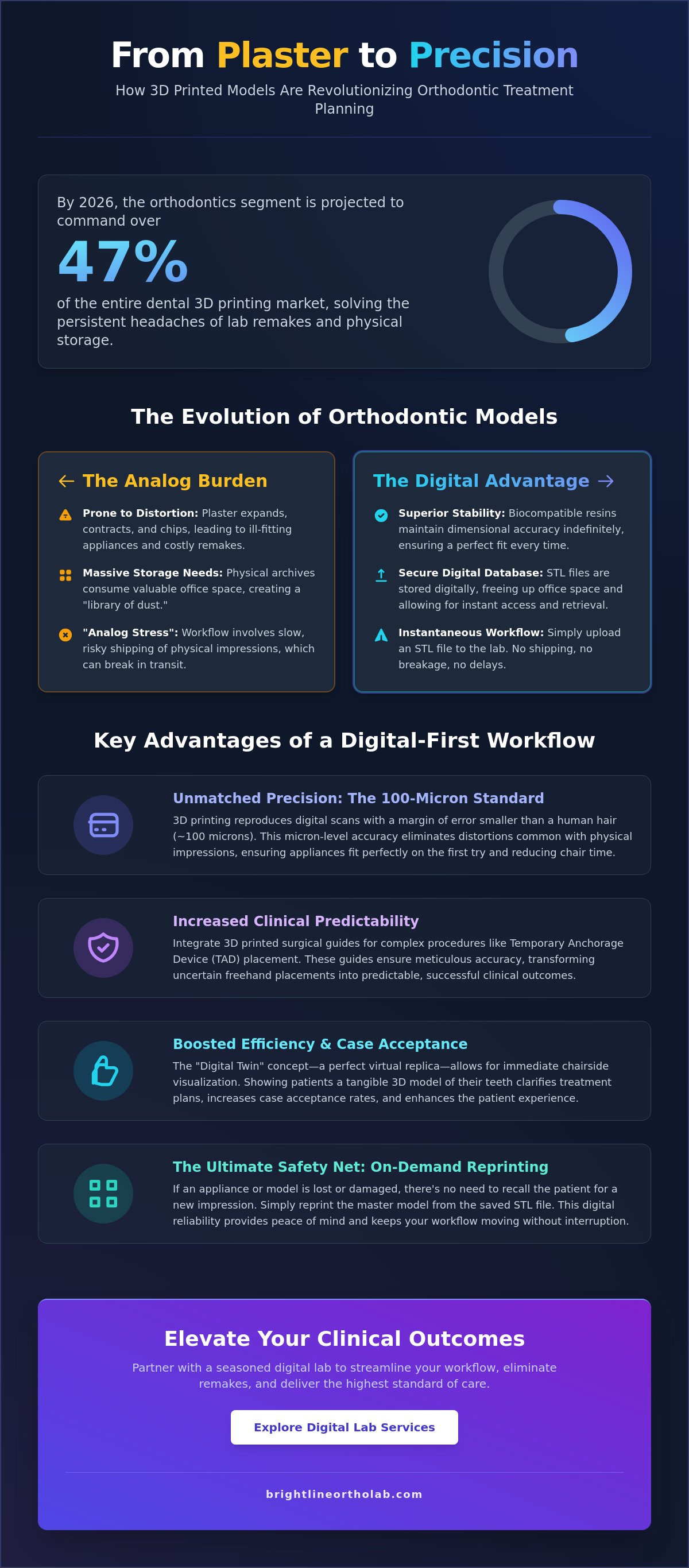
Did you know that by 2026, the orthodontics segment has grown to command over 47% of the entire dental 3D printing market? This massive shift toward using 3d printed models for treatment planning isn't just about following a digital trend; it's about solving the persistent headaches of lab remakes and storage rooms overflowing with dusty plaster. You've likely experienced the frustration of a distorted impression leading to an ill-fitting expander or the clinical uncertainty that comes with freehand miniscrew placement. It's a logistical stress that can weigh down even the most efficient practices.
We're here to help you navigate this digital evolution with confidence and ease. Integrating high-fidelity 3D models and surgical guides into your workflow ensures your appliances fit perfectly the first time, every time. This article explores how seamless STL file integration and advanced software like 3Shape Ortho System or iTero Treatment Studio provide the meticulous precision you need for everything from Hawley retainers to complex surgical interventions. You'll discover how to elevate your clinical outcomes while simplifying your daily office operations.
Key Takeaways
- Learn why biocompatible resins provide superior stability over traditional dental stone to eliminate appliance distortion and resolve physical storage issues.
- Discover how using 3d printed models for treatment planning reduces lab remakes by providing a high-resolution, digital-first foundation for every case.
- Increase the predictability of complex clinical scenarios by integrating 3D printed surgical guides for more accurate Temporary Anchorage Device (TAD) placement.
- Simplify your office operations by mastering the digital workflow requirements for high-quality intraoral scans and meticulous model verification.
- Find out how a collaborative partnership with a seasoned lab can elevate your patient clinical outcomes and streamline your appliance fabrication.
The Evolution of Orthodontic Treatment Planning: Digital Models vs. Plaster
For decades, the smell of alginate and the weight of plaster models defined the orthodontic office. Those days are fading fast. Today, 3D printed orthodontic models act as high-resolution resin replicas of a patient's dentition, offering a level of detail that traditional stone simply cannot match. By using 3d printed models for treatment planning, you're moving away from the fragility of dental stone, which is prone to expansion, contraction, and chipping. Biocompatible resins provide a stable, durable alternative that maintains its dimensions indefinitely, ensuring your master cast remains accurate from the day it's printed until the appliance is delivered.
This shift is central to modern digital dentistry workflows. In 2026, we often refer to the "Digital Twin" concept. This is a complete virtual representation of your patient's oral anatomy. While the digital file is the primary record, the 3D printed model is the tangible bridge that allows you to hold that data in your hands. It's a perfect physical manifestation of the digital scan. Beyond clinical accuracy, the environmental benefits are clear. Eliminating physical model archives frees up valuable square footage in your office. You're no longer managing a library of dust-collecting plaster; you're managing a secure, searchable digital database.
Why Accuracy Matters: The 100-Micron Standard
In orthodontics, we deal in tiny movements. The threshold of clinical significance usually sits around the 100-micron mark. Anything less accurate can lead to appliances that don't seat correctly or tooth movements that don't go as planned. Intraoral scans offer superior volumetric stability compared to traditional impressions, which often distort during the setting or shipping process. Micron-level accuracy in 3D printing refers to the ability of the printer to reproduce the digital scan with a margin of error smaller than the width of a human hair.
Overcoming the 'Analog Stress' in Orthodontic Practices
Think about the logistical burden of shipping physical impressions. It involves boxes, bubble wrap, and the constant risk of the lab calling to say the model arrived broken. Digital models eliminate this "analog stress" entirely. You simply upload an STL file, and the production process begins. This speed allows for immediate chairside treatment visualization. When you can show a patient a 3D model of their own teeth and explain the treatment plan, case acceptance rates naturally climb. It transforms a complex clinical explanation into a clear, visual conversation. It's about making the process as smooth for you as it is for the patient.
Maximizing Precision in Appliance Fabrication with 3D Printed Models
Precision in the digital phase is only valuable if it translates to the physical appliance. When you transition from a virtual setup to a tangible device, 3D printed models act as the definitive master cast. Unlike traditional dental stone, which can expand or contract during the setting process, biocompatible resins maintain their shape with meticulous accuracy. This stability is vital during thermoforming. Recent studies highlighting the accuracy of 3D-printed orthodontic appliances show that resin models significantly reduce "spring-back" and material distortion. By using 3d printed models for treatment planning, you ensure that the physical boundaries of the appliance align perfectly with your digital intentions.
These models also bridge the gap between modern technology and time-tested craftsmanship. Even when incorporating traditional wire-bending techniques, a resin model provides a durable surface that won't chip or abrade during the fabrication process. This durability ensures that the final product maintains its intended dimensions through every stage of production. Perhaps the greatest logistical advantage is the "reprintable" nature of digital files. If an appliance is lost or damaged during shipping or chairside delivery, you don't need to recall the patient for a new impression. You simply reprint the master model from the existing STL file and start again. This reliability is a cornerstone of our digital lab services, designed to keep your practice running without interruption.
Perfecting the Fit for Hawley and Essix Retainers
Achieving superior clasp adaptation for hawley retainers depends entirely on the accuracy of the underlying model. 3D printed models allow for digital articulation, which helps identify and minimize potential occlusal interference before the wire is even bent. For Essix retainers, using high-temperature resistant resins prevents model deformation during the vacuum-forming process. This ensures a crisp, snap-fit that improves patient comfort and compliance from day one.
Custom RPE and Expander Precision
Planning rapid palatal expanders requires a deep understanding of the patient's unique palatal vault. 3D printed master casts allow us to verify band fit and screw alignment with a level of detail that plaster cannot offer. If the model is accurate to within 100 microns, the expander will seat with minimal pressure. This precision directly reduces the time you spend on clinical adjustments during the expansion phase, making the entire process more predictable for you and your patient.
The Strategic Advantage: 3D Printed Surgical Guide for Orthodontics
While 3D models are essential for fabricating appliances, their role in guided surgery represents the absolute pinnacle of digital precision. We identify the 3D printed surgical guide as the ultimate solution for complex cases where margins for error are non-existent. These guides are specifically designed to facilitate the placement of Temporary Anchorage Devices (TADs), providing a physical template that directs your drill and miniscrew into the ideal position. By using 3d printed models for treatment planning in conjunction with CBCT data, you can merge surface anatomy with internal bone structures. This integration creates a "safe zone" for miniscrew insertion, ensuring the device is placed exactly where the bone is thickest and the roots are furthest apart.
This approach virtually eliminates the risks associated with root proximity. In a freehand environment, even a seasoned expert faces the challenge of "blind" placement. Digital planning removes that uncertainty. You can visualize the trajectory of the miniscrew in three dimensions before you ever touch the patient. This level of meticulousness protects the patient’s periodontal health and ensures the anchorage device remains stable throughout the duration of treatment. It’s a supportive technology that simplifies one of the most technically demanding procedures in modern orthodontics.
Guided TAD Placement: Step-by-Step Clinical Benefits
The transition from a digital plan to a clinical result is seamless when you follow a guided protocol. The benefits include:
- Pre-surgical Verification: Use your 3D models to verify bone density and cortical thickness at the intended site before the patient arrives.
- Coordinate Transfer: Precision digital coordinates from your planning software are transferred directly to the physical guide, ensuring sub-millimeter accuracy during the procedure.
- Patient Comfort: Guided insertion significantly minimizes surgical duration, reducing chair time and post-operative discomfort for a more reassuring patient experience.
Minimizing Remakes and Failures with Guided Orthodontics
The longevity of an anchorage device depends entirely on its initial stability. Surgical guides eliminate the guesswork of freehand placement, ensuring the miniscrew achieves maximum cortical engagement. This precision reduces the rate of premature failures, which often occur due to poor bone quality or accidental root contact. When your anchorage is predictable, your entire treatment plan stays on track. Integrating surgical guides into your complex anchorage cases provides a clear return on investment by preventing the clinical failures and emergency appointments that disrupt your practice schedule.
Streamlining the Digital Workflow: From STL File to Finished Appliance
The efficiency of a modern practice depends on the speed and clarity of the digital handoff. Unlike traditional impressions that spend days in a courier truck, digital files move across the country in seconds. This instant transmission is the first step in using 3d printed models for treatment planning to shorten your turnaround times. Most intraoral scanners export in STL or PLY formats. While STL is the industry standard for geometry, PLY files include color data that can help our technicians distinguish between soft tissue and restorative materials. Once we receive your file, our first priority is verifying the accuracy of 3D printed dental models against the original scan data to ensure no detail was lost in translation.
Clear lab prescriptions are just as vital in a digital environment as they were in the analog era. Because we aren't looking at a physical stone model together, your digital notes serve as our primary roadmap. Precise instructions regarding clasp placement or expansion screw orientation prevent the back-and-forth that slows down production. When you combine high-quality scans with detailed prescriptions, you create a synchronized workflow that allows us to move from file receipt to 3D printing in a fraction of the time required for traditional stone casting. If you're ready to experience this level of efficiency, you can start your digital case submission through our secure portal today.
Optimizing STL File Quality for Lab Submission
A successful 3D print starts with a clean scan. Common errors like holes in the mesh or "floating" artifacts can cause the printing software to misinterpret the geometry, leading to model failures. It's especially important to ensure a deep, clear capture of the gingival margin and the palate when you're planning for Rapid Palatal Expanders (RPE). We recommend performing a quick digital "trim" in your scanner software to remove excess cheek or tongue data before sending. This creates a cleaner file that's ready for immediate processing and printing.
Communication Protocols for Digital Orthodontic Labs
Digital portals have transformed how we track and manage cases. You don't have to wonder where your appliance is in the production line; you can see real-time updates through our case management system. This transparency allows for a more collaborative partnership. We can share digital setups with you for approval before we ever hit "print," allowing you to request adjustments chairside. This proactive communication reduces remakes and ensures the final appliance meets your exact clinical standards the moment it arrives at your office.
Partnering with Brightline Ortho Lab for Your 3D Printing Needs
Choosing a laboratory partner is about more than just finding someone to print a file; it's about finding an ally who understands the nuances of your clinical goals. With nearly two decades of industry experience, Brightline Ortho Lab serves as a seasoned expert in the transition from analog to digital. We don't just process orders. We act as a collaborative extension of your team, providing the technical support you need to alleviate logistical stress. By using 3d printed models for treatment planning through our facility, you gain access to a partner that has seen every possible clinical scenario and remains unfazed by complexity.
We believe that modern adaptability should never come at the expense of traditional craftsmanship. Our team is dedicated to supporting you as you navigate transitioning to a digital ortho lab, making the process feel simplified rather than overwhelming. Whether you're sending your first scan or your thousandth, our commitment to precision engineering and meticulous quality control remains the same. We take pride in our history of reliability and remain focused on the immediate needs of your practice.
Our Technology Stack: Precision at Every Layer
Accuracy is the heartbeat of our operation. We utilize medical-grade, biocompatible resins for all printed models, ensuring that every master cast is safe for intraoral use and dimensionally stable. Our facility employs rigorous calibration protocols to verify that every physical print matches your STL file exactly. However, technology is only half of the equation. The "human touch" is what sets us apart. Our experienced technicians review every digital file for clinical viability before production begins. If we spot a potential issue with a scan or a prescription, we reach out to discuss it, ensuring the final appliance is right the first time.
Getting Started with Brightline’s Digital Services
Connecting with us is a straightforward, action-oriented process. Our portal is designed to integrate seamlessly with your intraoral scanner, allowing you to upload files and track cases in real time. If you're new to using 3d printed models for treatment planning, we recommend trialing our services with your next Hawley retainer or RPE case. You'll see firsthand how our high-fidelity models improve appliance fit and reduce chairside adjustment time. Our goal is to accommodate your workflow and simplify your day. Contact Brightline Orthodontic Lab to start your digital case today and experience the difference that meticulous partnership makes.
Advancing Your Practice with Digital Precision
Transitioning to a fully digital workflow is a significant step toward clinical excellence and operational efficiency. By using 3d printed models for treatment planning, you ensure that every appliance, from a simple retainer to a complex surgical guide, is built on a foundation of micron-level accuracy. This shift eliminates the logistical burden of plaster storage and the frustration of lab remakes, allowing you to focus on what matters most: your patients. You've seen how digital integration simplifies communication and provides predictable outcomes for even the most challenging cases.
Brightline Orthodontic Lab is here to support you as your reliable ally in this evolution. As a US-based national laboratory founded on over 18 years of industry experience, we specialize in precision-engineered custom appliances that meet the highest standards of quality. We invite you to Partner with Brightline for Precision 3D Printed Solutions and see how our meticulous approach can serve as an extension of your own team. Let's work together to make your practice more efficient and your clinical results more predictable than ever before.
Frequently Asked Questions
Are 3D printed models as accurate as traditional stone models?
3D printed models are generally more accurate than traditional stone models because they eliminate the dimensional instability inherent in dental plaster. While stone models can expand or contract during the setting process, biocompatible resins maintain meticulous accuracy to within 100 microns. This stability ensures that the physical model is a perfect reflection of the digital scan, leading to better-fitting appliances and more predictable clinical results.
What file format does Brightline Ortho Lab require for 3D printing?
We primarily require STL or PLY file formats for all 3D printing projects. STL is the industry standard for geometric data, while PLY files are useful if you need to include color information from your intraoral scan. These open-format files allow for seamless integration into our digital workflow, ensuring your case moves quickly from submission to fabrication without any compatibility issues or data loss.
Can I use a 3D printed surgical guide for TAD placement with any scanner?
Yes, you can use a 3D printed surgical guide for TAD placement with any intraoral scanner that exports open-format STL or PLY files. The guide's accuracy depends on the quality of the initial scan and the subsequent merging with CBCT data. Most modern scanners are fully compatible with our guided surgery workflows, allowing for precise miniscrew placement regardless of your specific hardware brand.
How do 3D printed models handle the heat of appliance thermoforming?
Our 3D printed models are fabricated using high-temperature resistant resins specifically designed to withstand the heat and pressure of thermoforming. Unlike standard resins that might warp or soften, these medical-grade materials maintain their dimensional integrity during the production of Essix retainers or night guards. This ensures that the final appliance retains the exact fit planned during the digital design phase.
What is the typical turnaround time for a 3D printed model and appliance?
Digital transmission significantly shortens the typical turnaround time compared to traditional methods. By using 3d printed models for treatment planning, we eliminate the days spent in transit for physical impressions. While specific times vary based on appliance complexity, most digital cases are processed and shipped within a few business days, helping you get your patients into treatment much faster.
Do I need to store the STL files or will the lab archive them for me?
We maintain a secure digital archive of your files, but we always recommend keeping a copy in your own practice management system for your permanent records. Our digital portal allows you to access and re-order models or appliances from previous scans at any time. This cloud-based storage simplifies your office operations by eliminating the need for physical model rooms while ensuring your data is always accessible.
Is it possible to fabricate a Hawley retainer on a 3D printed model?
Yes, we frequently fabricate Hawley retainers on 3D printed models with exceptional results. The resin surface is durable enough to support traditional wire-bending and acrylic work without the chipping often seen with plaster. Using 3d printed models for treatment planning and fabrication ensures that the clasps and labial bow are adapted to a master cast that won't distort or wear down over time.
What happens if a 3D printed model breaks during appliance fabrication?
If a model breaks during fabrication, we simply reprint it from the original digital file. This is one of the primary benefits of a digital workflow; you never have to recall a patient for a new impression due to a lab accident. We can reproduce the exact master cast in a matter of hours, ensuring that your case stays on schedule with minimal interruption and no extra stress for the patient.