
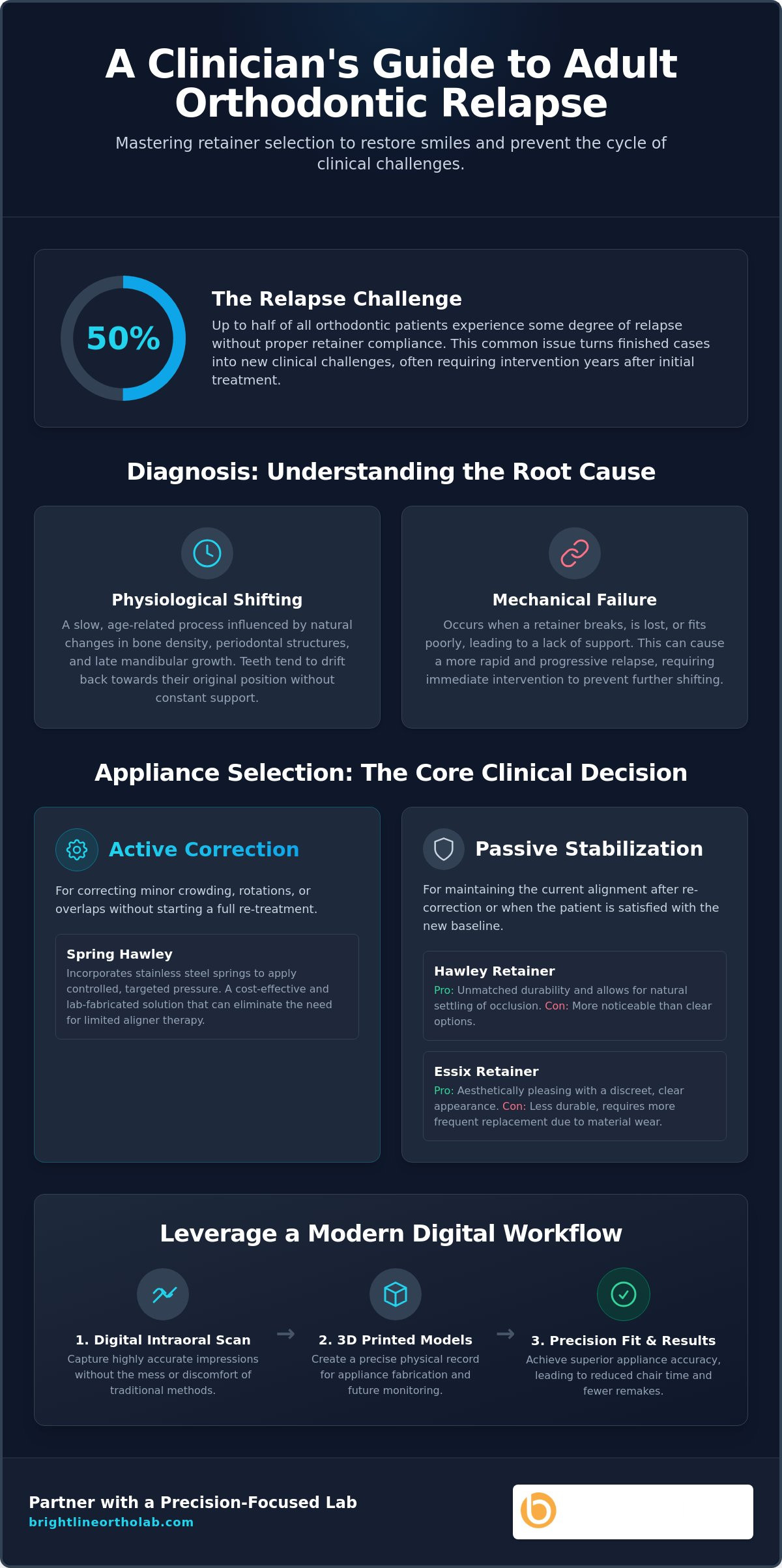
Up to 50% of orthodontic patients experience some degree of relapse if they don't wear their retainers as directed, often turning a finished case back into a clinical challenge. It's a common headache in any busy practice: a patient returns years later with minor crowding and a broken or forgotten appliance. You need a reliable way to address these shifts without necessarily starting from scratch. Mastering retainer selection for adult orthodontic relapse is the key to stopping this cycle and restoring both the smile and the patient's confidence in their care.
You shouldn't have to guess whether a traditional Hawley or a modern Essix is the better fit for a returning adult. We're here to provide a clear clinical framework that simplifies these decisions and helps you leverage digital lab workflows for a more precise fit. This guide walks you through the strengths of various lab-fabricated appliances, from durability concerns to minor tooth movement. You'll learn how to reduce chair time and minimize remakes by matching the right material to each unique relapse case.
Key Takeaways
- Define the difference between minor physiological shifting and structural relapse to choose the most effective clinical path for your patient.
- Master the nuances of retainer selection for adult orthodontic relapse by evaluating when to use active Spring Hawleys instead of passive retention.
- Select the right materials for adult bruxers to maximize appliance longevity and minimize the need for frequent replacements.
- Leverage digital intraoral scanning and 3D printed models to improve appliance precision and reduce your total chair time.
- Learn how a precision-focused lab partnership simplifies your workflow and provides reliable support for complex adult cases.
Understanding the Dynamics of Adult Orthodontic Relapse
Adult orthodontic relapse is the physiological or mechanical shifting of teeth following the completion of active treatment. It often manifests as minor lower anterior crowding or the reopening of a maxillary diastema. While we once viewed retention as a temporary phase, the modern clinical standard has shifted toward a "retainer for life" protocol. This shift acknowledges that the human dentition remains in a constant state of flux throughout a patient's life. Understanding these underlying dynamics is the first step in effective retainer selection for adult orthodontic relapse.
Several factors contribute to these unwanted movements. Late mandibular growth remains a primary culprit for late-stage crowding. As adults age, periodontal changes and a natural decrease in bone density can reduce the resistance of teeth to mesial drift. Additionally, the lack of long-term retention compliance often allows teeth to return toward their original, pre-treatment positions. Identifying whether the shift is a minor aesthetic nuisance or a significant structural relapse is essential for determining if the patient needs simple stabilization or a full course of re-treatment.
Physiological Shifting vs. Mechanical Failure
Distinguishing between these two types of relapse is vital for a successful outcome. Physiological shifting is a slow, age-related process influenced by changes in the supporting structures. The "neutral zone," where the forces of the tongue are balanced by the cheeks and lips, can narrow over time. If teeth were originally moved outside this zone, they will naturally migrate back without constant support. Mechanical failure, on the other hand, occurs when an appliance breaks or fits poorly. Identifying when a relapse is stable versus progressive helps you decide if immediate intervention is required to prevent further collapse.
The Clinician’s Role in Relapse Assessment
Your assessment begins with quantifying the shift. Use established protocols to measure the Degree of Irregularity (DI). This data directly informs your choice of appliance. Before prescribing a new regimen, evaluate the patient's compliance history. If they struggled with removable options in the past, they might need a different approach now. We recommend using 3d printed dental models to establish an accurate baseline record of the current occlusion. These models provide a precise reference point for retainer selection for adult orthodontic relapse and future monitoring. High-quality Orthodontic retainers are the primary defense against these changes, provided they are matched to the patient's current biological reality and lifestyle needs.
Appliance Options for Adult Orthodontic Relapse
When a patient returns with minor crowding, your first clinical decision involves determining if you're just holding the line or moving teeth back. Passive appliances maintain the current state, while active appliances provide the mechanical force needed for minor correction. This distinction is the core of effective retainer selection for adult orthodontic relapse. Choosing the right tool depends on the severity of the shift and the patient's willingness to comply with a new treatment phase.
Active Retainers: Correcting Minor Rotations
Active appliances, specifically the Spring Hawley, offer significant mechanical advantages for mandibular incisor crowding. By incorporating a stainless steel spring into the acrylic, you can apply controlled pressure to correct minor rotations or overlaps. When you fill out your lab slip, clearly specify the activation levels required for the desired movement. In many cases, these active retainers eliminate the need for more expensive limited aligner therapy. They provide a cost-effective, lab-fabricated solution for the patient and the practice alike.
Passive Stabilization: Maintaining the New Baseline
For patients who are satisfied with their current alignment or have just completed active re-correction, passive stabilization is the priority. Hawley retainers remain a gold standard here due to their incredible durability. Unlike clear vacuum-formed options, they allow for natural "settling" of the occlusion, which is often beneficial for adult bites. Aesthetic-conscious adults often prefer Essix retainers for their discreet appearance. These clear appliances offer a sleek look but require more frequent replacement due to material wear. Selecting between these options is a critical part of retainer selection for adult orthodontic relapse, as the wrong choice can lead to patient frustration or further tooth movement.
For a contemporary overview of orthodontic retainers, clinicians should consider how the patient's lifestyle and bruxism habits will impact the appliance's lifespan. Some cases demand a "belt and braces" approach. A fixed lingual retainer provides permanent security for lower anterior teeth, which are most prone to relapse. Pairing this with a removable Essix or Hawley for nighttime wear ensures the entire arch remains stable. Our team is ready to help you design the perfect appliance for your next relapse case, ensuring the best possible outcome for your patients.
Material Selection and Durability in Adult Retention
Selecting the right material is just as critical as choosing the appliance design itself. Adult patients often present with occlusal forces that would quickly destroy a standard adolescent retainer. When you approach retainer selection for adult orthodontic relapse, you must account for years of potential wear, staining, and physiological changes. This requires a shift from generic plastics to high-performance, biocompatible materials that can withstand the rigors of the adult oral environment. Precision lab fabrication ensures these materials maintain consistent density, providing the structural integrity needed for long-term success.
Durability isn't just about resisting breakage; it's about maintaining the appliance's fit and function over time. For clear thermoformed options, the choice between materials like Essix ACE and Essix C+ is pivotal. While ACE offers superior clarity for the most aesthetic-conscious patients, C+ is engineered for better wear resistance and is less likely to crack under heavy occlusal loads. Matching the material to the patient's specific lifestyle and dental history reduces the logistical stress of frequent remakes and keeps your clinical outcomes predictable.
Addressing the Bruxism Factor
Adult relapse cases frequently coincide with increased stress-related clenching or grinding. If you notice flattened cusps or wear facets during your assessment, a standard thin vacuum-formed material won't suffice. In these instances, consider fabricating a hard soft night guard that serves as a dual-purpose stabilization tool. These dual-laminates provide a hard occlusal surface to resist grinding while the soft internal layer cushions the teeth. This approach addresses both the relapse and the underlying parafunctional habit, helping you fulfill your long-term retention responsibilities by protecting the patient's dental health alongside their alignment.
Acrylic and Wire Specifications
For Hawley appliances, the choice between cold-cure and heat-cured acrylic significantly affects hygiene and longevity. Heat-cured acrylic is processed under intense pressure, resulting in a denser, less porous material that resists staining and bacterial buildup much better than cold-cure alternatives. This is a vital consideration for adults who may be frequent coffee or tea drinkers. Wire gauge choice is equally important for stability. While a .028 labial bow is standard for light retention, a .032 wire provides the extra rigidity needed when managing retainer selection for adult orthodontic relapse in patients with stronger masticatory musculature. Using high-quality, BPA-free specialty acrylics also ensures biocompatibility for sensitive patients, maintaining tissue health throughout the retention phase.
Clinical Workflow: Digital Integration for Precision Fit
The transition from traditional alginate impressions to intraoral digital scans is more than just a technological upgrade; it's a fundamental shift in clinical accuracy. When managing retainer selection for adult orthodontic relapse, the margin for error is incredibly thin. Digital workflows allow you to capture the current state of a patient's dentition with a level of detail that stone models simply cannot match. This precision ensures that every lab-fabricated appliance, whether it's an Essix or a Hawley, seats perfectly on the first try.
The Digital Advantage in Relapse Management
Moving to an STL-based fabrication process significantly reduces chair time. You no longer have to wait for impressions to set or deal with the logistical delays of physical shipping. By using a digital-ready orthodontic lab, you can upload files instantly, allowing us to begin work immediately. This speed is especially beneficial for adult patients who are eager to stop their teeth from shifting further. We see this as a way to simplify your day and provide your patients with a more comfortable experience.
- Instant Archiving: Permanent digital models mean you can replace lost appliances without a new office visit.
- Dimensional Stability: Digital files don't warp or break like stone models during shipping.
- Improved Patient Experience: Adults appreciate the comfort and modern feel of a digital scan over traditional trays.
Impression and Scan Best Practices
A precision-fit appliance is only as good as the initial scan. To avoid fit issues, ensure you capture the terminal molars and the gingival margins clearly. Soft tissue data is often overlooked but is essential for the stability of the acrylic in Hawley retainers. Common errors, such as "holes" in the scan data near the lingual surfaces, can lead to appliances that rock or fail to seat. Taking an extra minute to verify your scan quality in the software will save significant time during the delivery appointment.
Effective clinical-to-lab communication is the best way to reduce lab remakes and ensure a smooth workflow. When you submit a digital case, include specific notes about the patient's relapse history and any areas of concern. Our 3D printing technology creates a master model that serves as a perfect template for your custom appliance. If you're ready to modernize your practice, send your first digital scan to our team today and experience the difference that precision engineering makes.
Partnering with Brightline for Relapse Excellence
Success in managing adult cases depends on the reliability of your laboratory partner. Choosing a US-based lab with over 18 years of experience ensures that your practice benefits from a deep understanding of orthodontic mechanics and material science. At Brightline, we view ourselves as a collaborative extension of your clinical team. We focus on the meticulous details of every case, allowing you to concentrate on patient care while we handle the complexities of appliance fabrication. Our commitment to using high-quality, biocompatible materials ensures that every retainer selection for adult orthodontic relapse is built for longevity and comfort.
We understand the logistical pressures of a modern dental practice. That's why we've designed our services to accommodate your specific needs, whether you prefer traditional methods or a fully digital workflow. Our technicians blend decades of hand-crafted expertise with modern 3D printing technology to produce appliances that meet the highest standards of accuracy. By streamlining our communication and fabrication processes, we help you reduce remakes and minimize unnecessary chair time. This partnership simplifies your daily operations and provides the dependable support you need for even the most challenging relapse scenarios.
Precision Engineering for Predictable Results
The fit of an appliance is the single most important factor in preventing secondary relapse. If a retainer is uncomfortable or lacks precision, patient compliance will inevitably drop. We use a meticulous fabrication process for our Hawley and Essix appliances, ensuring each one matches the unique anatomy of your patient. This level of precision is achieved through rigorous quality control and a focus on consistent material density. When you partner with us, you gain access to expert support for complex cases. If you're unsure about a specific design or need a custom-tailored solution for a bruxing patient, our seasoned experts are here to provide guidance and ensure predictable clinical results.
Next Steps for Your Practice
Starting your first case with Brightline Orthodontic Lab is a straightforward and efficient process. We've simplified the onboarding experience so you can begin seeing the benefits of precision engineering immediately. You can access our digital submission portal to upload STL files or download our standard prescription forms for traditional cases. If you have a unique clinical challenge, we encourage you to request a consultation for custom appliance designs. We'll work closely with you to determine the best retainer selection for adult orthodontic relapse based on your patient's specific needs. Let us help you elevate your retention protocols and provide your patients with the stability they deserve.
Securing Long-Term Stability for Your Patients
Managing adult orthodontic relapse doesn't have to be a source of clinical frustration. By understanding the physiological shifts unique to adult patients and matching them with the right active or passive appliances, you can restore alignment with complete confidence. Remember that material durability and digital precision are your most effective tools for reducing chair time and preventing secondary shifts. Successful retainer selection for adult orthodontic relapse transforms a common challenge into an opportunity to reinforce patient trust and demonstrate your commitment to their long-term oral health.
Choosing a lab partner that understands these nuances is the final step toward predictable results. Brightline Orthodontic Lab is founded on over 18 years of industry experience, specializing in the creation of precision-engineered custom appliances. We are a digital-ready lab, accepting STL files to ensure a rapid turnaround and a meticulous fit for every case. Partner with Brightline Orthodontic Lab for your next relapse case to experience the difference that dedicated craftsmanship brings to your practice. We look forward to supporting your team and helping your patients keep their smiles for a lifetime.
Frequently Asked Questions
How much tooth movement can a Spring Hawley retainer realistically achieve?
A Spring Hawley retainer can realistically achieve approximately 1 to 2 millimeters of minor tooth movement. It's specifically designed to correct light anterior crowding or minor rotations that occur after initial treatment. If the relapse involves significant structural changes or root movement, limited aligner therapy or full re-treatment is usually necessary to achieve the desired clinical outcome.
Is an Essix retainer durable enough for an adult with heavy bruxism?
Standard Essix retainers often fail prematurely in adult patients with heavy bruxism. While clear retainers are aesthetically pleasing, the thin thermoformed plastic lacks the structural integrity to withstand intense clenching over time. In these cases, retainer selection for adult orthodontic relapse should lean toward a more durable Hawley retainer or a dual-laminate hard/soft night guard to protect the dentition.
What are the primary clinical indications for a fixed lingual retainer in adults?
Fixed lingual retainers are primarily indicated for patients with a high risk of lower anterior crowding or those with a history of poor compliance with removable appliances. They're also excellent for maintaining a closed maxillary diastema. Pairing a fixed wire with a removable nighttime appliance provides the most security against physiological shifting and ensures the long-term stability of the final result.
Can I use a digital scan to order a Hawley retainer with a custom labial bow?
You can absolutely use a digital intraoral scan to order a Hawley retainer. Our lab uses your STL files to create high-accuracy 3D printed models, which then serve as the foundation for hand-crafting the custom labial bow and acrylic body. This digital integration ensures a superior fit while maintaining the soul of traditional craftsmanship and reducing the need for physical impressions.
How often should an adult patient replace their lab-fabricated retainer?
Adult patients should generally replace their lab-fabricated Hawley retainers every 5 to 10 years, whereas Essix retainers typically require replacement every 1 to 3 years. These timelines vary based on the patient's hygiene habits and the presence of parafunctional habits like grinding. Regular clinical checks help you identify when an appliance has lost its precision or structural integrity and needs updating.
What is the best way to clean and maintain a dual-laminate night guard?
The best way to maintain a dual-laminate night guard is by cleaning it daily with cool water and a soft-bristled brush using non-abrasive soap. Don't use hot water, as it can warp the precision-fit materials and ruin the fit. Store the appliance in a ventilated case when it's not in use to prevent bacterial growth and ensure its longevity throughout the retention phase.
Should I prescribe a Hawley or Essix for a patient with a deep bite relapse?
A Hawley retainer is often the better choice for deep bite relapse because it allows for natural posterior settling. Unlike Essix retainers, which cover the occlusal surfaces and can sometimes exacerbate bite issues, the Hawley design leaves the posterior teeth free to find their natural occlusion. This is a critical factor in retainer selection for adult orthodontic relapse involving vertical dimensions and bite stability.
How do I handle a relapse case if the patient has missing or prosthetic teeth?
For relapse cases involving missing or prosthetic teeth, your lab-fabricated appliance can be customized with pontics or specialized wire configurations. We can design "wraparound" Hawleys that avoid interfering with bridges or implants while still providing stable retention for the remaining natural teeth. Clear communication on the lab slip ensures the appliance accommodates these specific prosthetic challenges without compromising the fit.