
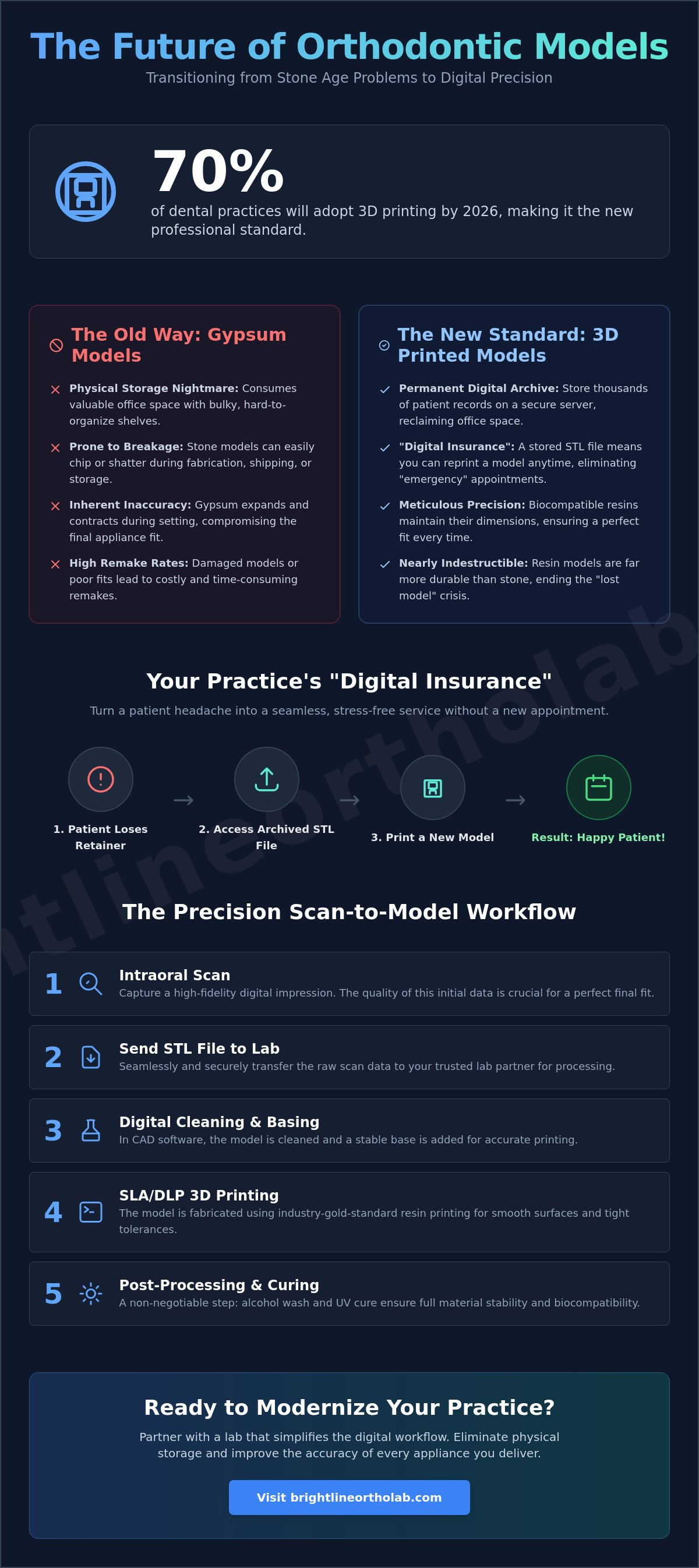
By 2026, 70% of dental practices are expected to adopt advanced 3D printing techniques to streamline their daily operations. This shift represents a major move away from the "stone age" of orthodontics, where physical storage and model breakage often dictate the pace of patient care. You've likely felt the frustration of managing overflowing shelves of plaster or dealing with the high remake rates that come when a traditional model chips or snaps during fabrication.
We understand that your time is best spent with patients, not digging through archives or retaking messy impressions. Using 3d printed retainer models provides a form of "digital insurance" for your practice. If a patient loses their appliance, you can simply pull up their digital file and print a new model without ever calling them back into the chair. This guide will walk you through the precise steps to integrate these digital assets into your workflow, helping you eliminate physical storage and improve the accuracy of every Hawley or Essix retainer you deliver. We'll cover everything from scan-to-print accuracy to the seamless lab handoff that keeps your practice running efficiently.
Key Takeaways
- Understand how transitioning from gypsum to high-precision 3d printed retainer models allows you to reclaim office space and eliminate the risk of model breakage.
- Learn how to optimize your digital workflow by capturing high-fidelity data and streamlining the transfer of STL files to your lab partner.
- Identify the clinical scenarios that still require physical 3D models for traditional appliances, such as Hawley retainers, compared to direct-printed alternatives.
- Gain strategies for verifying model accuracy and maintaining a permanent digital archive to secure your patients' results for the life of their smile.
- Discover how a collaborative lab partnership simplifies the fabrication of specialized appliances, including meticulous hard/soft night guards and sleep devices.
What Are 3D Printed Retainer Models?
At their core, 3d printed retainer models are high-precision resin replicas of a patient's dentition, created directly from an intraoral scan. This technology is a cornerstone of Digital dentistry, allowing us to move away from the traditional, messy gypsum models that have defined the industry for decades. These models are fabricated using UV-cured resins that offer a level of detail and stability that stone simply cannot match. While stone models are prone to chipping and environmental wear, resin models remain stable and accurate over time, ensuring a perfect fit for every appliance we create for you.
The most significant advantage for your practice isn't just the physical model itself; it's the "digital insurance" it provides. By maintaining a stored STL file, you effectively eliminate the need for future "emergency" impression appointments. If a patient calls on a Friday afternoon because they lost their retainer at a restaurant, you don't need to clear a spot in your schedule for a new scan or impression. You simply access the archived file and print a replacement. This creates a seamless, stress-free experience for both your team and your patient, turning a potential logistical headache into a quick, profitable service.
The Evolution from Stone to Resin
Traditional dental stone is notorious for its expansion and contraction variables during the setting process. These micro-movements can compromise the final fit of a retainer, leading to unnecessary chairside adjustments. In contrast, 3d printed retainer models use biocompatible resins that maintain their dimensions with meticulous precision. Because 60% of dental labs in the US have already adopted 3D printing technology as of 2024, this shift is no longer just a trend; it's the new professional standard. Resin models are nearly indestructible compared to their stone counterparts, which means you'll never have to deal with the "lost model" crisis when a plaster arch shatters in the lab or during shipping.
Digital Archiving and Patient Records
Storing physical models is a logistical nightmare that consumes valuable square footage in your office. Orthodontic records must be kept for years to meet legal and clinical requirements, but physical shelves are inefficient and difficult to organize. Transitioning to digital archiving allows you to store thousands of high-fidelity records on a secure cloud server or local drive. This space-saving benefit simplifies your office layout while improving the patient experience. You can offer "one-click" replacements for Hawley or Essix retainers, positioning your practice as a modern, tech-forward ally in your patients' long-term dental health. If a model is ever needed physically, it's just a print job away.
The Digital Workflow: From Intraoral Scan to Physical Model
The journey to a precision-fit appliance starts with a high-fidelity digital impression. Unlike traditional impressions that rely on the setting time of alginate, the digital workflow is instantaneous and allows for immediate verification. Once you capture the data using an intraoral scanner, the next crucial phase is sending STL files for dental models to our lab. We then take that raw data through a series of meticulous digital "cleaning" steps in CAD software, adding a stable base that ensures the model remains upright and accurate during the printing process.
We utilize both SLA (Stereolithography) and DLP (Digital Light Processing) technologies. These methods are the industry gold standard for orthodontic accuracy because they produce smooth surface finishes and tight tolerances. After printing, every model undergoes a rigorous post-processing routine, including an isopropyl alcohol wash and a final UV cure. This step is non-negotiable; it ensures the 3d printed retainer models achieve full material stability and biocompatibility before they reach your office. If you're looking to streamline this process, our team is here to help you manage your digital submissions with ease.
Capturing the Perfect Digital Impression
Successful fabrication begins with the quality of your scan. To ensure a perfect fit for appliances like Rapid Palatal Expanders (RPEs), pay close attention to the palate and the distal-most molars. If the scanner misses these deep undercuts or the soft tissue of the palate, the resulting model will lack the necessary landmarks for a stable appliance. We recommend verifying the scan quality on-screen before the patient leaves the chair. Look for "holes" in the mesh or distorted occlusal surfaces, as these common errors often lead to inaccuracies that require a second appointment.
Lab Processing and Material Selection
Precision is measured in microns. We focus on specific layer thicknesses that balance speed with the extreme detail required for a snug retainer fit. Our lab uses high-impact resins for 3d printed dental models, which provide the durability needed to withstand the pressures of thermoforming. Digital basing plays a vital role here too. By creating a uniform, flat base in the software, we ensure the model doesn't warp or shift during production. This methodical approach guarantees that the 3d printed retainer models we deliver are a true reflection of your clinical expertise.
Direct Printing vs. Fabricating on 3D Printed Models
Choosing between direct-to-print appliances and model-based fabrication is one of the most critical decisions in a modern digital workflow. While emerging technology allows for the direct printing of clear aligners and some retainers, 3d printed retainer models remain the gold standard for clinical versatility and durability. Direct printing can reduce labor by up to 75% in a lab setting, but this speed often comes at the cost of material flexibility. Many clinicians find that traditional thermoformed Essix retainers, when pressed over a high-precision resin model, offer superior tensile strength and a more predictable lifespan for the patient.
Accuracy is another major factor in this debate. For complex cases involving minor tooth movement or specific occlusal requirements, fabricating an appliance over a physical model ensures an intimate fit that direct printing sometimes struggles to replicate. When you have a physical resin model in hand, you can verify the fit and make minor chairside adjustments before the patient leaves. This tactile verification provides a layer of quality control that fully digital workflows can't yet match, especially when balancing the need for in-office speed with lab-grade precision.
When to Choose Model-Based Fabrication
Physical models are indispensable when your treatment plan involves wire-based appliances or orthopedic devices. If you're prescribing Hawley retainers, the lab requires a physical model to meticulously bend the stainless steel framework and adapt the acrylic to the lingual surfaces. This same requirement applies to Rapid Palatal Expanders (RPE) and specialized sleep devices like Dorsal or EMA appliances. Having a physical resin model allows our technicians to ensure the hardware is perfectly seated, preventing the "spring-back" effect often seen with less precise methods. It's the only way to guarantee the appliance performs exactly as intended.
The Limitations of Direct-to-Print Retainers
Material science is the primary hurdle for direct-print retainers. While resins for direct-print aligners are classified as FDA Class II medical devices, they can be more brittle than the high-impact thermoplastics used in thermoforming. This creates a "single point of failure" risk; if a direct-printed retainer cracks, the patient has no backup. Conversely, when you use 3d printed retainer models, you possess a permanent tool that allows for the immediate fabrication of a replacement. Most clinicians prefer this "tried and true" approach because it provides the patient with a more durable appliance while securing the practice with a physical or digital archive for future needs.
Ensuring Accuracy and Archival Success
Verifying the accuracy of your 3d printed retainer models starts the moment they arrive at your practice. Perform a visual inspection of the margins and interproximal spaces; they should appear crisp and free of visible layer lines. If a model looks slightly chalky or feels tacky, it may not have been post-processed correctly, which can lead to dimensional instability. Our lab technicians act as your first line of defense. We identify scan distortions or "noise" in the data before the printing process begins. Precision is our priority. If we spot an issue, we'll reach out to discuss a re-scan, saving you the frustration of a failed appliance delivery later on.
To maintain long-term success, you must manage "digital drift." This occurs when physical models are treated as the primary record instead of the original STL file. Always treat the digital file as your source of truth. If you need to store physical resin models for a short period, keep them in a cool, dark environment. Prolonged exposure to ambient UV light can cause resin to continue curing, which leads to warping and shrinkage. If you're ready to secure your patient records for life, partner with a lab that understands digital accuracy.
Troubleshooting Fit Issues
Fit issues often stem from "noise" in the STL file; these are stray data points that the printer interprets as solid material. This can create small bumps on the model that prevent the retainer from seating fully. Another common culprit is incorrect UV curing times. If the resin is under-cured, it remains soft; if it's over-cured, it can shrink beyond clinical tolerances. Sometimes, a model might fit the patient's mouth perfectly, but the appliance does not. This usually points to a distortion during the thermoforming process or a model that warped because it was left in a hot environment.
Long-Term Archival Strategies
Integrating your digital models into your Practice Management Software (PMS) is the most efficient way to secure your records. Most modern systems allow you to attach STL files directly to the patient's chart, creating a permanent archive that takes up zero physical space. We recommend a "3-2-1" backup protocol: three copies of your data, on two different media types, with one copy off-site. This level of security allows you to offer "Subscription Retainers." Because you have the archived 3D model, you can provide patients with a replacement every six months without ever needing a new scan. It's a powerful way to build patient loyalty while maximizing the value of your digital assets.
Partnering with Brightline for Your Digital Model Needs
Choosing a lab partner is about more than just finding a vendor; it's about finding an extension of your clinical team. At Brightline, we understand that the transition to a digital workflow can feel like a significant logistical shift. We're here to simplify that process. As 60% of dental labs in the US have already adopted 3D printing technology as of 2024, our expertise ensures you aren't just following a trend, but mastering a new standard of care. We provide the technical backbone that allows you to focus on your patients while we handle the meticulous details of 3D fabrication.
Our workflow is designed for total compatibility. We accept STL files from all major intraoral scanners, including iTero, Medit, and 3Shape. This seamless integration means you can send us your data with a few clicks and trust that the resulting 3d printed retainer models will be accurate to the micron. Beyond simple models, we use these digital assets for complex cases, such as fabricating a hard soft night guard with dual-laminate precision. Because we are based in the US, you benefit from reliable shipping and clear, expert communication with technicians who speak your language.
The Brightline Difference: Precision Over Volume
We don't just hit "print" on every file that enters our portal. Our master technicians review every digital submission for clinical viability before production begins. If we detect a scan distortion or a missing landmark, we'll contact you immediately to discuss a solution. We use only premium, biocompatible resins for every model we produce. This commitment to quality ensures that your 3d printed retainer models remain stable and durable, providing the perfect foundation for Hawley retainers, RPEs, or sleep appliances. We're here to support your practice as you move toward the 70% adoption rate expected for advanced 3D printing by 2026.
How to Get Started with Digital Submissions
Starting your digital journey with us is straightforward and efficient. First, we'll help you set up your dedicated portal for secure STL uploads. This centralized system keeps your "digital insurance" files organized and accessible for future needs. Once your files are uploaded, our team gets to work, maintaining methodical turnaround times that keep your patient appointments on track. If you have a complex case or need specific advice on scan techniques, you can contact our master technicians for a personal consultation. We're your reliable ally in the digital era, ensuring every appliance fits perfectly the first time.
Securing Your Practice with Digital Precision
Embracing a digital workflow is more than a technological upgrade; it's a commitment to long-term clinical excellence and patient convenience. By integrating 3d printed retainer models into your daily routine, you effectively eliminate the logistical burden of physical storage while providing a permanent "digital insurance" policy for every smile you treat. You've seen how these high-precision resin replicas offer superior stability over traditional stone, ensuring that replacements and adjustments are handled with meticulous accuracy.
Our team at Brightline Orthodontic Lab is ready to act as a reliable ally for your practice. With over 18 years of specialized experience and a team of US-based technicians, we provide the clear communication and craftsmanship your cases deserve. Our systems are fully compatible with iTero, 3Shape, and Medit scanners, making it easier than ever to submit your data and receive a precision-fit appliance. We're here to simplify your workflow and support your success in this evolving digital landscape.
Streamline your practice today—Upload your STL files to Brightline Orthodontic Lab. We look forward to helping you provide the best possible care for your patients.
Frequently Asked Questions
How accurate are 3D printed dental models compared to traditional stone?
3D printed models offer superior accuracy because they eliminate the expansion and contraction variables inherent in gypsum. While dental stone can shift slightly during the setting process, UV-cured resins maintain their dimensions with meticulous precision. This results in a more intimate fit for the final appliance and significantly reduces the need for chairside adjustments. You can trust that the digital replica is a true reflection of the patient's dentition.
Can I use any intraoral scanner to send files for 3D printed models?
You can use any intraoral scanner that exports files in a standard STL format to send data for 3d printed retainer models. Our lab is fully compatible with all major systems, including iTero, 3Shape, and Medit. This flexibility allows you to integrate our services into your existing digital workflow without the need for proprietary hardware or expensive software upgrades. It's a simple, streamlined process that supports your practice's efficiency.
How long do 3D printed resin models last in storage?
3D printed resin models can last for several years when stored in a cool, dark environment. Unlike stone models that are prone to chipping or snapping over time, resin is highly durable and impact-resistant. However, you must keep them away from direct sunlight or ambient UV light. Prolonged exposure can cause the resin to continue curing, which eventually leads to warping, shrinkage, or brittleness that compromises the model's accuracy.
Do I still need a physical model if I am only ordering Essix retainers?
Yes, a physical 3D printed model is still necessary for fabricating Essix retainers through the traditional thermoforming process. The model serves as the precise mold over which the thermoplastic material is heated and vacuum-formed. While some emerging technologies explore direct printing for appliances, using a high-impact resin model remains the most reliable method for ensuring the strength, clarity, and predictable fit of a clear retainer.
What is the best way to clean a 3D printed retainer model?
Clean your 3D printed models using mild soap and lukewarm water for routine handling in your office. Avoid using harsh chemicals, alcohol-based wipes, or high-heat sterilization, as these can distort the resin's dimensions or degrade the surface finish. If you are preparing a model for long-term archiving, ensure it is completely dry before placing it in a protective container to prevent any surface degradation or moisture-related issues over time.
Can 3D printed models be used to fabricate Hawley retainers and expanders?
3D printed models are ideal for fabricating traditional appliances like Hawley retainers and Rapid Palatal Expanders (RPE). These models provide a stable, high-fidelity foundation that allows our technicians to bend wire and adapt acrylic with extreme precision. The durability of the resin ensures the model won't break during the complex laboratory steps required for these specialized orthodontic devices, leading to a more dependable result for your patient.
What happens if my 3D printed model doesn't fit the patient?
Contact our master technicians immediately if a model or appliance doesn't fit your patient as expected. Most fit issues arise from "noise" in the initial scan data or distortions captured during the intraoral scanning phase. We review every digital file for clinical viability before printing, but if an error occurs, we'll work closely with you to identify the cause and coordinate a re-scan if necessary to ensure a perfect fit.
Are the resins used in 3D printing safe for clinical environments?
The resins used for 3d printed retainer models are safe and specifically formulated for professional dental laboratory environments. While the models themselves are used for fabrication and do not stay in the patient's mouth, the materials meet rigorous industry standards for stability and biocompatibility. We use high-quality, UV-cured resins that ensure a safe, professional experience for your staff while maintaining the soul of traditional craftsmanship through modern technology.