
Is your chairside time being swallowed by complex titration and patient complaints about appliance bulk? It's a common frustration for clinicians who want to provide effective care without the logistical headaches. When you're deciding between a dorsal vs ema sleep appliance, you aren't just choosing a piece of hardware; you're selecting the clinical foundation for your patient's treatment. We understand that finding the right balance between durability for heavy bruxers and comfort for sensitive patients is what separates a successful sleep practice from one bogged down by constant adjustments.
With an estimated 30 million adults in the U.S. suffering from obstructive sleep apnea, the need for reliable, custom-fabricated oral appliances has never been greater. This guide will help you master the clinical differences between these two leading designs so you can optimize patient outcomes and streamline your workflow. You'll learn how to match specific patient profiles to the right mechanics, ensuring higher compliance and predictable results. We'll break down the mechanical advantages of interlocking fins versus elastic tension, helping you make a confident selection every time.
Key Takeaways
- Identify the core mechanical differences of the dorsal vs ema sleep appliance to better align treatment with specific patient jaw mobility and anatomy.
- Recognize clinical indicators, such as limited vertical opening or heavy lateral bruxism, that dictate whether a fin-based or strap-based design is the superior choice.
- Manage patient expectations regarding long-term maintenance; specifically, the 6-12 month replacement cycle for EMA elastic straps versus the structural durability of Dorsal fins.
- Optimize your chairside workflow by implementing precise bite registration techniques at 50-70% protrusive to ensure a predictable lab fit and fewer adjustments.
- Discover how a collaborative partnership with an experienced lab helps you troubleshoot complex titration cases and improve overall patient compliance.
Understanding the Mechanics: EMA vs. Dorsal Sleep Appliances
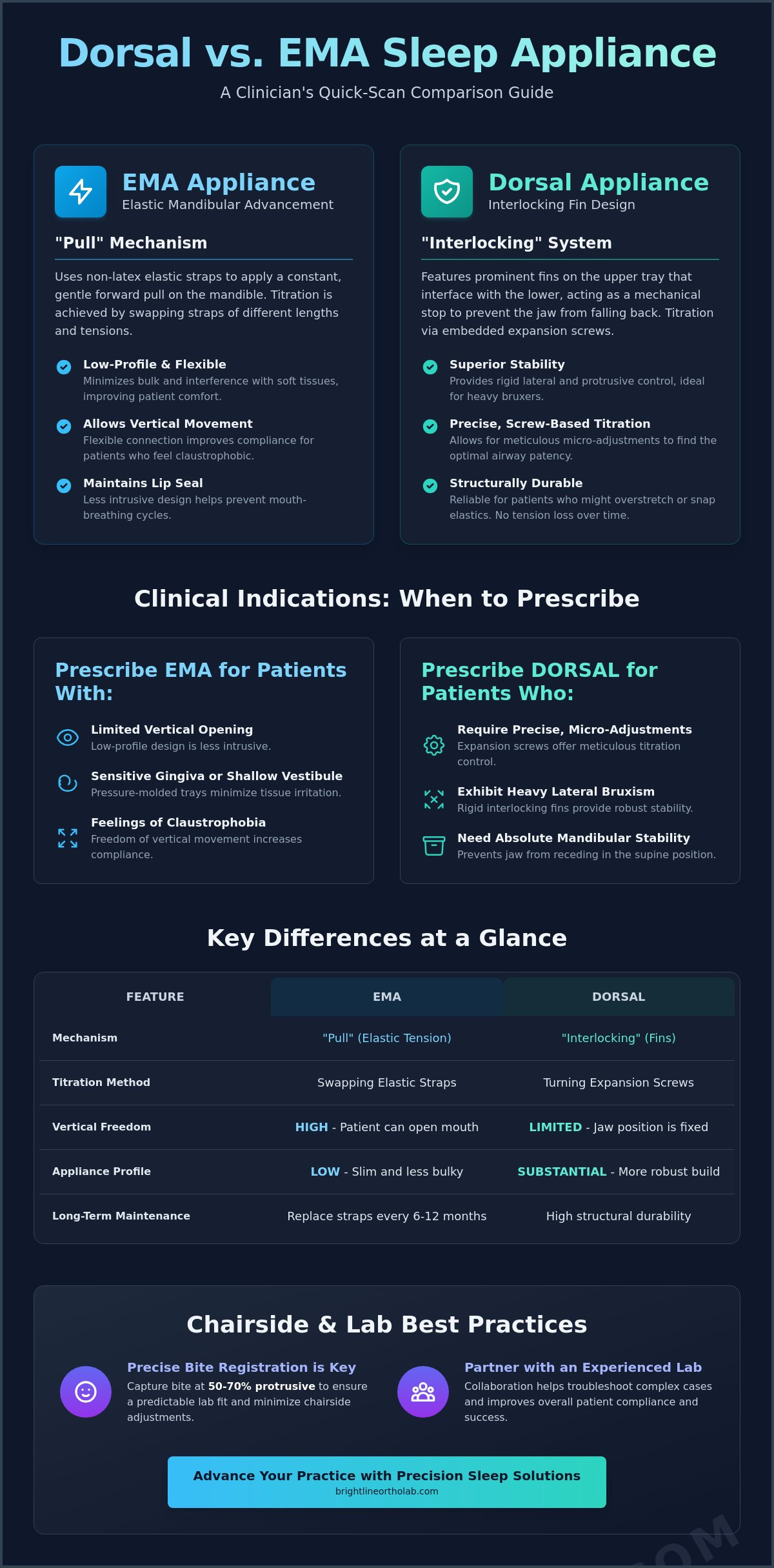
Both the EMA and the Dorsal fall under the broad category of a Mandibular advancement splint. Their fundamental objective is the same: they physically prevent the tongue and soft tissues from collapsing into the airway during sleep. However, the mechanical execution differs significantly. When evaluating a dorsal vs ema sleep appliance, you're choosing between a "pull" system and an "interlocking" system. One relies on elastic tension to guide the jaw, while the other uses physical blocks to maintain a fixed position.
The "Pull" Mechanism of the EMA
The EMA (Elastic Mandibular Advancement) system consists of two pressure-molded trays connected by non-latex elastic straps. These straps apply a constant, gentle forward pull on the mandible. You can titrate the device easily by swapping the straps for different lengths or levels of firmness. Shorter straps provide more advancement, while different colors signify varying elastic tension. This design is exceptionally low-profile. It's an excellent choice for patients who struggle with the bulky feel of traditional appliances. Because the connection is flexible, patients maintain the ability to open their mouths vertically. This freedom often improves compliance for patients who feel claustrophobic with a locked jaw.
The "Interlocking" Stability of the Dorsal Fin
The Dorsal appliance utilizes a two-piece design where the upper tray features prominent "fins" that interface with the lower tray. These fins act as a mechanical stop. When the patient lies in a supine position, the fins prevent the mandible from falling backward. This interlocking relationship provides superior lateral and protrusive stability. Titration occurs via expansion screws embedded in the upper component. By turning these screws, you move the fins forward in precise, incremental steps. This setup is particularly effective for patients who need a more rigid mandibular position. It's a dependable solution for those who might overstretch or snap elastics in other designs. The Dorsal ensures the jaw remains in the desired protrusive position throughout the night without relying on material tension.
Choosing the right mechanics depends on your patient's specific needs. If your patient values vertical movement and a slim profile, the EMA is often the winner. If they need absolute stability and a device that won't lose tension over time, the Dorsal is your reliable ally. Both devices effectively increase oropharyngeal airway space, but the way they achieve that result will dictate the patient's long-term success and comfort.
Clinical Indications: When to Prescribe Dorsal vs. EMA
Selecting the ideal device isn't a matter of clinical habit. It's a decision driven by the unique anatomical and physiological presentation of your patient. When you weigh the dorsal vs ema sleep appliance, you must look beyond the diagnosis of OSA and evaluate the environment where the appliance will live. A patient's dental history, arch shape, and even their ability to breathe through their nose will often dictate which mechanism will yield the highest compliance and the best clinical outcome.
The EMA is frequently the preferred choice for patients with limited vertical opening or those with sensitive gingiva. Because the trays are pressure-molded and low-profile, they minimize interference with the soft tissues. This design also facilitates a better natural lip seal. Maintaining a lip seal is critical for preventing the mouth-breathing cycle that can exacerbate snoring and airway collapse. If your patient has a shallow vestibule or struggles with the bulk of traditional devices, the EMA offers a supportive, less intrusive solution.
Conversely, Dorsal appliances are excellent for patients who require precise, screw-based titration. If you're managing a case where micro-adjustments are necessary to find the "sweet spot" for airway patency, the expansion screws in a Dorsal provide a level of meticulous control that elastic straps cannot match. You can find more specific case types in this guide to indications for dorsal appliance. These devices are particularly effective for patients who need rigid stability to prevent the jaw from receding during supine sleep.
Anatomical Considerations for Appliance Selection
Evaluate the patient’s arch shape and existing dental restorations before making your final call. Tapered arches may lack the surface area needed for certain retention components, while heavy restorations might require a more flexible fit. Periodontal health also plays a significant role; the "pull" of an EMA strap distributes forces differently than the "stop" of a Dorsal fin. To ensure accuracy from the start, the George Gauge protocol should be used to capture a precise initial bite registration at the desired protrusive position.
Comparison Framework for Clinicians
Understanding the impact on the Temporomandibular Joint (TMJ) is vital for long-term success. The Clinical Guidelines for Oral Appliance Therapy emphasize that appliance choice should minimize potential side effects while maximizing efficacy. Use this framework for your next consultation:
- Lateral Movement: The EMA allows for significant lateral excursions, whereas the Dorsal is more restrictive.
- Vertical Opening: EMA permits mouth opening during sleep; the Dorsal design generally keeps the mandible closed.
- Titration Style: Choose EMA for strap-based simplicity or Dorsal for screw-based precision.
Working with a lab that understands these nuances simplifies your chairside experience and ensures the final appliance fits the patient's anatomy perfectly on the first try.
"Will this appliance break if my patient grinds their teeth?" This is the most common question we hear from clinicians during the selection process. It's a valid concern because appliance failure leads to frustrated patients and lost chairside time. When comparing a dorsal vs ema sleep appliance, the answer depends on the specific vectors of force the patient exerts. You aren't just choosing a design; you're managing the lifecycle of the material under repetitive stress.
EMA appliances utilize pressure-molded trays that are generally thinner and more flexible than the PMMA acrylic used in Dorsal designs. While the trays themselves are robust, the elastic straps are essentially consumables. They experience elastic fatigue and typically require replacement every 6 to 12 months. If you don't educate the patient on this schedule early, they may perceive strap failure as a product defect rather than standard maintenance. Providing a few extra straps during the initial fitting can alleviate this stress and empower the patient to manage their own care.
Dorsal appliances offer a different durability profile. The acrylic is harder and the fins are either chemically bonded or precision-milled into the structure. This makes the device feel exceptionally solid and dependable. However, extreme lateral bruxers can put immense shear stress on those fins. If the patient has a history of snapping other appliances, the rigid nature of the Dorsal might lead to fractures where a more flexible device would simply give. It's a trade-off between the "set and forget" nature of the Dorsal and the flexible maintenance of the EMA.
The Impact of Sleep Bruxism
Lateral forces are the primary enemy of appliance longevity. The EMA’s inherent flexibility allows for lateral excursions, which can actually reduce TMJ strain and prevent the trays from de-bonding. If your patient is a heavy grinder, the flexibility of the straps acts as a shock absorber for the joint. We recommend sourcing these from a high-quality dental lab for sleep apnea appliances to ensure the material thickness is optimized for both comfort and strength. A well-fabricated tray distributes grinding forces across the entire arch, protecting individual teeth from excessive wear.
Titration Protocols and Maintenance
Titration protocols vary significantly between the two designs. For the EMA, you'll need to follow a specific EMA appliance titration guide to swap straps as the patient acclimates. This keeps the advancement progressive and gentle. Contrast this with the process of adjusting a dorsal appliance, which uses a precision expansion screw. This screw allows for micro-adjustments without the need to remove and replace components. To prevent bacterial buildup on either device, advise your patients to use dedicated home-care kits and avoid abrasive toothpastes that can create micro-scratches in the material.
Lab Requirements for Precision Sleep Appliance Fabrication
Precision at the lab bench begins with meticulousness at the chairside. Whether you are prescribing a dorsal vs ema sleep appliance, the quality of your records determines the success of the entire titration process. A poor fit doesn't just frustrate the patient; it creates a cycle of remakes and adjustments that drain your practice's profitability. Modern digital workflows, including the use of 3d printed dental models, have significantly reduced these errors by providing a more stable and accurate foundation for appliance fabrication.
Digital Scans vs. Traditional Impressions
Digital scans offer a distinct advantage when capturing the deep undercuts required for EMA tray retention. STL files allow us to visualize the anatomy with a level of detail that traditional stone models often lose during the pouring process. If an appliance is lost or damaged, having a digital record on file simplifies the replacement process; we can fabricate a new device without requiring the patient to return for new impressions. To avoid lab delays, ensure your scan data is "clean" by checking for these three elements:
- Capture at least 3-5mm of gingival tissue beyond the cervical margins.
- Ensure the distal surfaces of the second molars are fully recorded.
- Verify that there are no "holes" or distorted data in the buccal segments.
Bite Registration Accuracy
A protrusive bite registration is non-negotiable for any mandibular advancement device. We generally recommend taking the bite at 50% to 70% of the patient’s maximum protrusion. Using a George Gauge or a similar device ensures this measurement is repeatable and precise. If the registration is inaccurate, you risk an "open bite" scenario where the appliance doesn't seat properly or forces the jaw into an uncomfortable position. For Dorsal appliances specifically, please include clear instructions regarding the desired fin height. Standard fins work for most, but patients with deep bites or specific lateral movement needs may require customized fin dimensions to maintain patency without sacrificing comfort.
Our team is here to help you troubleshoot records before the fabrication process begins. If you aren't sure about a specific scan or bite registration, reach out to our technicians for a digital consultation. We pride ourselves on being an extension of your team, ensuring every appliance meets our meticulous standards for accuracy and longevity.
Partnering with Brightline Orthodontic Lab for Sleep Success
Building a successful sleep practice requires more than clinical knowledge; it demands a dependable lab partner who shares your commitment to excellence. When you're managing the choice of a dorsal vs ema sleep appliance, you need a team that understands the mechanical stakes of each design. At Brightline Orthodontic Lab, we bring 18 years of specialized experience to your chairside. We've seen every possible clinical scenario and remain unfazed by the complexities of OSA management. Our role is to support your workflow with precision-engineered devices that reduce remakes and maximize patient compliance.
The Brightline Difference: Precision Engineering
Precision engineering is the cornerstone of the Brightline difference. In Dorsal designs, the relationship between the upper and lower components must be perfect to ensure the interlocking mechanism functions without binding. We meticulously calibrate fin height and angle based on your specific bite registration to prevent unwanted shifts during the night. For EMA appliances, we ensure the pressure-molded trays provide the exact amount of retention needed to hold the straps without irritating the gingiva. This level of craftsmanship is a standard we've maintained since our early days fabricating Hawley retainers. By applying these time-tested orthodontic principles to modern sleep medicine, we create appliances that are as durable as they are effective. If you're unsure which appliance fits a particular patient's anatomy, our technicians are always available for a consultation to help you weigh the clinical trade-offs.
Getting Started with Your First Case
Starting your first case with us is a simple, guided experience. We accommodate both digital and traditional workflows, ensuring that your preferred method of data collection is supported with the highest level of accuracy. Our national reach means that whether your practice is local or across the country, you'll receive the same reliable turnaround times and meticulous attention to detail. We use only high-quality, FDA-cleared materials to ensure the longevity of every device we manufacture. This commitment to quality helps you manage patient expectations and reduces the likelihood of breakage or material fatigue. We invite you to experience the peace of mind that comes from working with a lab that acts as a true ally in your clinical success. Submit your sleep appliance case to Brightline Orthodontic Lab today.
Advancing Your Practice with Precision Sleep Solutions
Choosing the right mandibular advancement device is a clinical decision that balances patient comfort with structural stability. By matching the specific mechanics of the appliance to your patient's anatomy and bruxism history, you create a foundation for high compliance and predictable results. Whether you utilize the flexible tension of the EMA or the interlocking control of the Dorsal, the success of the case ultimately rests on the precision of your lab records and the quality of the fabrication. Deciding on the dorsal vs ema sleep appliance for your next case becomes much simpler when you have a partner who understands these technical nuances.
Brightline Orthodontic Lab brings 18 years of industry expertise to your practice, specializing in both EMA and Dorsal configurations with national US-based manufacturing. We're here to support your clinical goals by providing the meticulous craftsmanship your patients deserve. Let us help you streamline your sleep dentistry workflow and deliver appliances that fit perfectly on the first try. View our Sleep Appliance Catalog and Order Your Lab Kit today. We look forward to helping you transform your patients' lives through better sleep.
Frequently Asked Questions
Is the EMA appliance or Dorsal appliance better for severe OSA?
Clinical efficacy for severe OSA depends more on the patient’s ability to tolerate the device than the specific design. While CPAP remains the primary recommendation for severe cases, oral appliances can reduce the AHI by 40-60% on average. When evaluating a dorsal vs ema sleep appliance for severe cases, the Dorsal often provides the rigid stability needed for significant advancement, whereas the EMA offers the comfort necessary for long-term compliance.
How long do EMA elastic straps typically last before needing replacement?
EMA elastic straps generally last between 6 and 12 months before they experience elastic fatigue. The exact lifespan depends on the patient's grinding habits and the specific strap firmness used. We recommend providing patients with a replacement schedule and a few extra straps during the initial fitting. This ensures their treatment remains effective without interruption and reduces the need for emergency chairside visits.
Can a patient with a history of TMJ disorder use a Dorsal sleep appliance?
Patients with TMJ issues can use a Dorsal appliance, but you must evaluate their specific symptoms first. The Dorsal’s interlocking fins provide excellent lateral stability, which can prevent the jaw from shifting into painful positions for some patients. However, if a patient requires more freedom of movement to avoid joint strain, the flexible straps of an EMA might be a more supportive alternative for their specific joint anatomy.
What is the standard protrusive starting point for a sleep appliance bite registration?
The standard protocol is to capture the bite registration at 50% to 70% of the patient’s maximum protrusive range. This range provides a balance between opening the oropharyngeal airway and maintaining patient comfort. Using a George Gauge during this process ensures the measurement is precise and repeatable. Accuracy at this stage is the foundation of a well-fitting laboratory-fabricated appliance and successful long-term titration.
Are Dorsal appliances more durable than EMA appliances for heavy grinders?
Dorsal appliances are typically more durable for heavy grinders because they are constructed from robust PMMA acrylic. The rigid fins are less likely to wear down compared to the consumable elastic straps of an EMA. However, extreme lateral bruxers can still fracture a fin if the force is excessive. In those specific cases, the give in an EMA strap might actually protect the appliance from structural failure.
Do I need to take a new impression if my patient needs a replacement EMA?
You don't need a new impression if your practice utilizes a digital workflow. Since we store STL files and digital records, we can fabricate a replacement appliance using the existing data. This streamlines the process for both you and the patient. If you only have traditional stone models, a new impression is usually required to ensure the fit remains accurate and the new trays seat perfectly.
How much lateral movement does the EMA allow compared to the Dorsal?
The EMA allows for significant lateral movement because the elastic straps are flexible and can stretch during jaw excursions. This freedom of movement often leads to higher patient compliance for those who feel restricted by rigid devices. In contrast, the Dorsal design uses interlocking fins that restrict lateral movement to maintain a more fixed protrusive position. This makes the Dorsal a better fit for patients who need rigid stability.
Can these appliances be used for patients with full dentures or implants?
Oral appliances require a sufficient number of healthy teeth for retention, so they are generally not suitable for patients with full dentures unless they are implant-retained. For patients with dental implants, these appliances are often highly effective. The implants provide excellent anchor points, and the custom-fabricated trays are designed to distribute forces evenly. This protects the integrity of the implant and the surrounding bone during advancement.