
You have a patient in the chair for a 2:00 PM appointment, but the delivery truck hasn't arrived with their Rapid Palatal Expander. It's a frustrating scenario that forces your team into a cycle of apologies and rescheduling, all because of vague estimates. We understand that unpredictable orthodontic lab turnaround time isn't just a minor inconvenience; it's a direct threat to your practice's efficiency and your patients' trust. You need a partner who values precision as much as you do, providing clear timelines instead of best-case guesses.
This guide will help you master the logistics of appliance lead times so you can build a truly reliable appointment calendar. We'll explore how digital workflows and intraoral scanning are accelerating production for items like Essix retainers and 3D printed models. If you've been struggling with the quality issues often found in rushed offshore work, this information will help you regain control. You'll learn how to leverage modern technology to eliminate scheduling gaps and gain full confidence in every appliance that reaches your office.
Key Takeaways
- Learn the critical distinction between "in-lab" production and "door-to-door" delivery to ensure your patient scheduling remains accurate and stress-free.
- Master your orthodontic lab turnaround time by identifying the specific prescription complexities and submission errors that often lead to avoidable delays.
- Accelerate your workflow by transitioning to digital STL file transfers and 3D printed models, significantly reducing the time between scan and appliance delivery.
- Understand the logistical advantages of partnering with a US-based lab to eliminate international shipping bottlenecks and facilitate direct communication with technicians.
- Gain the tools to evaluate lab partners based on their verified on-time performance and status transparency rather than just their marketing promises.
Understanding Standard Orthodontic Lab Turnaround Times
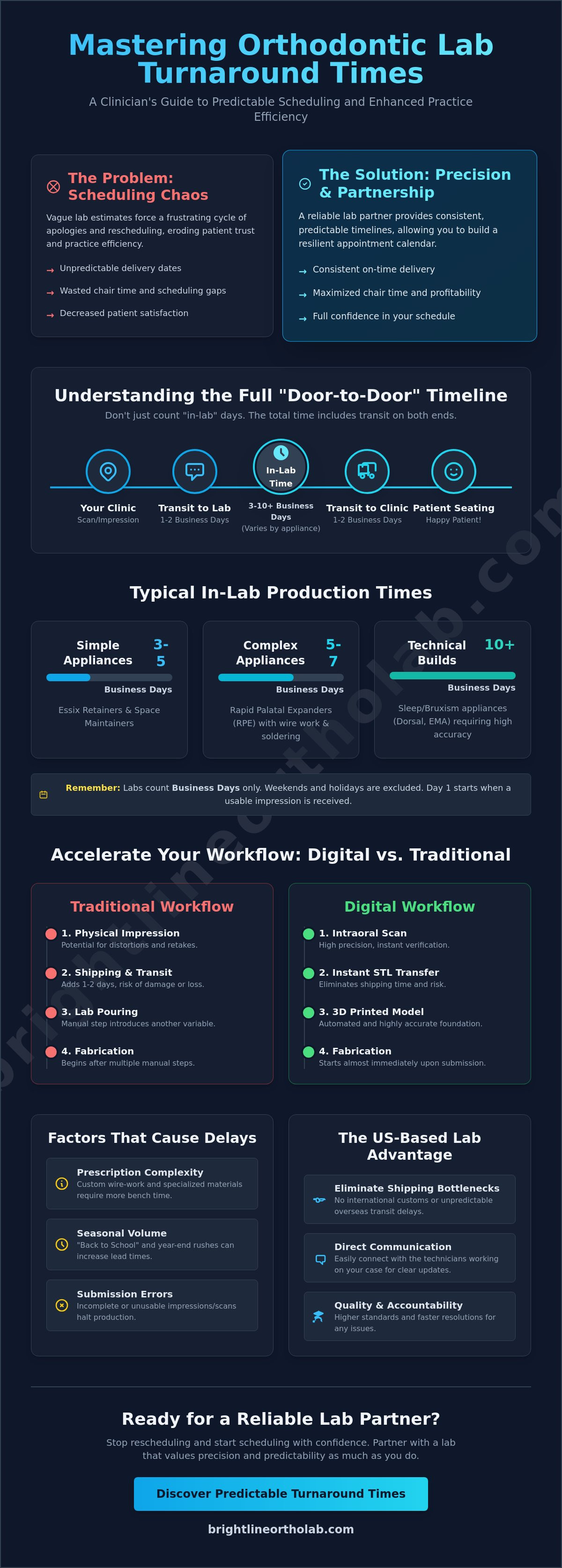
Most clinicians operate within a standard window of 5 to 10 business days for the majority of their cases. This timeframe isn't just a suggestion; it's the heartbeat of your practice scheduling. However, there's a significant difference between "in-lab" production time and the total "door-to-door" experience. If you only look at the production phase, you'll likely find yourself making awkward phone calls to patients to reschedule their seating appointments. Successfully managing a predictable orthodontic lab turnaround time requires you to account for the transit time on both ends of the process. Effective orthodontic therapy relies on the seamless coordination between your clinical chairside work and our laboratory production.
While it's tempting to choose a partner based on the fastest "promised" date, consistency actually serves your bottom line better. A lab that delivers exactly on day seven every single time allows you to book your chair with confidence. A lab that fluctuates between three and eight days creates chaos in your calendar. We believe that reliability is the ultimate form of speed. When you know exactly when an appliance will arrive, you can maximize your chair time and ensure your patients aren't left waiting in the lobby for an appliance that hasn't arrived yet.
Typical Lead Times by Appliance Category
Different appliances require varying levels of technical focus and craftsmanship. For simple retainers and space maintainers, you can generally expect a 3 to 5 day production window. More complex devices, like a Rapid Palatal Expander (RPE), typically need a 5 to 7 day bench time because of the precise wire work and soldering involved. Technical builds for sleep and bruxism appliances, such as Dorsal or EMA devices, often require 10 business days or more to ensure the high level of accuracy needed for patient comfort and long-term compliance.
The "Business Day" vs. "Calendar Day" Distinction
It's easy to forget that lab schedules only count business days. This means weekends and federal holidays are excluded from your delivery estimates. When you're calculating a "deliver-by" date for a patient, always add two days for every weekend that passes during the production cycle. Day 1 begins only after a complete, usable impression is received at the laboratory facility. If an impression arrives late on a Friday, the clock doesn't start until Monday morning. Understanding this "Day 0" rule is the simplest way to avoid scheduling errors and keep your workflow moving smoothly.
Factors That Influence Appliance Lead Times
Every clinician understands the frustration of a stalled case. While we strive for a predictable orthodontic lab turnaround time, several variables can extend the clock beyond the standard window. The complexity of your prescription is often the primary driver of lead times. A simple Essix retainer moves through the facility much faster than a custom wire-work appliance. Beyond the physical build, external factors like seasonal volume play a significant role. During "Back to School" or year-end rushes, labs nationwide see a spike in volume that can strain even the most efficient workflows. High-quality orthodontic care depends on managing these expectations with your patients before they leave the chair.
Specialized material requirements also dictate the pace of production. Appliances like night guards or sleep devices often utilize advanced polymers that require specific handling. If a case requires a material we don't keep in high-volume stock, or if the material demands an extended curing cycle, the timeline shifts accordingly. We believe that rushing these stages compromises the integrity of the device. It's better to wait an extra day for a perfectly cured appliance than to deal with a premature failure in the patient's mouth.
Technical Complexity and Bench Time
Technical requirements vary wildly between appliance types. For instance, a Hawley retainer requires specific curing and finishing stages to ensure the acrylic is durable and biocompatible. It isn't just about bending the labial bow; it's about the meticulous polymerization process. Similarly, fabricating a hard soft night guard involves dual laminate materials that must be bonded under precise heat and pressure. Unlike standard aligners, sleep appliances like Dorsal or EMA units demand multi-stage quality checks. These devices require articulated mounting and precise hardware alignment, which naturally adds days to the technical build to ensure patient safety and comfort.
The Role of Case Clarity in Speed
The #1 cause of avoidable lab delays is an incomplete case submission. When a prescription is vague or an impression is distorted, the lab must pause production to contact your office. This back-and-forth communication can easily add 48 hours to your total turnaround. Mastering your orthodontic lab case submission process is the most effective way to keep cases moving. Common "stop-work" triggers include missing trim line instructions or bubbles in critical anatomy on a physical model. If you provide clear, detailed instructions from the start, we can move directly into fabrication without hesitation. For a partner that values this level of precision, you can always rely on our expertise to support your practice's growth.
The Advantage of a US Based Orthodontic Lab
Choosing a domestic partner is one of the most effective ways to stabilize your orthodontic lab turnaround time. While offshore labs might offer a lower initial price point, the hidden costs of international shipping and customs bottlenecks often derail even the most organized practice. When a case is stuck in a clearing facility for three extra days, your patient scheduling suffers. By keeping production within the United States, you eliminate the unpredictability of global logistics and ensure that your appliances arrive when promised. This reliability allows you to maintain a tighter clinical schedule without the constant fear of a missing delivery.
Quality control is another area where domestic labs excel. We use only FDA-cleared materials and adhere to strict domestic labor regulations, which guarantees that every Hawley retainer or RPE is safe for your patients. This commitment to quality directly impacts your bottom line. When you consider the "Total Cost of Care," domestic reliability actually helps in managing orthodontic lab costs by virtually eliminating the need for expensive remakes. A meticulously crafted appliance that fits perfectly the first time saves you more money in chair time than any offshore discount ever could.
Logistics and Shipping Reliability
Predictable transit times are the backbone of a successful orthodontic workflow. Working with a US-based lab means you benefit from major domestic carriers like FedEx and UPS, providing real-time tracking from our bench to your front door. You won't have to guess where a package is or why it hasn't moved in 48 hours. Additionally, shorter transit distances reduce the physical stress on delicate stone models and lower the overall carbon footprint of your practice's supply chain. This efficiency is further enhanced by the adoption of digital workflows in dentistry, which allows for instant file transfer and domestic-only physical shipping.
Expert Consultation and Partnership
We view our laboratory as an extension of your team. If a complex case requires a specific modification, you can pick up the phone and speak directly to the technician who is actually bending the wire. There are no time-zone barriers or language gaps to navigate when you need immediate troubleshooting. This collaborative approach ensures that every nuance of your prescription is understood and executed with precision. Our domestic labs maintain 18+ years of industry experience to ensure meticulous fit for every patient you serve. This level of partnership transforms a simple vendor relationship into a reliable alliance that supports your clinical excellence.
How Digital Workflows Accelerate Turnaround
Shaving days off your schedule begins the moment you capture a patient's anatomy. In a traditional setting, physical impressions spend days in transit, vulnerable to heat and handling. By contrast, digital STL files arrive at our facility in seconds. This instant transmission effectively reduces your orthodontic lab turnaround time by 48 to 72 hours immediately. You're no longer at the mercy of courier schedules or weather delays; you're operating at the speed of your internet connection.
Eliminating the traditional model pour stage is another major efficiency gain. We move directly from your digital file to 3D printed dental models, which removes the time required for stone to set and dry. This digital-to-physical transition is far more precise than plaster, as it avoids the expansion or contraction issues inherent in traditional materials. If you submit a digital scan, we can often begin the fabrication of your Essix retainers or RPEs the same day the file arrives.
Digital archiving provides a long-term safety net for both your practice and your patients. If a patient loses their retainer six months after treatment, you don't need to bring them back in for a new impression. We can simply pull the archived STL file and print a new model. This capability simplifies the replacement process and ensures that "emergency" appointments don't disrupt your primary clinical workflow.
From Intraoral Scan to 3D Print
Digital files bypass the physical mail system entirely, creating a direct line between your chair and our bench. High-resolution 3D printing maintains meticulous precision, capturing every undercut and contact point with a level of detail that stone models simply cannot match. To maximize this benefit, transition your practice to a digital-first submission process. This shift allows you to review the digital model on your screen before sending, ensuring the scan is complete and usable.
Reducing Remakes and Adjustments
Accuracy is the ultimate time-saver in any orthodontic practice. Digital verification ensures that the appliance fits perfectly the first time, which drastically reduces your chair-side adjustment time. To ensure the highest quality, always check your STL files for "holes" or missing data in critical areas like the molars or incisal edges before hitting send. If you provide a clean scan, we can guarantee a meticulous fit that supports your reputation for excellence. If you are ready to modernize your workflow, partner with our digital laboratory to experience true efficiency.
Choosing the Right Lab Partner for Your Practice
Selecting a partner based solely on the fastest "promised" date is a common pitfall that often leads to clinical frustration. While a lab might market a three day production window, that number is meaningless if their on-time delivery rate is inconsistent. You should evaluate a facility based on their verified on-time percentage and their willingness to be transparent about their data. A predictable orthodontic lab turnaround time is the result of disciplined systems, not just aggressive marketing. When you choose a partner based on their historical reliability, you're investing in the stability of your own office environment.
Transparency in tracking and case status updates is no longer a luxury; it's a necessity for modern practice management. You need to know exactly where a case stands at any given moment to manage patient expectations effectively. A high-quality orthodontic lab understands this need and provides the tools to keep you informed. They prioritize meticulous precision over "speed-at-all-costs" because they know that a fast appliance that requires a remake is actually the slowest option available. Building a long-term relationship with a lab that values accuracy ensures consistent clinical success and reduces the stress on your administrative team.
Questions to Ask Your Prospective Lab
Before committing to a new partnership, verify their operational standards with these targeted questions:
- Do you provide real-time tracking for every case? You should be able to see when an STL file is received, when the appliance is on the bench, and when it ships.
- What is your internal remake rate for custom expanders? A lab that tracks this data shows a commitment to quality control and continuous improvement.
- How do you handle rush requests during peak seasons? Understanding their capacity during the "Back to School" rush helps you plan your own calendar more effectively.
The Brightline Commitment to Precision
We pride ourselves on being a seasoned expert and a reliable ally for your practice. Our workflow strikes a perfect balance between traditional craftsmanship and modern digital adaptability, ensuring that every appliance is precision-engineered for a meticulous fit. We focus on supporting your clinical goals by providing dependable, US-made solutions that never compromise on quality. If you're ready to eliminate the logistical stress of late appliances and vague lead times, we're here to help. Partner with Brightline Orthodontic Lab for reliable, US-made appliances.
Streamline Your Workflow for Clinical Success
Building a practice around predictable logistics is the most effective way to eliminate chair-side stress. When you align your patient scheduling with a reliable orthodontic lab turnaround time, you're doing more than just managing a calendar; you're ensuring that every seat appointment is a success. Transitioning to digital workflows and domestic production isn't just a technical upgrade; it's a commitment to clinical excellence that your patients will notice from their very first visit.
Our facility is designed to accommodate the immediate needs of modern dental professionals. With over 18 years of industry experience, we combine traditional craftsmanship with the speed of 3D printed models to support your practice's growth. We focus on meticulously engineered, US-made appliances that fit perfectly the first time. By acting as a supportive extension of your team, we help you simplify the complex logistics of appliance fabrication.
Experience Predictable Turnaround Times with Brightline Orthodontic Lab
Don't let vague lead times disrupt your clinical flow. Take the next step toward a more efficient and dependable practice by partnering with a lab that values precision as much as you do.
Frequently Asked Questions
What is the average turnaround time for a Hawley retainer?
The standard production time for a Hawley retainer is typically 3 to 5 business days. This window allows our technicians to meticulously bend the labial bow and ensure the acrylic is perfectly cured for durability. You should also account for transit time on both ends if you're sending physical impressions. If you use a digital workflow, you can often expect the appliance to be ready for shipment on the shorter end of that timeframe.
Does sending a digital STL file make the lab work faster?
Yes, sending a digital STL file significantly accelerates the process by eliminating the days your case would otherwise spend in the mail. Your files arrive at our facility in seconds rather than days, which can reduce your total orthodontic lab turnaround time by up to 72 hours. We move directly to 3D printing models, bypassing the traditional stone-setting phase and allowing fabrication to begin almost immediately.
How do I calculate the "seating date" for a patient appointment?
To calculate a reliable seating date, start your count on the day the lab receives a usable impression and add the quoted production days plus shipping transit. It's vital to remember that "Day 1" only begins once all technical requirements and clear instructions are met. Always exclude weekends and federal holidays from your calculation to ensure your patient isn't scheduled before the delivery truck arrives at your office.
Can I request a "rush" service for an appliance?
We accommodate rush requests whenever our current production capacity allows, though it's best to call and verify availability for complex cases. While simple items like Essix retainers are easier to expedite, technical builds like an RPE require fixed bench times to ensure material integrity and patient safety. If you have an emergency case, contact our team directly so we can support your patient's immediate needs.
Why do sleep apnea appliances take longer to fabricate than retainers?
Sleep apnea appliances like Dorsal or EMA units require a more complex, multi-stage fabrication process compared to standard retainers. These devices involve articulated mounting and precise hardware alignment to ensure proper mandibular positioning and patient comfort. Because these technical builds demand extra quality control checks and specialized polymers, they typically require a production window of 10 business days or more.
What happens if a case is put on "lab hold"?
If a case is put on "lab hold," our team has identified an issue that prevents us from proceeding with precision. This often happens due to distorted impressions, missing trim line instructions, or incomplete prescriptions that require clarification. We'll contact your office immediately to resolve the discrepancy. Once we receive the necessary information or a new scan, the production clock restarts to ensure the final appliance fits perfectly.
Are US-based orthodontic labs more expensive than offshore alternatives?
While offshore labs may have lower initial invoices, US-based labs often prove more cost-effective when you consider the total cost of clinical care. Domestic production eliminates international shipping fees and customs delays while drastically reducing the rate of expensive remakes. Investing in a partner that uses FDA-cleared materials and provides direct access to technicians saves you significant money in chair time and long-term patient satisfaction.
How does shipping time factor into the total turnaround?
Shipping time is the most variable component of your total orthodontic lab turnaround time and must be added to the internal production days. While our internal fabrication times are consistent, you must account for the transit days required by carriers like FedEx or UPS for door-to-door delivery. Choosing a domestic lab ensures you have access to real-time tracking, which simplifies your scheduling and provides peace of mind that the appliance will arrive as expected.