
If you prescribe a soft night guard to a chronic clencher simply for immediate comfort, you might be unintentionally training their jaw to bite down even harder. It's a common frustration in every clinical practice. You want to protect your patient's dentition, yet you're tired of seeing soft appliances chewed through in months or hearing that a rigid acrylic guard is sitting in a drawer because it's too uncomfortable. Finding the right balance in the hard vs soft night guard for clenching debate often feels like choosing between a failed appliance and a non-compliant patient.
We're here to help you move past that compromise and provide a more predictable solution for your chairside decisions. This guide dives into the clinical differences between materials to help you determine which appliance best manages heavy clenching forces while remaining wearable for the long term. We will explore how specific material properties influence the masticatory biofeedback loop and look at why a dual-laminate approach often provides the precision your patients need. You'll gain a clear framework for selecting the right material and the correct CDT codes to keep your workflow efficient and your outcomes reliable.
Key Takeaways
- Master the mechanical differences between vertical clenching forces and lateral grinding excursions to better protect your patient's TMJ and periodontal ligaments.
- Evaluate the clinical longevity of a hard vs soft night guard for clenching to reduce the frequency of appliance replacements and chew-throughs in your practice.
- Discover why soft thermoplastic materials often lead to rapid degradation and a lack of stable occlusal support when subjected to chronic vertical loads.
- See why the dual-laminate appliance has become the professional standard by balancing internal patient comfort with a hard, durable occlusal surface.
- Leverage digital workflows and custom lab fabrication to ensure high precision and better patient compliance compared to over-the-counter alternatives.
Understanding the Mechanics: Clenching vs. Grinding
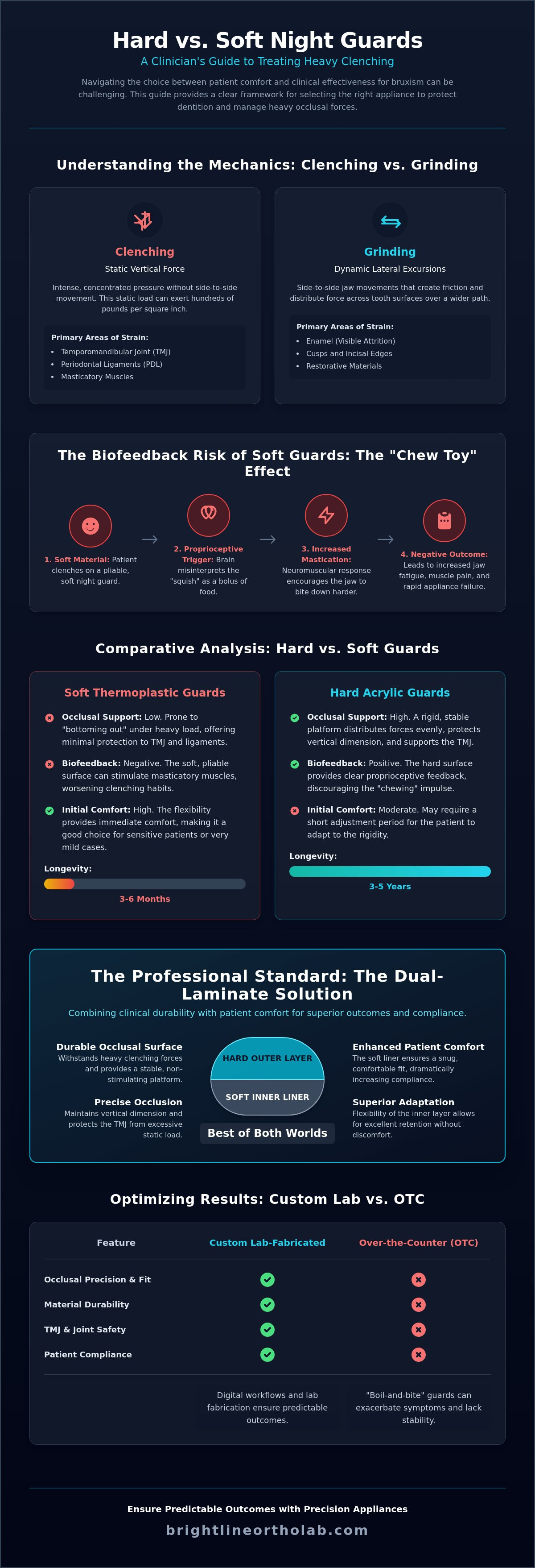
To choose the right appliance, we must first distinguish between the two primary behaviors often grouped under the umbrella of bruxism. While many clinicians treat clenching and grinding as interchangeable, their mechanical impacts on the oral cavity are quite different. Grinding involves lateral excursions that lead to attrition and visible tooth wear. Clenching, however, is characterized by intense vertical occlusal force without the side-to-side movement. For a comprehensive overview of bruxism, it's helpful to see how these forces manifest as either dynamic friction or static load.
Static clenching forces place immense strain on the temporomandibular joint (TMJ) and the periodontal ligaments rather than just the enamel. Because there's no lateral "release" of energy, the pressure stays concentrated. This is where the debate over a hard vs soft night guard for clenching becomes critical. While a softer material might seem to offer a cushion, that same "give" can actually become a double-edged sword. Our clinical goal isn't just to provide a soft landing; it's to distribute force effectively without triggering a negative neuromuscular response.
The Vertical Force Challenge
During nocturnal clenching episodes, patients can exert hundreds of pounds of pressure per square inch. This isn't just a steady squeeze. It's a series of high-intensity events that can easily overwhelm thin or overly pliable materials. For these patients, material thickness and density matter significantly more than they do for a light grinder. If you provide a guard that's too soft, the patient will simply "bottom out." This means the material compresses completely under load, allowing the teeth to make functional contact through the guard and rendering the appliance ineffective at protecting the ligaments or the joint.
Biofeedback and the Proprioceptive Response
The most significant risk with soft materials is what we often call the "chew toy" effect. When a patient clenches down on a soft thermoplastic material, the brain may perceive that squishy sensation as a bolus of food. This triggers a proprioceptive response that encourages the jaw to chew or bite down harder. Instead of resting the muscles, the soft guard acts as a stimulant for increased masseter activity during sleep. This biofeedback loop can lead to more frequent clenching episodes and increased jaw fatigue upon waking. By selecting a material with a harder occlusal surface, you provide the stable support needed to discourage this destructive neuromuscular habit.
Hard vs. Soft Night Guards: A Comparative Analysis
Choosing the right material for your patient requires a careful balance between therapeutic goals and long-term compliance. While the debate over a hard vs soft night guard for clenching often centers on patient comfort, the clinical reality is far more nuanced. Soft thermoplastic materials and heat-cured acrylics serve different roles in managing occlusal forces. Understanding how these materials behave under stress allows you to prescribe the most effective appliance for each specific case.
Durability is often the first point of failure in clenching cases. A soft thermoplastic guard typically lasts only 3 to 6 months before the material begins to pit or tear under intense vertical load. In contrast, a custom-fitted hard acrylic guard can last between 3 and 5 years. This longevity isn't just about cost; it's about maintaining a stable occlusal relationship over time. When you consider a systematic review on occlusal splints, it's clear that material stability plays a vital role in successful long-term management.
The Case for Soft Night Guards
Soft guards are often best suited for mild, acute clenching cases or for patients who are exceptionally sensitive to foreign bodies in their mouth. They provide a low barrier to entry for patients who might otherwise reject a rigid appliance. Because these materials are flexible, they offer a sense of immediate comfort that can help a patient transition into nightly wear. However, their lack of rigidity means they cannot support complex occlusal features. If your patient has a high clenching force, they'll likely bottom out on these materials quickly, leading to rapid degradation.
The Case for Hard Night Guards
Hard acrylic guards are the clinical standard for maintaining vertical dimension and providing a stable platform for the opposing arch. These appliances allow you to incorporate specific occlusal features, such as cuspid rises or anterior ramps, to guide the jaw into a more relaxed position. While some patients initially complain of a "tight" sensation, this is usually a result of the high-precision fit required for retention. Once habituated, hard guards provide superior protection for the dentition. If you're looking for a middle ground that combines this stability with better internal feel, consider our Hard/Soft Night Guards for your next case.
Clinical adjustment is another area where hard materials shine. You can easily perform chairside grinding and polishing on a hard acrylic guard to fine-tune the occlusion. Soft materials, unfortunately, are nearly impossible to adjust chairside. They tend to melt or tear when hit with a bur, often leaving a ragged surface that harbors bacteria. For patients who require precise occlusal balancing, the hard-surface appliance is the only predictable choice.
Why Soft Guards Can Fail Chronic Clenchers
While a soft thermoplastic appliance often feels like the path of least resistance for a hesitant patient, it frequently leads to a cycle of clinical frustration. For chronic clenchers, the primary issue is that soft materials lack the structural integrity to withstand repetitive, high-intensity vertical loads. This brings us to the core of the hard vs soft night guard for clenching debate: durability isn't just a matter of convenience; it's a requirement for clinical success. When a soft guard begins to pit or deform, it fails to provide a stable occlusal surface. This instability can lead to unpredictable tooth movement or even minor migration if the appliance doesn't maintain its original shape across the entire arch.
You can often identify a failing soft appliance during a routine exam by looking for "pitting" or deep indentations in the posterior regions. These aren't just cosmetic issues. They represent areas where the material has lost its ability to distribute force. If the patient continues to use a perforated or severely thinned guard, they risk localized periodontal ligament inflammation and acute tooth sensitivity. It's a sign that the patient's clenching forces have exceeded the material's physical limits.
Material Fatigue and Perforation
Thermoplastic breakdown is an inevitable result of constant vertical pressure. As the material fatigues, it begins to thin out, eventually leading to a full perforation. Once the teeth can touch through the guard, the appliance no longer serves its primary purpose. These perforations create "hot spots" where forces are concentrated on a few specific teeth rather than being spread evenly. Additionally, the porous nature of soft materials creates a significant hygiene challenge. Over time, these guards absorb saliva and harbor biofilm more aggressively than polished acrylic, making them difficult for the patient to maintain properly.
The Neuromuscular Trigger
Perhaps the most counterproductive aspect of soft guards for clenchers is the squishy texture itself. This often triggers a "munching" reflex where the brain perceives the soft material as a bolus of food. Instead of the jaw muscles finding a resting position, the patient's neuromuscular system is encouraged to bite down harder. You'll often see this manifest as increased masseter hypertrophy or reports of intensified morning jaw soreness. To catch this early, we recommend asking specific screening questions during follow-up appointments:
- "Do you find yourself actively biting or chewing on the guard during the night?"
- "Is your jaw tension worse on the mornings after you wear the appliance?"
- "Does the guard feel 'mushy' or flattened when you wake up?"
If your patient reports these symptoms, it's a clear clinical indicator that they've outgrown a soft appliance. Moving them to a more rigid solution is the only way to break the biofeedback loop and protect their long-term oral health.
The Dual Laminate Solution: The Professional Standard
The debate over a hard vs soft night guard for clenching often ends when clinicians discover the dual laminate appliance. This design doesn't force a choice between durability and comfort. Instead, it utilizes a dual-layered construction that provides the best of both worlds. It is increasingly recognized as the optimal occlusal guard for patients who exhibit high vertical clenching forces but struggle with the rigidity of traditional heat-cured acrylic. By combining these materials, you address the patient's primary pain points while maintaining the clinical integrity of the treatment.
Achieving success with these appliances requires meticulousness during the manufacturing phase. Precision in fabricating a hard soft night guard ensures the two layers bond chemically, preventing delamination over time. When the bond is secure, the appliance acts as a single, cohesive unit that manages stress predictably. This synergy creates a supportive environment for the jaw without the bulk or "bounce" of a purely thermoplastic device.
Balancing Durability and Compliance
The soft internal liner provides a gentle "grip" on the teeth, which significantly reduces the pressure-point discomfort often associated with hard acrylic. This flexibility accommodates minor tooth irregularities and eases the patient's transition into nightly use. Simultaneously, the hard external surface provides a stable, non-yielding occlusal contact. This prevents the "munching" reflex we discussed previously and allows for smooth lateral movements if the patient also grinds. Because of this balance, clinicians often see a significantly lower remake rate compared to pure soft guards.
Clinical Applications for the Dual Laminate
This appliance is the ideal choice for chronic clenchers who have previously chewed through soft guards or rejected hard ones due to discomfort. It's also excellent for patients with complex dental work who need a precise fit that won't put undue stress on crowns or veneers. You can expect a well-maintained dual laminate guard to last between 2 and 5 years, depending on the patient's clenching intensity. For more technical specifications on material thickness and bonding, refer to the clinician’s guide to dual laminate night guards.
If you're looking to provide a more reliable experience for your patients, we can help you integrate these advanced appliances into your workflow. You can order custom dual laminate guards from our team to ensure your clenching patients receive the precision and durability they require.
Optimizing Results with Custom Lab Fabrication
While patients often ask about over-the-counter options they find at local pharmacies, boil-and-bite guards are clinically contraindicated for chronic clenchers. These generic devices lack the necessary precision and often introduce excessive bulk that can exacerbate TMJ symptoms. When you are weighing the benefits of a hard vs soft night guard for clenching, the delivery method is just as important as the material itself. A custom-fitted appliance ensures that forces are distributed evenly across the entire arch, preventing the localized pressure points that often lead to tooth pain and appliance failure.
Achieving a predictable clinical outcome depends on the expertise of your manufacturing partner. It's essential to work with a high-quality orthodontic lab that understands the nuances of occlusal management. A lab that acts as a collaborative extension of your team will help you troubleshoot difficult cases and ensure that every appliance meets your exact standards for fit and finish. This partnership simplifies your workflow and allows you to focus on patient care rather than logistical frustrations.
The Digital Impression Advantage
Digital workflows have significantly improved the accuracy of nocturnal appliances. Utilizing 3d printed dental models allows us to maintain a level of precision that traditional stone models often lack due to expansion or breakage. This digital accuracy means you spend less time on chairside adjustments and more time discussing treatment goals with your patient. To ensure a perfect fit, we recommend following these steps during your scan:
- Capture at least 3-4mm of the gingival margin to ensure proper retention and stability.
- Provide a clear occlusal registration in a neutral or slightly open position.
- Check for any "holes" in the scan data, particularly on the occlusal surfaces of the molars.
Partnering for Clinical Success
Effective clenching management is a collaborative effort between the clinician and the lab technician. Custom fabrication allows you to request patient-specific modifications, such as increased material thickness for heavy clenchers or specific clasping for better retention in the posterior. These small details can make the difference between a patient who wears their guard and one who leaves it in a drawer. If you are struggling to decide on a material, our final recommendation for the majority of clenching cases is the dual laminate appliance. It provides the hard occlusal protection your patients need while offering the soft internal comfort that ensures long-term compliance. By choosing the right material and a dependable lab partner, you can provide a reliable solution that truly protects your patients' oral health.
Elevating Your Standard of Occlusal Care
Providing the right appliance for your patients doesn't have to be a choice between durability and comfort. By understanding the unique vertical forces of clenching and moving beyond the limitations of purely soft materials, you can significantly reduce appliance failure and increase patient satisfaction. The decision in the hard vs soft night guard for clenching debate becomes clear when you implement high-precision dual laminate guards. These appliances offer the stable, non-yielding surface required to manage clenching forces while providing the gentle internal fit that ensures nightly compliance.
Precision and reliability are the cornerstones of a successful clinical outcome. You deserve a partner that brings meticulousness to every case. Partner with Brightline Orthodontic Lab for high-quality custom night guards that are expertly crafted to meet your specific clinical needs. As a US-based lab with over 18 years of industry experience, we are dedicated to supporting your practice with precision-engineered appliances. We look forward to helping you simplify your workflow and provide your patients with the protection they deserve.
Frequently Asked Questions
Is a hard or soft night guard better for TMJ pain caused by clenching?
A hard or dual laminate appliance is typically superior for managing TMJ pain because it provides a stable occlusal relationship. Soft guards often compress under vertical load, which fails to unload the joint effectively and can lead to increased muscle tension. When deciding on a hard vs soft night guard for clenching, a rigid surface is better for allowing the muscles to find a resting position rather than encouraging active biting.
Can a soft night guard actually make clenching worse?
Yes, a soft night guard can exacerbate clenching by triggering a proprioceptive "chew toy" response. When the brain senses a soft material between the teeth, it often interprets it as a food bolus and initiates the masticatory cycle. This leads to increased masseter activity and more intense nocturnal clenching. Patients often report greater morning jaw soreness after wearing an overly pliable appliance.
How long does a dual laminate night guard typically last for a heavy clencher?
A dual laminate night guard typically lasts between 2 and 5 years for a heavy clencher, depending on the specific intensity of their habit. This longevity is significantly greater than pure soft guards, which often fail within 3 to 6 months. The hard outer layer protects the appliance from being chewed through. The soft inner liner maintains its fit and comfort over time.
What is the 'chew toy' effect in bruxism appliances?
The 'chew toy' effect refers to the neuromuscular stimulation caused by squishy or resilient materials in the mouth. Patients often find themselves subconsciously biting or "munching" on soft appliances throughout the night. This behavior prevents the masticatory muscles from reaching a state of rest. It can worsen the very symptoms the appliance was intended to treat by keeping the jaw in a constant state of activity.
Are hard night guards more likely to cause tooth movement than soft ones?
No, a properly fitted hard night guard is less likely to cause tooth movement than a poorly made soft one. Hard acrylic provides a rigid, stable arch that holds teeth in their current positions. In contrast, soft materials can deform or lose their shape over time. This potentially allows for minor tooth migration if the appliance doesn't maintain full arch coverage and uniform contact.
Can I adjust a dual laminate night guard chairside if the fit is too tight?
You can adjust the hard external surface of a dual laminate guard chairside using standard acrylic burs and polishing wheels. This allows you to fine-tune the occlusion or clear any tight spots in the rigid section. The soft internal liner is difficult to modify without tearing. We recommend an accurate initial impression or digital scan to minimize the need for internal adjustments.
Why do patients often prefer soft guards initially, only to request an alternative later?
Patients often prefer soft guards initially because they feel less intrusive and require less "break in" time. However, as the material begins to pit, tear, or trigger increased muscle activity, the patient may experience returning pain or appliance failure. This leads them to request a more durable alternative. A dual laminate offers a balance between that initial comfort and long term stability.
What are the contraindications for prescribing a pure soft night guard?
Pure soft night guards are contraindicated for patients with severe nocturnal clenching, chronic TMJ disorders, or those who require specific occlusal features like cuspid guidance. Their lack of rigidity makes them unsuitable for maintaining vertical dimension. If a patient has a history of chewing through appliances, a harder material is necessary for clinical success. These cases require the structural integrity found in the hard vs soft night guard for clenching comparison.