
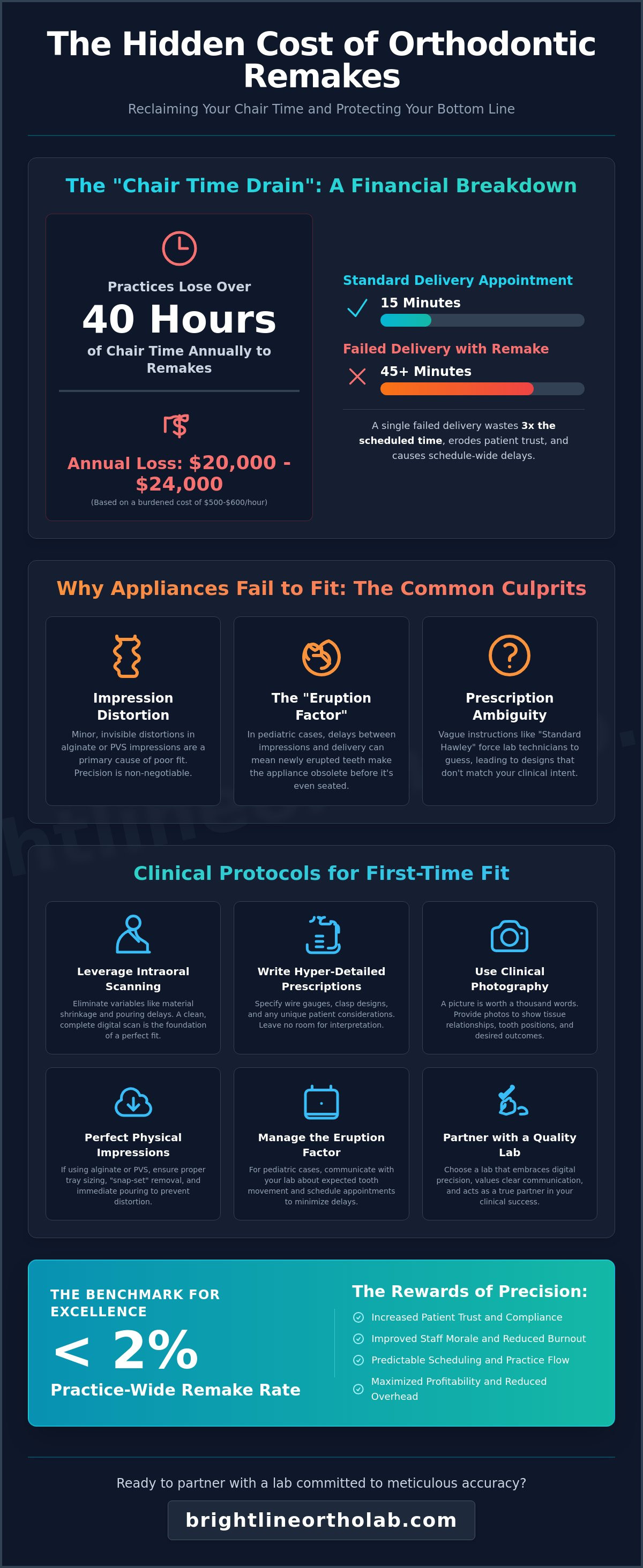
Did you know that the average orthodontic practice loses over 40 hours of chair time every year simply to appliance adjustments and redos? At a fully burdened cost of $500 to $600 per hour, those lost moments represent a significant drain on your practice's bottom line. We understand how frustrating it is when a delivery appointment for a Hawley retainer or a Rapid Palatal Expander turns into a troubleshooting session. It's not just about the overhead; it's about the patient's trust. Reducing lab remakes orthodontics isn't just a goal for your lab; it's a vital strategy for maintaining a seamless patient experience and protecting your schedule.
We believe that precision is a collaborative effort. In this guide, you'll learn the specific clinical protocols and communication strategies designed to eliminate the logistical stress of appliance remakes. We'll show you how to leverage intraoral scanning and clear prescriptions to reclaim your chair time and lower your lab-related overhead. By focusing on upstream quality control and digital precision, you can ensure that every appliance fits perfectly the first time, allowing you to focus on what you do best: creating beautiful smiles.
Key Takeaways
- Quantify the true impact of the "Chair Time Drain" on your practice overhead and patient satisfaction.
- Implement refined clinical protocols, such as proper tray sizing and "snap-set" timing, to eliminate common impression distortions.
- Master detailed prescription writing and clinical photography as essential strategies for reducing lab remakes orthodontics.
- Learn to manage the "eruption factor" in pediatric cases to ensure appliances like Rapid Palatal Expanders seat perfectly every time.
- Identify the hallmarks of a reliable lab partner that combines traditional craftsmanship with modern digital precision.
The True Cost of Orthodontic Lab Remakes
An orthodontic remake occurs when an appliance, such as a Hawley retainer or Rapid Palatal Expander, cannot be seated or adjusted to meet clinical standards during the delivery appointment. It's more than just a minor inconvenience; it's a technical failure that forces a complete restart of the clinical and laboratory cycle. When we talk about reducing lab remakes orthodontics, we're really talking about reclaiming the predictability of your practice schedule and ensuring that your technical partners have the records they need to succeed.
The most immediate impact is the "Chair Time Drain." A standard delivery appointment is typically scheduled for 15 minutes. However, when an appliance doesn't fit, that window quickly stretches into a 45-minute troubleshooting session. You might spend that time trying to adjust wire tension or grinding acrylic, only to realize the underlying impression was distorted. This doesn't just waste your time; it creates a bottleneck that delays every subsequent patient in your afternoon, causing stress for your team and your waiting room.
Patient psychology is another critical factor. To understand the patient's perspective, it helps to look at the broader scope of what is orthodontics as a journey of trust and transformation. When a patient arrives excited to receive their appliance and leaves with nothing but a second round of impressions, their confidence in the treatment plan wavers. This frustration often leads to lower compliance rates, particularly with removable appliances, as the patient begins to doubt the precision of the entire process.
Measuring the Impact on Practice Efficiency
The financial realities extend far beyond the lab bill. With the fully burdened cost of chair time reaching between $500 and $600 per hour in 2026, a single failed delivery can wipe out the profit margin of the entire case. Beyond production loss, you must account for administrative re-entry, shipping costs, and material waste. These hidden factors are central to managing orthodontic lab costs effectively. In a high-volume clinic, even a 4% remake rate creates a constant state of "catch-up" that disrupts the flow of the entire team and limits your ability to take on new starts.
The Opportunity Cost of Clinical Inaccuracy
Accepting "good enough" records is the fastest way to "never right" appliances. Reducing lab remakes orthodontics starts with acknowledging that clinical inaccuracy has a ripple effect on staff morale. When clinical staff feel pressured to move quickly, they might overlook a slight drag in an alginate impression or a void in a digital scan. This leads to a cycle of remakes that is a primary driver of staff burnout. Teams thrive on successful outcomes; constant rework is demoralizing. By setting a practice-wide benchmark, such as aiming for a remake rate below 2%, you create a culture of meticulousness that supports both your staff and your bottom line.
Common Culprits: Why Orthodontic Appliances Fail to Fit
While crown and bridge remakes often stem from poor margin visibility, orthodontic failures are usually rooted in the dynamic nature of the dental arch and the complexity of wire-to-tissue interactions. Impression distortion remains a primary hurdle. Alginate is highly susceptible to dimensional changes if not poured immediately. Even a minor shift in a PVS impression can prevent a Hawley retainer from seating fully, leading to the chair time drain we discussed earlier. These technical failures are often invisible to the naked eye but become painfully obvious the moment you try to seat the appliance.
Timing is equally critical, especially in pediatric cases. We call this the "Eruption Factor." If there is a significant delay between taking records and the delivery of a Rapid Palatal Expander, newly erupting permanent molars or the loss of primary teeth can render the appliance obsolete before it even touches the patient's mouth. When the clinical environment changes faster than the lab can produce the device, a remake is almost guaranteed.
Prescription ambiguity often forces technicians to make "best guesses" that lead to errors. If a prescription simply says "Standard Hawley," the technician might choose a wire gauge or clasp design that doesn't align with your specific clinical preference for that patient. This lack of detail is a major barrier to reducing lab remakes orthodontics. Similarly, for sleep appliances like the Dorsal or EMA, a slightly off-center bite registration can result in an appliance that causes TMJ discomfort rather than therapeutic mandibular advancement.
Technical Errors in Appliance Fabrication
Precision isn't just about the records you send; it's about how the lab processes them. Understanding how RPE appliances work involves recognizing that even small errors in band seating on a stone model can lead to clinical failure. Technical studies on accuracy in appliance fabrication show that material shrinkage during the stone-pouring phase or improper wire tensioning can compromise the final fit. If your lab isn't meticulously managing these material variables, the most accurate impression in the world won't result in a perfect fit.
Data Voids in Digital Orthodontics
Digital workflows solve many traditional problems but introduce new ones, specifically "data voids." If an intraoral scan contains "noise" or artifacts, the resulting 3D Printed Models will be inaccurate. Maxillary expanders require a complete scan of the full palate, not just the dentition. If the deep vault of the palate is missed, the appliance won't seat. Technicians also struggle when the distal-most molars are only partially captured. Missing these critical landmarks compromises the anchorage and stability of the entire appliance. To avoid these issues, consider a consultation with a reliable orthodontic partner who can review your digital scans for accuracy before fabrication begins.
Clinical Protocols for Capturing Precision Records
Establishing a repeatable clinical workflow is the most effective way to protect your practice from the frustration of a failed delivery. Precision isn't a happy accident; it's the result of meticulous attention to detail during the few minutes the patient is in your chair. By implementing these five steps, you'll find that reducing lab remakes orthodontics becomes a natural byproduct of your clinical excellence.
Step 1: Select the right tray size. Always test the tray in the patient's mouth before loading it with material. A tray that's too small causes tissue impingement and thin spots in the impression material, which leads to immediate distortion. Ensure there's at least 3-5mm of space around the entire arch to allow for adequate material thickness.
Step 2: Master the "Snap-Set." When using alginate, avoid the temptation to "wiggle" the tray to break the seal. This creates micro-tears and permanent deformation. Instead, use a quick, vertical "snap" motion to remove the tray. This preserves the integrity of the material and ensures the lab receives an accurate representation of the dentition.
Step 3: Verify the "Critical Zones." Before dismissing the patient, inspect the record for voids in key areas. For a Hawley retainer, check the lingual surfaces and the occlusal tables. For an RPE, ensure the gingival margins of the anchor molars are crisp. If you see a bubble or a drag in these zones, retake the record immediately.
Step 4: Manage storage and shipping. If you're working with analog materials, time is your enemy. Wrap alginate impressions in a damp paper towel and place them in a sealed bag. If you pour your own stone, allow it to set fully before packaging. Never ship an impression that hasn't been properly stabilized, as the vibrations of transit will ruin even the best clinical work.
Step 5: Review digital records. When moving to a digital workflow, take a moment to inspect your 3d printed dental models or STL files. Look for "stepping" or data holes that might compromise the fit. Digital precision is only as good as the raw data you capture.
The Analog Golden Rules: Alginate and PVS
Control your environment to control your results. Use cool water to extend the working time of alginate, which allows you to seat the tray more calmly and accurately. If your practice ships stone models, consider the "Two-Pour" rule: pour the model, let it set, and then pour a second base for stability. This prevents the model from fracturing during the laboratory fabrication process.
Digital Scan Optimization for Orthodontic Labs
Capture high-fidelity data by using proper retraction. Keep the cheeks and tongue away from the scanner tip to avoid "ghost data" that confuses the software. Follow a "Slow and Steady" scan path, moving from the occlusal to the lingual and finally the buccal surfaces. Always verify the integrity of your STL files before completing your orthodontic lab case submission. Taking thirty seconds to rotate the 3D model on your screen can save you thirty minutes of chair time later.
Streamlining Communication: The Key to "First-Time-Right" Appliances
Precision is a two-way street. Your clinical skill and record-taking provide the foundation, but clear communication ensures the final structure stands. reducing lab remakes orthodontics depends on a shared technical language between the chair and the bench. If a lab script is vague, the technician is forced to make assumptions that might not align with your clinical philosophy. This is where most avoidable errors occur.
Move beyond generic descriptions. Instead of requesting a "Standard Hawley," specify whether you prefer .030 or .036 wire for the labial bow. Detail your clasping preferences, such as Adams clasps on the first molars and ball clasps on the bicuspids. When you establish these preferences as a Standard Operating Procedure (SOP), you create a predictable environment where "first-time-right" becomes the norm rather than the exception.
Digital portals and real-time feedback loops have changed the dynamic of clinical partnership. We can now flag potential issues, such as a distorted scan or a missing data void, within minutes of your submission. This proactive approach stops a bad appliance from ever being made. Clinical photography adds another layer of security. A simple intraoral photo clarifies complex cases, showing us the soft tissue health or unique tooth morphology that a 3D model might obscure.
Essential Elements of a High-Quality Lab Script
Think of your lab script as a blueprint for success. When fabricating a hard soft night guard, the technician needs to know your specific dual-laminate preferences and any undercut concerns. Clearly indicate any planned tooth movements or specific retention needs for the patient. Notating patient-specific concerns, such as latex sensitivities or previous appliance discomfort, allows us to accommodate those needs during the design phase. Meticulousness in the script translates directly to meticulousness in the appliance.
Leveraging Your Lab as a Clinical Consultant
We are here to support your clinical outcomes, not just process orders. If you have a challenging case, call your technician before the patient even sits in the chair. Discussing orthodontic lab turnaround time helps you schedule delivery appointments when the clinical records are most relevant. For complex expanders or sleep appliances, request a digital design preview. This allows you to approve the screw placement or bite alignment before we move to fabrication. If you want a lab partner that functions as a true extension of your team, start your first case with us today.
Choosing an Orthodontic Partner Committed to Meticulous Accuracy
Selecting a laboratory based solely on the lowest unit price is often a false economy. While a cheaper Hawley retainer might save a few dollars on the invoice, a single failed seating appointment can cost your practice hundreds in lost production. Reducing lab remakes orthodontics requires a partner who prioritizes precision engineering over high-volume shortcuts. When you choose a lab that values meticulousness, you aren't just buying an appliance; you're investing in the predictability of your clinical schedule and the confidence of your patients.
A reliable partner should be transparent about their quality control systems. Ask potential labs how they track internal remakes and what specific steps they take when a distortion is detected during the fabrication process. A lab that proactively flags a questionable impression or a "noisy" digital scan before fabrication begins is far more valuable than one that simply ships a subpar product. This level of accountability is what transforms a vendor into a true extension of your clinical team, allowing you to focus on treatment planning rather than troubleshooting.
The Brightline Approach to Precision
With 18 years of experience, we have refined a fabrication process that balances traditional craftsmanship with modern digital adaptability. We understand that every 3D Printed Model and Rapid Palatal Expander represents a patient waiting for a result. Our technicians treat every case with the quiet confidence that comes from seeing thousands of unique clinical scenarios. By integrating digital precision into our core workflows, we ensure that the appliances you receive are as accurate as the raw data you capture. We don't just "make" appliances; we support your practice growth by ensuring your delivery days are your most efficient and stress-free days.
Next Steps for Your Practice
The path to a more efficient clinic starts with an honest assessment of your current data. Audit your remake rate over the last quarter and look for specific patterns. Are the failures concentrated in pediatric cases, or perhaps in specific types of digital scans? Once you identify these gaps, schedule a consultation with us to align your practice preferences with our laboratory standards. This collaborative step ensures that your specific wire gauges, clasping styles, and turnaround needs are documented and respected every time you submit a case. For more detailed insights on finding the right fit, review our clinician’s guide to choosing an ortho lab and discover how a dedicated partnership can help you reclaim your chair time.
Reclaiming Your Practice Flow Through Precision
Eliminating the chair time drain begins with a commitment to meticulous clinical protocols and crystal-clear communication. By mastering tray selection and leveraging digital scan optimization, you remove the technical variables that lead to distortion. As we discussed, a detailed lab script acts as your technical blueprint, ensuring that every Hawley retainer or Rapid Palatal Expander meets your exact clinical standards on the very first try. Reducing lab remakes orthodontics is more than a cost-saving measure; it's the key to maintaining patient trust and a stress-free schedule.
You don't have to navigate these complexities alone. With over 18 years of specialized expertise in US-based manufacturing, we serve as a reliable ally to your clinical team. Our precision-engineered approach to custom appliances ensures that every case is handled with the technical proficiency your practice deserves. If you're ready to lower your overhead and improve your delivery outcomes, Start Your Next Case with Brightline Precision today. We look forward to supporting your practice growth and helping you deliver beautiful, predictable results for every patient.
Frequently Asked Questions
What is an acceptable remake rate for an orthodontic practice?
An acceptable remake rate in 2026 typically falls between 3% and 4%, though practices utilizing high-fidelity digital workflows often achieve rates below 1%. Monitoring this metric is essential for reducing lab remakes orthodontics, as rates exceeding 4% indicate systematic issues in clinical record-taking or laboratory communication. Setting a practice-wide benchmark of 2% helps your team stay focused on the meticulousness required for first-time precision and predictable results.
How much chair time does a typical orthodontic remake cost?
A typical orthodontic remake costs between $500 and $600 per hour in fully burdened chair time as of early 2026. This figure accounts for lost production, staff wages, and administrative overhead required to re-appoint the patient. When you multiply this by the 40 or more hours many practices lose annually to redos, the financial impact of clinical inaccuracy becomes a significant hidden cost that drains your practice's profitability and disrupts your daily flow.
Can digital scans completely eliminate lab remakes?
Digital scans significantly reduce errors but cannot completely eliminate remakes due to potential data noise or improper scanning techniques. While one lab reported a 1.3% remake rate for digital processes, success still depends on capturing clear gingival margins and full palatal data. Digital workflows solve traditional material distortion issues; however, they require meticulous attention to scan integrity and software alignment to achieve the high level of accuracy needed for complex appliances.
What are the most common reasons a Hawley retainer won’t seat?
A Hawley retainer usually fails to seat due to subtle impression distortions or shifting tooth positions between the record date and delivery. If the alginate was not poured immediately, dimensional changes can ruin the fit of the acrylic base. Additionally, if you don't account for minor tooth eruptions in pediatric patients, the appliance may meet resistance against new anatomy that wasn't present during the initial record-taking, leading to a frustrating delivery appointment.
How do I know if my impression material is causing fit issues?
You can identify impression material issues by looking for drags, voids, or a lack of surface detail on the occlusal tables before the patient leaves the chair. Alginate is particularly prone to micro-tears if not removed with a quick vertical snap motion. If you notice consistent fit issues despite accurate models, your material might be losing dimensional stability during transit. Switching to PVS or immediate stone pouring can help mitigate these common material-based failures.
Should I send clinical photos with every orthodontic case?
Sending clinical photos is highly recommended for complex cases where soft tissue health or unique tooth morphology might be obscured on a 3D model. A single intraoral photo clarifies wire placement and clasping needs for the technician, acting as a visual safeguard against prescription ambiguity. While not mandatory for every simple case, they are a powerful tool for reducing lab remakes orthodontics when designing appliances like sleep devices or complex Rapid Palatal Expanders.
How does 3D printing improve the accuracy of orthodontic appliances?
3D printing improves accuracy by eliminating the manual errors associated with traditional stone pouring and material expansion. Modern labs utilize high-resolution printers that follow ISO 13485:2016 standards for process validation, ensuring every model is a faithful replica of the digital scan. This technology allows for a level of precision engineering that traditional analog methods struggle to match, resulting in appliances that seat with much higher predictability and require fewer chairside adjustments.
What should I do if an appliance fits the model but not the patient?
If an appliance fits the model but not the patient, the error almost always lies in the record-taking stage rather than the fabrication process. This discrepancy usually indicates that the impression material distorted before the model was poured or the digital scan contained artifacts that the software smoothed incorrectly. In these scenarios, you must take a new, high-fidelity record and verify the critical zones to ensure the next appliance meets our standards for meticulous accuracy.